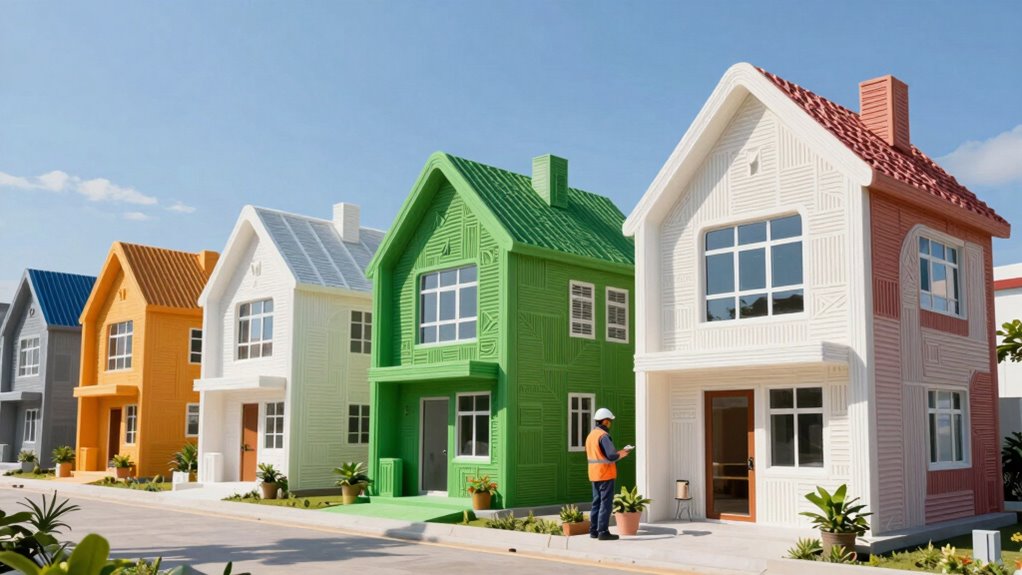

3D printing can revolutionize housing by allowing you to build homes faster, cheaper, and stronger. Using digital models and robotic systems, you can create durable structures in days rather than months. This technology reduces costs by up to 80% and waste by 60%, making affordable housing more accessible. With ongoing innovations, more sustainable and customized homes are within reach. Discover how this innovative process could change the way you think about solving the housing crisis.
Open a free Amazon Business account
Business pricing, bulk buying and tax-exempt orders.
As an affiliate, we earn on qualifying purchases.
Key Takeaways
- 3D printing drastically reduces construction time, enabling rapid development of affordable homes.
- Lower labor and material costs make housing projects more financially accessible.
- Customizable designs allow for tailored housing solutions to meet diverse community needs.
- Strong, resilient structures withstand natural disasters, improving long-term housing safety.
- The technology scales efficiently, offering sustainable, cost-effective options to address global housing shortages.

Printable Houses
Have you ever wondered how 3D printing could revolutionize the way we build homes? This innovative technology promises faster construction, lower costs, and more sustainable solutions—key factors in tackling the ongoing housing crisis. Traditional homebuilding faces challenges like rising material costs, labor shortages, and lengthy timelines. In contrast, 3D printing creates structures layer by layer using digital models, making it possible to produce affordable, durable homes in a fraction of the time. Once a blueprint is designed using modeling software, it’s sliced into thin layers that guide robotic extruders to deposit heated concrete or other materials precisely where needed. Rails installed around the site direct the robotic arms, ensuring accuracy as the printer extrudes material through nozzles. The process involves mixing concrete with water or using fast-setting mortars like CyBe Mortar, which harden quickly and provide durability. The equipment includes robotic arms or gantry systems that move along fixed frames, controlled via software to maintain consistent layers—each just 0.75 inches thick, with each layer taking about five to ten minutes to set. In many cases, the entire foundation and walls of a small house can be printed in under 24 hours, with larger structures like multi-room villas taking roughly 10 days. This rapid pace cuts construction time drastically compared to traditional methods, which often span months. furthermore, costs are considerably reduced; small homes can be built for roughly 15% less than wood-frame equivalents, with some projects like Habitat for Humanity’s first 3D printed home costing around $110,000. The affordability potential is promising, especially when considering the reduction in labor costs—up to 80%—and waste reduction of up to 60%. Homes built with 3D printing tend to be stronger and more resilient, with materials like self-compacting concrete capable of withstanding earthquakes and hurricanes. These homes often feature smaller footprints, typically 300-600 square feet, which reduces material use and increases efficiency. The technology’s speed and flexibility also enable mass customization, allowing for tailored designs that meet specific community needs. Recent advancements in 3D printing also include the development of newer, faster-setting materials, which could further decrease construction times and improve structural integrity. Additionally, integrating sustainable construction practices into 3D printing processes can further enhance their environmental benefits. While challenges remain, such as ensuring full affordability and managing workforce implications, the benefits are clear. Several real-world projects already demonstrate the potential, including homes in Texas, Mexico, and Cleveland, designed to address homelessness and poverty. The global market for 3D printed housing is projected to grow from nearly $60 million in 2024 to almost $3 billion by 2032, emphasizing its potential to reshape our approach to housing. As this technology advances, it offers a sustainable, cost-effective solution to meet the escalating demand for affordable homes worldwide.
As an affiliate, we earn on qualifying purchases.
Frequently Asked Questions
What Are the Long-Term Durability Prospects of 3d-Printed Homes?
You can trust that 3D-printed homes have strong long-term durability prospects. Advances in materials like reinforced concrete and innovative composites enhance resilience against weather, fire, and pests. Regular maintenance and ongoing research guarantee these structures meet or exceed traditional building standards. As technology improves, you’ll see 3D-printed homes becoming even more durable, providing safe, sustainable housing options for decades to come, making them a reliable choice for long-term living.
How Does 3D Printing Handle Complex Architectural Designs?
You can achieve complex architectural designs with 3D printing because it offers precision, flexibility, and customization. You design digitally, enabling intricate shapes, curved surfaces, and unique features that traditional methods struggle to reproduce. You incorporate advanced software and printing technology that adapts to complex geometries, ensuring detailed craftsmanship. With 3D printing, you transform innovative ideas into tangible structures efficiently, making complex and aesthetically appealing homes more accessible and affordable.
Are There Zoning or Regulatory Barriers to 3d-Printed Housing?
Zoning and regulatory barriers can slow down your adoption of 3D-printed housing. Local codes may not yet recognize or permit this new construction method, requiring updates or variances. Building permits, inspections, and standards often lag behind innovative techniques, making it essential for you to work closely with authorities and advocate for updated regulations. Overcoming these hurdles is key to expanding 3D printing’s role in solving housing shortages.
How Scalable Is 3D Printing Technology for Large Housing Developments?
You can see that 3D printing technology is highly scalable for large housing developments, as it speeds up construction, reduces costs, and minimizes waste. With automated on-site printers, you can build homes faster, needing fewer workers and allowing for mass production. As the technology advances and costs decrease, you’ll find it increasingly feasible to develop entire communities, transforming how housing shortages are addressed across regions.
What Training Is Needed for Workers to Operate 3D Printing Construction Equipment?
You’ll need specialized training to operate 3D printing construction equipment. This includes understanding how to set up and calibrate printers, manage digital design files, and troubleshoot technical issues. Training should cover safety protocols, maintenance procedures, and material handling. Hands-on experience is vital to guarantee efficiency and safety on-site. Many programs combine technical courses with safety certifications, preparing workers to handle advanced machinery confidently and effectively.
robotic home construction system
As an affiliate, we earn on qualifying purchases.
As an affiliate, we earn on qualifying purchases.
Conclusion
As you can see, 3D printing is opening doors to a future where homes are as accessible as they are innovative. It’s like turning a blank canvas into a masterpiece of sustainable living. With this technology, you could soon find yourself in a house built faster than you can say “home sweet home,” helping to solve the housing crisis one printed wall at a time. The future of affordable housing is just a print away.
sustainable building materials for homes
As an affiliate, we earn on qualifying purchases.
As an affiliate, we earn on qualifying purchases.
fast-setting mortar for construction
As an affiliate, we earn on qualifying purchases.
As an affiliate, we earn on qualifying purchases.
NFL season / tailgating Picks
team gear
As an affiliate, we earn on qualifying purchases.