
You’ll find 3D printers useful beyond hobbies because they enable custom medical implants, prosthetics, and surgical models tailored to individual needs. They streamline manufacturing, cut costs, and allow rapid prototyping of complex parts and prototypes. This technology supports innovation in industries like healthcare and manufacturing, offering on-demand, precise solutions that traditional methods can’t match. To see how these advancements are transforming various fields, keep exploring what’s possible with 3D printing.

Get privacy and security gear delivered free with Prime
- Fast, free delivery on millions of items
- Prime Video, Amazon Music and more included
- Member-only deals all year
Key Takeaways
- Enable the creation of custom, patient-specific medical implants and surgical models, improving healthcare outcomes.
- Facilitate rapid prototyping and testing of complex industrial components, reducing development time and costs.
- Support on-demand production of intricate parts and small batches without the need for molds or tooling.
- Allow for flexible, precise manufacturing of tailored solutions across various industries, fostering innovation.
- Promote faster, cost-effective manufacturing processes that enhance supply chain agility and reduce waste.
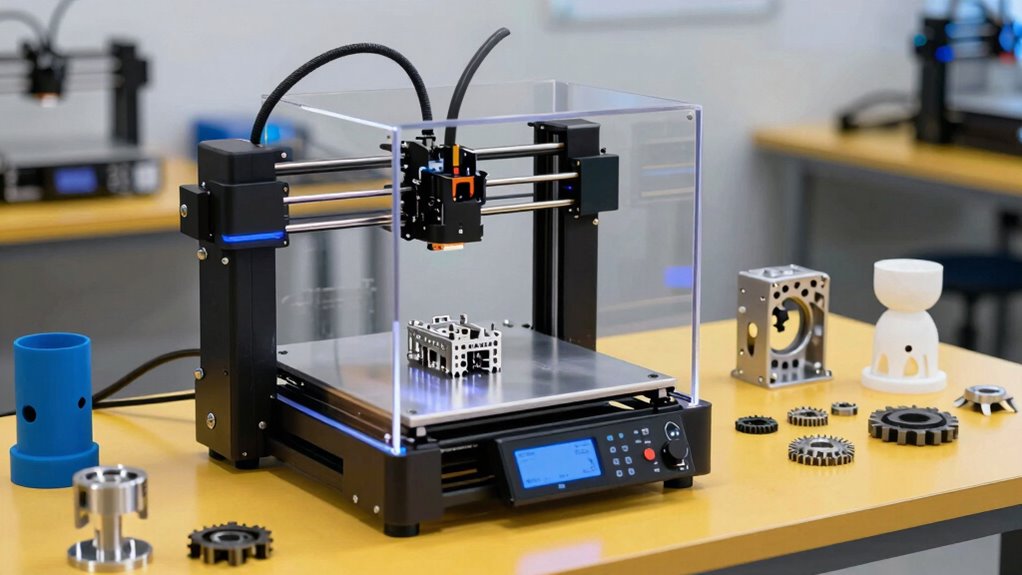
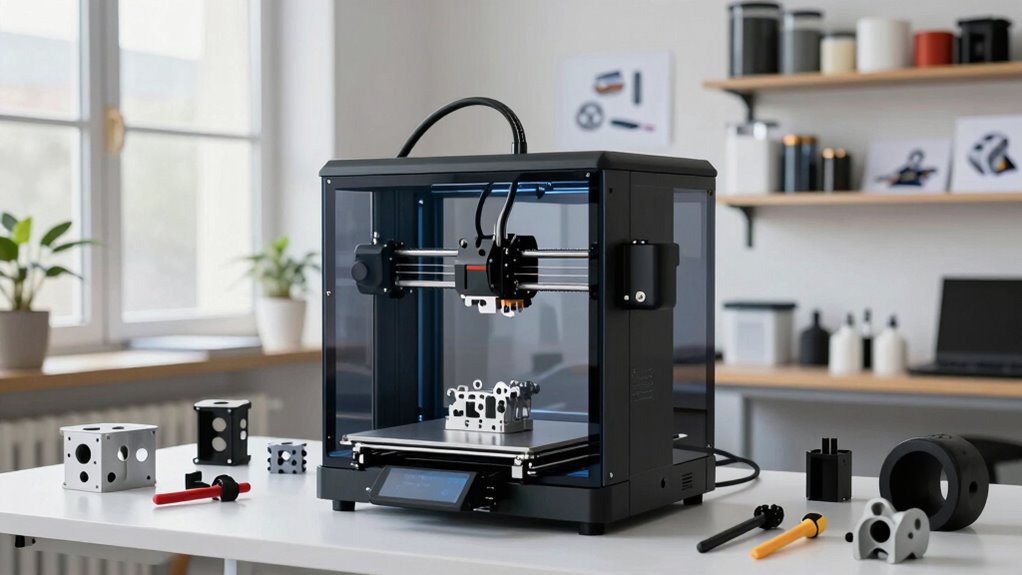
3D printers have moved far beyond their original role as hobbyist tools, transforming industries and everyday life. Today, they’re essential in fields like medical applications and industrial manufacturing, proving their value far beyond simple models and prototypes. In healthcare, 3D printing allows you to create custom implants, prosthetics, and surgical models tailored precisely to individual patients. This customization enhances patient outcomes, reduces surgery times, and improves the accuracy of treatments. For example, complex bone structures or dental implants can be printed to match a patient’s unique anatomy, making procedures more efficient and less invasive. Medical professionals now rely on 3D printing to develop detailed anatomical models for pre-surgical planning, giving you a clearer understanding of complex cases before stepping into the operating room. The ability to produce patient-specific devices quickly and cost-effectively has revolutionized healthcare, making personalized medicine more accessible. Additionally, the rapid prototyping capabilities of 3D printing allow for faster innovation and customized solutions in medical device development. As the technology advances, it also opens up opportunities for cost-effective production of complex devices and tools that enhance treatment options. The expanding variety of materials used in 3D printing means that applications in medicine can become even more versatile and sophisticated, accommodating diverse needs and innovations. In the domain of industrial manufacturing, 3D printers help you streamline production processes, reduce costs, and accelerate product development. Instead of waiting for traditional manufacturing methods, you can use 3D printing to create functional prototypes rapidly, test designs, and iterate faster. This agility shortens the time from concept to market, giving companies a competitive edge. 3D printing also enables the production of complex, intricate parts that would be difficult or impossible to manufacture with traditional methods, such as lightweight aerospace components or custom tooling. You can produce small batches or even one-off products without the need for expensive molds or tooling, saving both time and money. Additionally, the ability to produce on-demand parts reduces inventory costs and waste, making supply chains more flexible and sustainable. Both in medical fields and industrial settings, 3D printing offers unmatched versatility. You’re able to create tailored solutions, whether it’s a customized medical device or a complex industrial component, with precision and speed. This technology eliminates many of the limitations of traditional manufacturing, allowing you to innovate and adapt swiftly. Moreover, as 3D printing materials continue to diversify, you’ll find even more applications that can meet specific industry needs. As 3D printing technology becomes more accessible, more industries are discovering innovative ways to incorporate it into their workflows. As 3D printers continue to advance, their applications will only expand further, enabling you to push the boundaries of what’s possible in medicine, manufacturing, and beyond. The key takeaway is that 3D printing’s ability to produce bespoke, complex, and cost-effective items sets it apart as a transformative tool across multiple sectors. It’s clear that what once seemed like a hobbyist venture now plays a vital role in shaping the future of multiple industries.
Products Worth Considering

Samsung 27 Odyssey OLED G5 (G50SF) QHD QD-OLED Gaming Monitor

Amazon Kindle Scribe Colorsoft 64GB (1st Generation)

Bose TV Speaker (2nd Gen) Compact Soundbar with Bluetooth and HDMI Connectivity
As an affiliate, we earn on qualifying purchases.
Frequently Asked Questions
How Do 3D Printers Impact Traditional Manufacturing Industries?
You see, 3D printers revolutionize traditional manufacturing by enabling design innovation and cost reduction. They let you prototype quickly, test ideas efficiently, and customize products without expensive tooling. This flexibility cuts costs and speeds up production, giving you a competitive edge. Plus, on-demand manufacturing reduces waste and inventory needs. Overall, 3D printing transforms how industries develop, produce, and deliver products, making processes more agile and cost-effective.
What Are the Environmental Considerations of 3D Printing?
Imagine you’re using a 3D printer to create custom prosthetics, but you’re concerned about environmental impact. You can implement recycling programs to reuse excess filament, reducing waste. However, consider energy consumption, as 3D printers often require significant power. By choosing energy-efficient models and recycling materials, you minimize environmental harm. This proactive approach helps balance innovative manufacturing with sustainability, making 3D printing more eco-friendly.
Can 3D Printers Produce Medical Implants?
Yes, you can use 3D printers to produce medical implants. You’ll need biocompatible materials designed for surgical applications, ensuring safety and functionality inside the body. This technology allows for custom implants tailored to individual patients, improving fit and comfort. By leveraging 3D printing, you enable rapid, precise production of complex medical devices, ultimately enhancing treatment options and patient outcomes in healthcare settings.
What Materials Are Compatible With Industrial 3D Printers?
You can’t put just any material into industrial 3D printers; they’re designed for specific materials like metals, plastics, and composite filaments. As the saying goes, “You are what you eat,” and in industrial applications, material compatibility is essential. These printers handle high-performance materials like stainless steel, titanium, and specialized thermoplastics, enabling manufacturing of durable, precise parts across aerospace, automotive, and medical industries. Choosing the right material opens endless possibilities for innovation.
How Does 3D Printing Influence Supply Chain Logistics?
3D printing transforms supply chain logistics by enabling customization options and rapid prototyping, which reduce lead times and inventory costs. You can produce parts on-demand, minimizing the need for extensive warehousing. This technology allows you to quickly iterate designs and troubleshoot issues, streamlining product development. As a result, it enhances flexibility, accelerates delivery, and helps you respond swiftly to market changes, ultimately making your supply chain more efficient and adaptable.
Conclusion
Think of 3D printers as your personal toolkit, transforming raw ideas into tangible reality. Beyond hobbies, they’re like a bridge connecting innovation and practicality—turning concepts into prototypes, custom tools, or even replacement parts instantly. Their versatility means you’re no longer limited by store shelves or long wait times. Embrace this technology, and you’ll see how it opens a world of possibilities, making your creative and practical needs as effortless as turning the page in a favorite book.