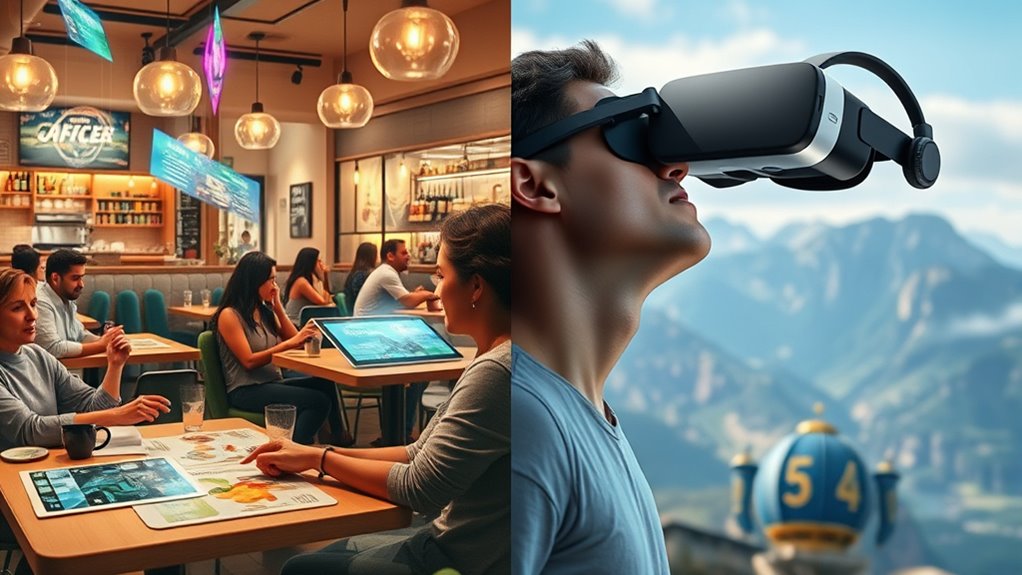

Augmented Reality (AR) overlays digital information onto your real-world environment, enhancing your everyday experiences. In contrast, Virtual Reality (VR) immerses you in a completely digital domain, isolating you from the physical world. While AR’s applications include gaming, navigation, and real-time translation, VR is ideal for training, education, and virtual tours. Both technologies offer unique interactions and experiences that transform how you engage with digital content. Discover more about how these innovations impact various industries.
Key Takeaways
- Augmented Reality (AR) overlays digital content on the real world, while Virtual Reality (VR) immerses users in entirely digital environments.
- AR enhances real-life interactions, useful for navigation and gaming, whereas VR focuses on immersive experiences for training and education.
- AR applications include real-time translation and gaming, while VR is utilized for simulations and virtual tours.
- AR integrates seamlessly into daily life, while VR creates isolated experiences that transport users away from their surroundings.
- Both technologies are transforming industries by enhancing engagement and interaction with digital content in unique ways.
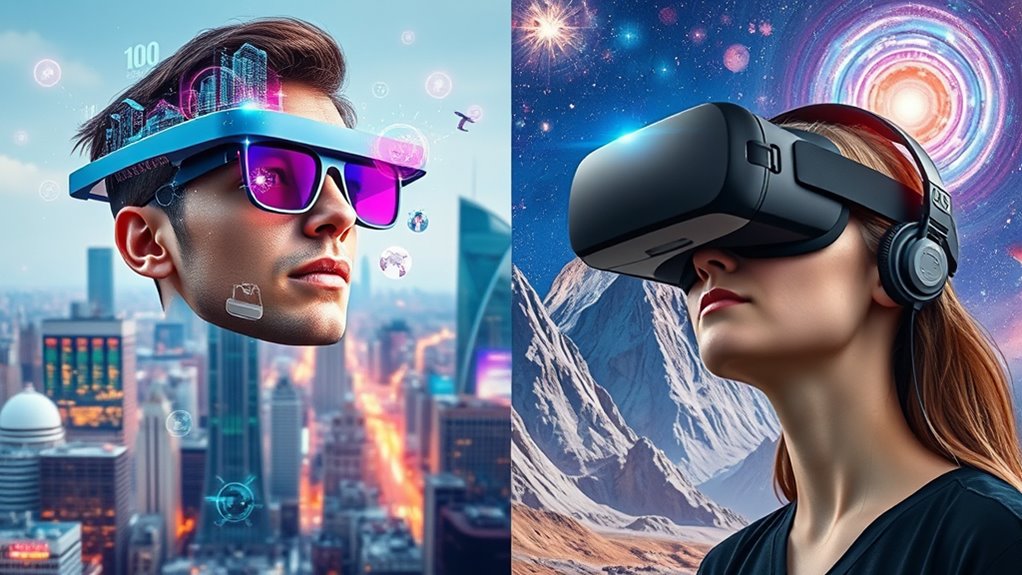
As technology continues to evolve, understanding the differences between augmented reality (AR) and virtual reality (VR) becomes essential for exploring the digital landscape. These two innovative technologies are reshaping how you interact with digital content, and knowing their distinctions can enhance your experience, whether you’re playing games or using educational tools.
AR overlays digital information onto the real world, allowing you to engage with your environment in new ways. For instance, imagine playing a gaming technology experience where characters appear in your living room, blending seamlessly with your furniture. With AR, you’re not just seeing a digital character; you’re interacting with it in your space. This interaction can elevate your gaming experience by creating a sense of presence that feels more immersive and engaging than traditional screen-based gaming.
AR enhances your environment by blending digital characters with reality, creating an immersive gaming experience that goes beyond traditional screens.
On the other hand, VR transports you entirely into a digital domain, isolating you from your surroundings. When you put on a VR headset, you’re stepping into a completely different environment. It’s like being in a video game where everything around you is computer-generated. This technology is particularly powerful for educational tools, allowing students to explore history or science in ways they never could in a classroom. Picture a biology lesson where you can walk through a human body, examining organs and systems up close. The immersion VR provides can make learning more engaging and effective, enhancing retention and understanding.
While both AR and VR offer unique experiences, their applications vary considerably. AR can be used for practical tasks, like navigation or real-time translation, making it a valuable tool in everyday life. VR, however, is often used for more immersive experiences, such as training simulations or virtual tours. This distinction can help you decide which technology best suits your needs, whether you’re looking to enjoy a thrilling game or learn something new.
Understanding these differences can also help you appreciate how both AR and VR are being integrated into various industries. From gaming technology to educational tools, these advancements are changing how you interact with the world. As you explore the possibilities, consider how each technology can enhance your experiences, whether for entertainment or education. Embracing both AR and VR opens up a world of opportunities for personal and professional growth, shaping the future of digital interaction. Additionally, the use of AI-driven insights can further enhance the development of applications in both AR and VR, making experiences even more tailored to user needs.

Quiet Rackmount Computer (3.8-4.6GHz AMD Ryzen 7 5700G CPU, 32GB RAM, 1TB SSD, W11 Pro) - 2U Rack Mount Server or Workstation Desktop PC for Home or Business
[CPU] AMD Ryzen 7 5700G Processor (8 Cores, 16 Threads, 3.8 GHz Base Clock Speed up to 4.6...
As an affiliate, we earn on qualifying purchases.
Frequently Asked Questions
What Devices Are Required for Augmented and Virtual Reality Experiences?
To enjoy augmented reality experiences, you’ll need AR hardware like smart glasses or a mobile device with AR capabilities. For virtual reality, a VR headset is essential, which immerses you in a completely digital environment. You might also consider additional accessories, like motion controllers or haptic gloves, to enhance your experience. Each device offers unique features, so choose the one that best fits the type of experience you want to explore.
How Do AR and VR Impact User Experience Differently?
AR enhances your sensory engagement by overlaying digital elements onto your real-world surroundings, letting you interact with both seamlessly. VR, on the other hand, offers a deeper emotional immersion, transporting you entirely to a different environment where you can experience a story or scenario as if it’s real. While AR enriches your reality, VR envelops you in a new one, each shaping your experience in unique and impactful ways.
ARe There Health Risks Associated With Using AR or VR?
Yes, there are health risks associated with using AR or VR. You might experience health concerns such as eye strain, headaches, or motion sickness due to sensory overload. Extended use can lead to discomfort or fatigue, affecting your overall well-being. It is crucial to take regular breaks and pay attention to how your body reacts during sessions. Staying aware of these issues can help you enjoy AR and VR experiences more safely.
Can AR and VR Be Used in Education?
Yes, AR and VR can be powerful tools in education. You can use AR technology in classrooms to create interactive lessons that engage students with real-world applications. Meanwhile, VR provides immersive learning experiences, allowing you to explore historical events or complex scientific concepts firsthand. By incorporating these technologies, you enhance student understanding and retention, making learning more dynamic and enjoyable. It’s an exciting way to foster curiosity and creativity in your educational environment.
What Industries ARe Leading in AR and VR Adoption?
You’re seeing significant adoption of AR and VR in industries like healthcare, gaming, and retail. These sectors are leading in industry innovation, using these technologies for training, immersive experiences, and enhanced shopping. In healthcare, for instance, professionals integrate AR for surgical simulations, while retailers leverage VR to create virtual showrooms. As you explore these fields, notice how technological integration is transforming processes and enhancing customer engagement, pushing boundaries of what’s possible.

AOOSTAR WTR MAX AMD R7 8845HS(up to 5.1 Ghs 6+5 Bays Desktop NAS(Barebone),2 * 10GB SFP+ LAN Ports,USB4&Oculink Port,Support ECC RAM, 2*DDR5 5600Mhz Slots,5* M.2 NVME Slots
All-in-One AI DIY NAS:Fueled by the AMD R7 PRO 8845HS processor (Zen 4 architecture), this NAS delivers exceptional...
As an affiliate, we earn on qualifying purchases.
Conclusion
In the world of tech, augmented reality (AR) is like the icing on your favorite cake, adding flavor to the real world, while virtual reality (VR) is the cake itself, immersing you in a completely new experience. Both have unique applications, from enhancing your shopping experience with AR to diving into a VR game that transports you to another universe. Understanding their differences helps you choose the right tool for your needs, making your digital adventures all the more exciting.

Dell PowerEdge T320 Tower Server with Intel Xeon E5-2470 v2 CPU, 32GB RAM, 4TB SSDs, 8TB HDDs, RAID, Windows Server 2019 (Renewed)
The Dell PowerEdge T320 is a powerful one socket tower workstation that caters to small and medium businesses,...
As an affiliate, we earn on qualifying purchases.

Hewlett Packard Enterprise ProLiant MicroServer Gen11 Tower Server, Intel Xeon E-2434 Processor, 32GB Memory, 4TB HDD Storage, External 180W US Power Supply (HPE Smart Choice P74440-005)
MODEL P74440-005: Ultra-compact HPE ProLiant MicroServer Gen11 featuring Intel Xeon E-2434 3.4GHz 4-core processor, ideal for SMB workloads...
As an affiliate, we earn on qualifying purchases.