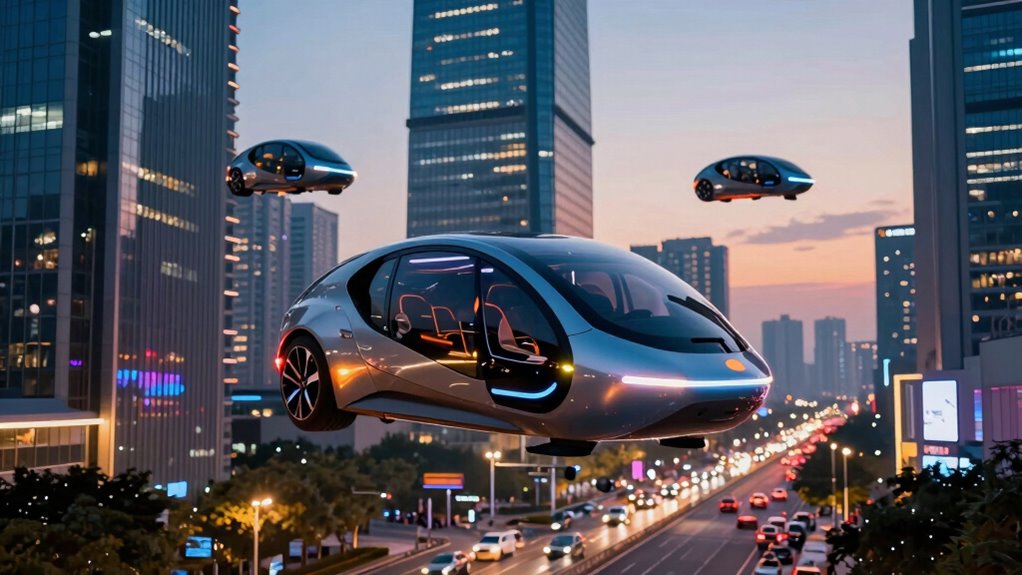

Flying cars are quickly becoming a reality, thanks to advances in electric propulsion, improved batteries, and autonomous flight systems that make urban air mobility safer and more accessible. New designs with VTOL features allow takeoff and landing without runways, while safety elements guarantee reliability. Companies like Klein Vision, Airbus, and Alef are developing models ready for certification and mass production. Stay tuned, as you’ll discover how these innovations could soon transform your daily commute.

Get privacy and security gear delivered free — and shop member deals
- Fast, free delivery on millions of items
- Access to Prime Big Deal Days deals on October 6–7
- Prime Video, Amazon Music and more included
Key Takeaways
- Advances in electric propulsion and improved batteries enable longer, quieter, and more efficient flights for modern flying cars.
- Autonomous flight systems and user-friendly interfaces facilitate safe, seamless urban air mobility without pilot training.
- Vertical takeoff and landing (VTOL) designs allow operation from rooftops or vertiports, integrating into existing urban infrastructure.
- Regulatory progress, including certifications and airspace integration, supports commercial deployment and safety standards.
- High-speed, ultralight models are approaching production, promising to transform urban transportation with decreasing costs and increased accessibility.

Flying cars are rapidly shifting from science fiction to reality, thanks to recent advancements in electric propulsion, battery technology, and autonomous flight systems. These innovations are transforming the way we think about urban transportation, making air taxis a tangible option for everyday travel. Electric propulsion systems are a key breakthrough; they notably reduce noise and reliance on fossil fuels, helping lower carbon emissions. Combined with improved battery technology, these systems now offer greater energy density, longer flight ranges, and better efficiency, which are vital for making flying cars practical.
Flying cars are becoming a practical reality with advanced electric, battery, and autonomous systems.
Vertical takeoff and landing (VTOL) capabilities are another game-changer. They allow vehicles to operate in city environments without traditional runways, enabling you to hop from rooftop to rooftop or designated vertiports. Autonomous flight systems are also advancing rapidly—these integrate seamlessly with air traffic control, minimizing human error and increasing safety. User-friendly interfaces mean you don’t need pilot training to operate these vehicles; instead, you’ll be able to choose destinations and let the onboard tech handle the flying.
Prototypes like Klein Vision’s AirCar can switch modes in under two minutes, reaching speeds of up to 155 mph, while models like the FAA-certified ASKA A5 are already available for pre-order, with deliveries expected by late 2026. Airbus’s CityAirbus NextGen can carry four passengers for about 50 miles at 75 mph, and high-performance models like Leo Coupe can hit speeds near 248 mph, competing with high-speed rail. Alef Aeronautics’s Model A is targeting production next year, with plans to produce ultralight, road-legal flying cars that use less energy per trip than a Tesla. These vehicles feature safety-enhancing elements like six independent motors and retractable wheels for aerodynamic efficiency. In fact, Alef’s Model A is the first of its kind to be classified as an “ultralight,” avoiding strict certification requirements for road use.
Regulatory progress is also encouraging. The Slovak Civil Aviation Authority granted Klein Vision’s AirCar an airworthiness certificate after extensive testing. In the United States, the FAA is actively discussing standards for eVTOL certification and air taxi operations, working on integrating these vehicles into existing airspace. While some countries are starting to allow road-to-air transitions, widespread adoption still faces hurdles. Battery limitations mean most flying cars can only stay airborne for 20 to 30 minutes, and high power demands for takeoff challenge current battery capacities. Additionally, ongoing regulatory efforts aim to streamline certification processes and expand operational frameworks, which will be crucial for broader adoption.
Despite these challenges, the industry is making steady progress. Mass production is on the horizon, with some Chinese models aiming for deliveries by 2025. Companies like Alef Aeronautics and XPENG are building toward large-scale manufacturing, and prototypes are proving the practicality of these vehicles. As technology advances, costs are expected to decrease, making flying cars accessible to a broader audience, transforming urban mobility and opening up new possibilities for how you get around.
Frequently Asked Questions
How Safe Are Flying Cars Compared to Traditional Vehicles?
Flying cars are generally safer than traditional vehicles because they incorporate multiple independent motors, advanced sensors, and autonomous flight systems that reduce human error. Electric propulsion lowers fire risks, and modern air traffic management helps prevent collisions. However, safety depends on rigorous certification, reliable battery technology, and proper training. As technology advances, expect flying cars to become increasingly safe, but they still face challenges like battery limits and regulatory hurdles.
What Are the Costs Involved in Owning a Flying Car?
Owning a flying car can cost between $800,000 and $1 million, depending on the model and features. While the initial price is high, expect additional expenses for maintenance, insurance, and training. Advances in battery tech and production scale may lower costs over time, but right now, flying cars remain a luxury investment. You should also budget for charging infrastructure and regulatory compliance, which can add to the overall expense.
How Will Air Traffic Control Manage Flying Car Congestion?
You’ll see air traffic control managing flying car congestion through advanced automation and real-time tracking systems. They’ll use high-definition mapping and autonomous flight integration to monitor vehicle movements precisely. Expect coordinated routing and traffic management algorithms to prevent collisions and optimize flow. As regulations develop, control centers will adapt, ensuring safety and efficiency, just like today’s air traffic systems but scaled for the new aerial vehicles.
Are There Training Programs for Operating Flying Cars?
Training programs for flying cars are quickly climbing in complexity. You’ll likely undergo specialized simulation sessions, safety standards, and skill seminars designed to develop your dexterity and decision-making. Manufacturers and regulators aim to guarantee pilots are prepared for unpredictable urban airways. As technology advances, expect user-friendly interfaces and optional autonomous features to ease operation, but thorough training will still be essential to master maneuvering these modern marvels safely and smoothly.
What Insurance Options Will Be Available for Flying Car Owners?
You’ll find that insurance options for flying car owners will resemble those for traditional vehicles but with added layers for aviation risks. Expect specialized policies covering flight-specific damages, pilot liability, and airspace regulations. Major insurers are already developing plans tailored to eVTOL and flying car technologies. As the market matures, you’ll be able to choose from extensive coverage options that protect your investment and guarantee compliance with evolving safety standards.
Conclusion
So, here you are, thinking flying cars are just a distant dream. Turns out, they’re almost reality, zipping around above traffic jams you’ve cursed for years. Who knew that the future you’d joked about might actually land in your driveway—or skyway? Ironically, just when we’ve perfected the tech, you might find yourself longing for good old ground-bound chaos. Guess it’s true: the sky’s no longer the limit—it’s the new commute.
Fall Picks
fall essentials
As an affiliate, we earn on qualifying purchases.