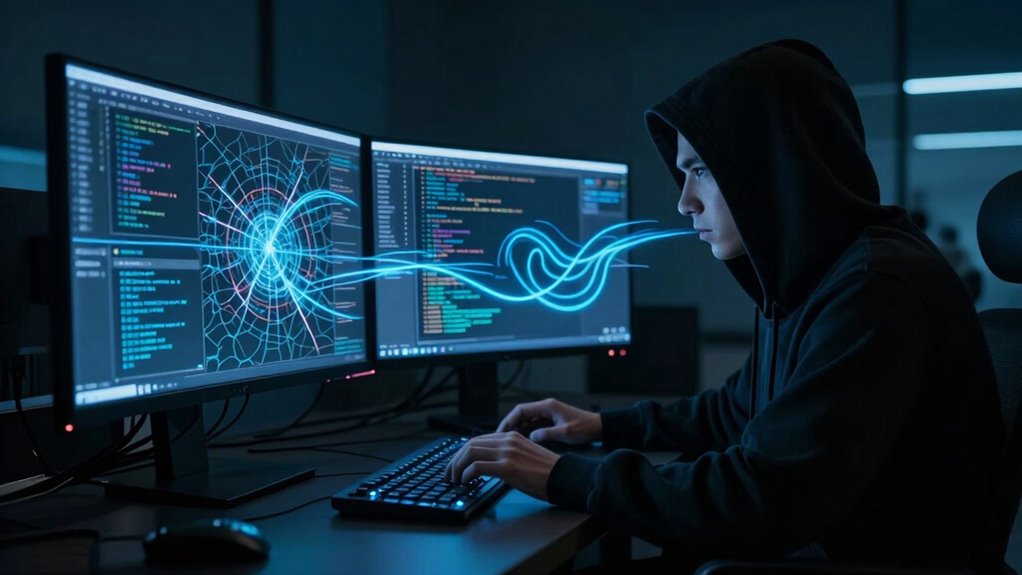

AI hackers are rapidly advancing, using automation, machine learning, and scalable tools to find vulnerabilities faster and create convincing deepfake or phishing attacks. They效率, adaptability, and low costs make them increasingly difficult for human defenders to keep up. While humans excel at strategic planning and understanding context, AI-driven threats continue to grow more sophisticated and persistent. If you want to understand how this ongoing battle unfolds and what it means for security, keep exploring the details ahead.

Get privacy and security gear delivered free with Prime
- Fast, free delivery on millions of items
- Prime Video, Amazon Music and more included
- Member-only deals all year
Key Takeaways
- AI-driven attackers can automate vulnerabilities discovery and exploit generation faster than human defenders can respond.
- Defensive AI tools improve threat detection and response speed, but attackers also leverage AI for more sophisticated attacks.
- Deepfake media and impersonation AI increase the success rate of social engineering attacks, challenging traditional defenses.
- The cybersecurity arms race persists, with attackers benefiting from scalable, low-cost AI models and fewer regulations.
- Human expertise remains crucial for understanding context and strategy, but AI advancements threaten to shift the balance toward attackers.
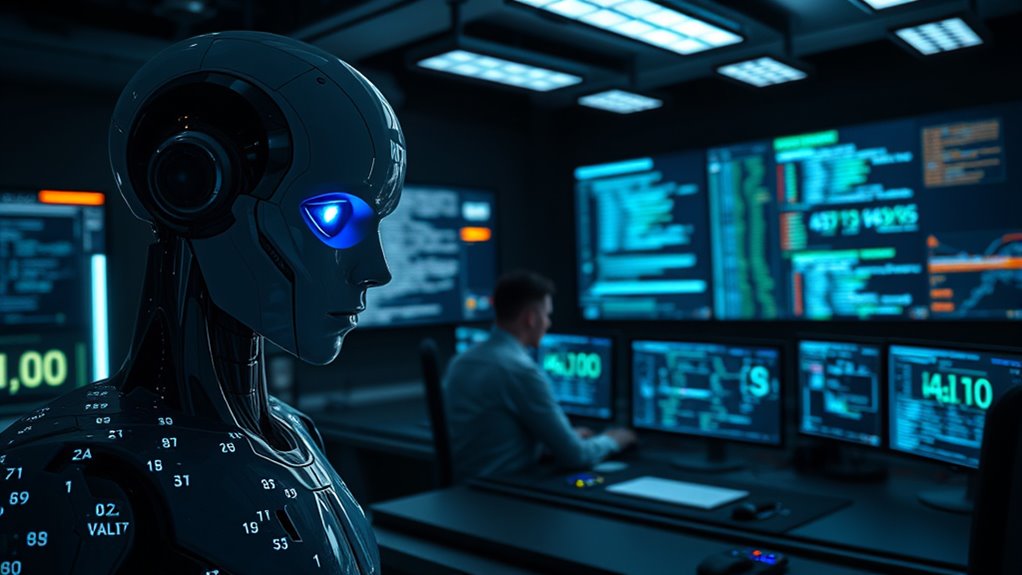
As AI technology advances at an unprecedented pace, hackers are harnessing bots to outsmart human defenders and launch more sophisticated cyberattacks. The capabilities of AI-powered offensive tools have grown exponentially, enabling rapid reconnaissance across vast networks, identifying misconfigurations, exposed services, and vulnerabilities at lightning speed. Automated exploit generation, driven by language models and code-creating agents, shortens the window from identifying a weakness to exploiting it, often with minimal human guidance. Meanwhile, machine learning-driven malware can adapt its payloads and obfuscation techniques in real time, evading detection and bypassing traditional security measures. These AI-backed attacks are not only faster but also more targeted; attackers can craft highly personalized phishing emails, voice clones, and deepfake media at scale, notably increasing their success rates compared to generic campaigns. With automation reducing operational costs, malicious actors can sustain persistent, low-cost operations, probing networks continuously without proportional human effort.
On the defensive side, AI enhances detection and response processes, but attackers keep pace by leveraging the same technology to outmaneuver defenders. Automated threat hunting and anomaly detection can identify suspicious activity faster than signature-based systems, shrinking the dwell time of intrusions. AI-driven incident response tools can isolate compromised endpoints, revoke credentials, and deploy patches within seconds, reducing attackers’ window of opportunity. Multi-agent defensive swarms can coordinate across networks, correlating signals from different layers—network, endpoint, identity—to enact synchronized mitigations. Predictive analytics help prioritize high-risk assets, enabling proactive vulnerability management before exploits occur. These AI-powered defenses provide scalability that manual monitoring cannot match, especially across large, complex environments. Furthermore, adversaries are increasingly employing AI to develop more convincing deepfake media and impersonations, complicating authentication processes and increasing the risk of social engineering attacks. As the technology becomes more accessible, the automation capabilities available to malicious actors continue to expand, heightening the threat landscape.
However, the advantage isn’t solely on the side of defenders. Competition parity has been demonstrated in Capture The Flag competitions, where AI systems match or even outperform elite human teams in solving challenges. Controlled experiments show automated defenders often outperform attackers early in engagements, with success rates of 54.3% versus 28.3%. Still, humans retain an edge in understanding business context, strategic planning, and interpreting adversary intent—areas where automation struggles. Furthermore, attackers benefit from fewer regulatory constraints, lower costs, and rapid iteration capabilities, giving them a considerable asymmetry. They can deploy pre-trained models and scalable agents to conduct large-scale, persistent campaigns at minimal expense. As both offensive and defensive AI tools evolve swiftly, the balance remains dynamic, with the potential for attackers to continually outsmart human defenders if security strategies don’t keep pace. In this landscape, staying ahead requires not just adopting AI but understanding its limitations and vulnerabilities.
Frequently Asked Questions
How Quickly Can AI Adapt to New Cybersecurity Defenses?
AI can adapt to new cybersecurity defenses within minutes to hours, thanks to its ability to learn and modify tactics rapidly. It analyzes patterns, identifies vulnerabilities, and crafts new attack methods almost instantly, often faster than human teams can respond. This quick adaptation means you need to stay ahead by continuously updating your security measures, leveraging AI-driven defenses, and maintaining awareness of emerging threats to avoid falling victim to sophisticated cyberattacks.
Are There Effective AI Countermeasures Against AI-Driven Phishing?
Think of AI countermeasures as a digital fortress, constantly evolving to outwit cunning intruders. You can deploy advanced AI tools for real-time threat detection, anomaly analysis, and rapid incident response. Training your team to recognize AI-generated scams and using AI-driven email filters can block phishing at the source. Combining these defenses creates a dynamic shield, making it harder for malicious AI to succeed and helping you stay one step ahead.
What Industries Are Most Targeted by Ai-Powered Attacks?
You should know that finance, healthcare, and government sectors are most targeted by AI-powered attacks. Hackers exploit high-value data and sensitive information, making these industries prime targets. You’re at risk from AI-driven phishing, deepfakes, and credential theft, which can lead to significant financial and reputational damage. Staying vigilant, using advanced AI defense tools, and educating your team are essential steps to protect your organization effectively.
Can Ai-Generated Deepfakes Be Reliably Detected?
AI-generated deepfakes are increasingly challenging to detect reliably, but advances in detection tools are making progress. You can rely on AI-based systems that analyze facial movements, voice patterns, and inconsistencies to identify deepfakes more accurately. However, no method is foolproof yet. Staying vigilant, using multiple detection techniques, and keeping software updated help you better spot and prevent deepfake-related frauds.
How Can Organizations Improve Human-Ai Collaboration in Cybersecurity?
You can improve human-AI collaboration in cybersecurity by leveraging AI tools that speed up threat detection and analysis. Since 45% of organizations already use AI for incident response, you should focus on continuous training, like 83% already do, to keep staff updated on AI risks. Encouraging teamwork between humans and AI enables faster responses, reduces errors, and enhances overall security, especially as attacks become more sophisticated and frequent.
Conclusion
As AI hackers become smarter, you’ll need to stay vigilant, adapt quickly, and innovate constantly. You must understand the threats, learn the tactics, and embrace the technology. Because as bots outsmart humans in one way, you’ll outthink them in another. It’s a battle of wits, a race of resilience, and a test of ingenuity. So, stay prepared, stay informed, and stay ahead—because in this new era, your defenses depend on your awareness as much as your technology.
Fall Picks
fall essentials
As an affiliate, we earn on qualifying purchases.