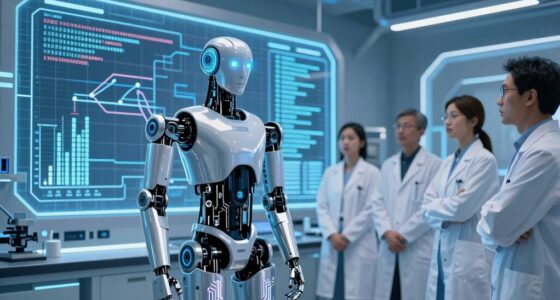
By 2030, automation will take over many jobs in manufacturing, customer service, and routine healthcare tasks, putting millions of roles at risk. Repetitive physical and administrative jobs are especially vulnerable, like fast-food workers, machine operators, and call center agents. While some jobs will disappear, new opportunities will emerge in emerging industries, requiring workers to learn new skills. Stick with us to discover how you can prepare for these changes and stay ahead in the future workforce.
Open a free Amazon Business account
Business pricing, bulk buying and tax-exempt orders.
As an affiliate, we earn on qualifying purchases.
Key Takeaways
- Routine manufacturing, machinery operation, and fast-food roles are highly vulnerable to full automation by 2030.
- Customer service jobs, including call center agents and telemarketers, are increasingly replaced by AI chatbots.
- Repetitive physical tasks and routine healthcare duties are at significant risk of automation.
- Jobs involving data entry, basic analysis, and simple administrative tasks are likely to be taken over by robots.
- Many roles will experience task modifications, with some tasks automated but overall job displacement varying across sectors.
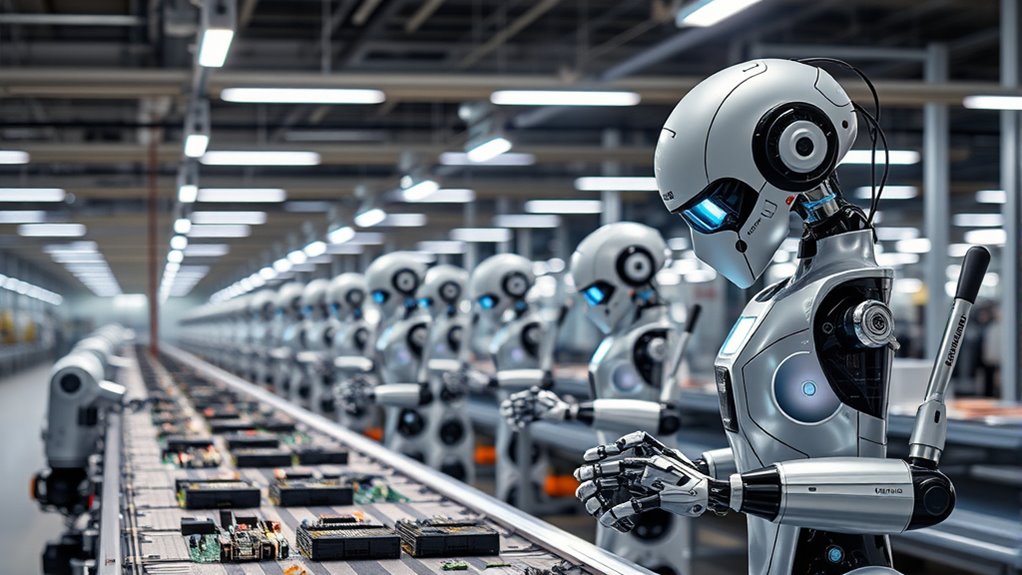
Have you ever wondered how robots are transforming the workplace? By 2030, automation could reshape the job landscape in profound ways. Up to 30% of current U.S. jobs could be fully automated, while 60% will see significant task modifications due to AI. This means millions of roles may disappear or change beyond recognition. Routine manufacturing jobs are especially vulnerable; since 2000, about 1.7 million U.S. manufacturing roles have been lost to automation, and many more could follow. Jobs involving repetitive physical tasks, like machinery operators or fast-food workers, are highly susceptible. Customer service roles, such as telemarketers and call center agents, are also at risk — AI chatbots are already replacing many of these positions. Predictions suggest that by 2030, around 40% of U.S. jobs will fall into highly automatable categories, leading to an estimated 39 million job losses in the country alone. Rapid automation could even eliminate as many as 73 million positions, forcing workers to adapt quickly.
Beyond the U.S., the impact is staggering. Worldwide, as many as 300 million jobs could be lost to AI by 2030, accounting for about 9.1% of all jobs. Countries like China, India, and Japan face massive displacement — hundreds of millions of workers will need to switch careers or retrain. It’s estimated that between 75 and 375 million workers globally will change occupational categories, with many forced to find entirely new lines of work. But it’s not just doom and gloom; automation also *liberates* new opportunities. By 2025, AI is expected to create about 97 million new jobs in emerging fields, with an overall net increase of roughly 78 million jobs worldwide by 2030. These new roles often require retraining, and nearly half of Japan’s workforce might need to learn new skills. Furthermore, the economic benefits are significant. AI agents and robots could generate about $2.9 trillion in U.S. economic value annually by 2030, contributing to a total potential of $6.4 trillion. This productivity boost helps offset job losses and fuels economic growth. Sectors like manufacturing and healthcare are seeing this shift firsthand—robots now work alongside humans in warehouses, with a robot-to-worker ratio of about one to one in Amazon’s facilities. Healthcare automation is expected to automate around 15% of work hours, mainly in routine tasks. Despite these advances, many roles are vulnerable to displacement, and companies are increasingly replacing workers with AI tools. Still, opportunities for re-skilling are emerging, with millions of workers expected to *reorient* into new careers in the coming years. The landscape of work is evolving rapidly, and understanding which jobs are most at risk helps you prepare for the future. As automation progresses, the importance of developing digital skills becomes more crucial for workforce resilience.
Frequently Asked Questions
How Will Automation Impact Job Salaries and Wages?
Automation will likely put downward pressure on job salaries and wages, especially for roles easily replaced by AI or robots. You may see pay stagnation or cuts in vulnerable sectors like manufacturing and customer service. However, if you adapt by gaining new skills in tech or management, you could benefit from higher wages in emerging fields. Overall, automation shifts demand, impacting income levels across different industries and job types.
What New Job Sectors Might Emerge From Automation Advancements?
You’ll see new job sectors emerge around AI development, robot maintenance, and data analysis. Expect growth in fields like cybersecurity, software engineering, and digital marketing. As automation advances, opportunities arise in renewable energy, robotics design, and virtual reality. You might also find roles in ethical AI oversight and human-AI collaboration. These new sectors will create jobs that didn’t exist before, offering fresh career paths as automation reshapes the workforce landscape.
How Can Workers Prepare for Jobs Affected by AI?
To prepare for jobs affected by AI, you should upskill and reskill in areas like tech, data analysis, and AI management. Embrace lifelong learning through online courses, workshops, and certifications. Stay adaptable, develop soft skills such as creativity and problem-solving, and keep an eye on emerging industries. Networking and gaining hands-on experience will also boost your resilience, helping you shift seamlessly into new roles as automation changes the job landscape.
Will Automation Worsen Economic Inequality?
Yes, automation can worsen economic inequality because it disproportionately impacts low and middle-income workers, replacing routine jobs while benefiting those with tech skills. You might find yourself facing job displacement or needing to reskill. Without proper policies, the wealth gap could widen, making it harder for some to adapt. To prevent this, investing in education and retraining is essential so everyone can share in the benefits of automation.
What Policies Can Mitigate Negative Effects of Job Automation?
You can embrace policies like investing in workforce retraining, expanding access to education, and strengthening social safety nets to soften automation’s impact. By encouraging lifelong learning and providing support during shifts, you help workers adapt to new roles. Promoting equitable growth ensures everyone benefits from technological progress. These strategies foster resilience, allowing you to navigate changes confidently while minimizing economic disruptions and creating opportunities for all.
Conclusion
By 2030, automation could take over up to 30% of jobs, transforming the way you work. Imagine a future where robots handle repetitive tasks, freeing you for creative and strategic roles. It’s fascinating to note that industries like manufacturing and transportation will see the biggest shifts. Embrace these changes, and you’ll stay ahead in the evolving job landscape. The key is to adapt and develop skills that complement automation rather than compete with it.
Flea & tick season Picks
flea and tick prevention
As an affiliate, we earn on qualifying purchases.