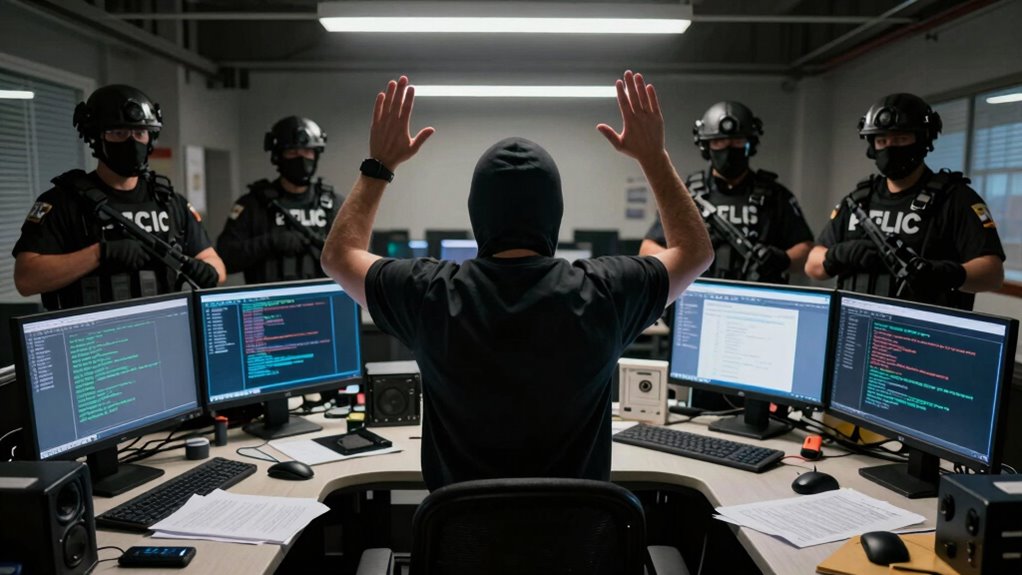

The FBI caught Silk Road’s founder, Ross Ulbricht, by tracing digital footprints from encrypted chats to server data, revealing his identity as Dread Pirate Roberts. They infiltrated the dark web marketplace through undercover agents, intercepted fake IDs, and linked Ulbricht’s personal email to his pseudonym. Internal betrayals and digital evidence solidified their case. If you want to uncover more about how law enforcement finally captured him, keep exploring the details behind this high-stakes investigation.

Get privacy and security gear delivered free with Prime
- Fast, free delivery on millions of items
- Prime Video, Amazon Music and more included
- Member-only deals all year
Key Takeaways
- Law enforcement infiltrated Silk Road through undercover operations and seized servers revealing Ross Ulbricht’s links to the Dread Pirate Roberts alias.
- Ulbricht was arrested in a public library while logged into Silk Road, allowing immediate seizure of digital evidence.
- Digital footprints, pseudonyms, and encrypted communications helped investigators connect Ulbricht to the site.
- Internal betrayals and digital evidence from multiple sources built a strong case against Ulbricht.
- Ulbricht was convicted and sentenced to life imprisonment, demonstrating effective dark web investigation techniques.

Have you ever wondered how the dark web enables some of the most notorious criminal activities today? The story of Silk Road and its founder, Ross Ulbricht, is a prime example. Launched in January 2011, Silk Road quickly grew into the most sophisticated illegal marketplace on the dark web. Using the Tor network for anonymity and Bitcoin for untraceable transactions, it allowed users to buy and sell drugs, weapons, counterfeit IDs, and even hitman services. The platform operated as a hidden eBay, facilitating over $200 million in sales with more than 100,000 buyers. Despite claims of privacy, law enforcement agencies were determined to shut it down.
Silk Road, a dark web marketplace, facilitated over $200 million in illegal sales using Tor and Bitcoin.
The FBI’s investigation into Silk Road was extensive and multifaceted. It began with an undercover drug agency infiltrating the site, gaining access to internal chats and revealing operational details, including the use of Pacific time zone servers. A critical breakthrough came when investigators seized a server in Iceland, which provided essential operational data. Meanwhile, IRS agent Gary Alford linked Ulbricht’s personal email to the Dread Pirate Roberts alias, exposing his identity. Canadian border inspectors intercepted a package containing fake IDs with Ulbricht’s photos, addressed to San Francisco, further tying him to the site. Over two years, a coalition of agencies pieced together clues from scattered sources, meticulously building a case. The use of encrypted communications made the investigation particularly challenging but not insurmountable for law enforcement.
The arrest happened in October 2013, in a public library in San Francisco. Ulbricht was logged into the site at the moment of his arrest, which allowed authorities to seize the server in real-time. The FBI’s multi-agency task force, including undercover DEA agents, had been working tirelessly to dismantle Silk Road’s infrastructure and identify its users. The operation was swift and decisive, with the site taken offline immediately after Ulbricht’s arrest. The investigation was further complicated by the fact that Ulbricht used multiple pseudonyms and encrypted communications to hide his identity. The case demonstrated how digital evidence can be pieced together despite efforts to obfuscate identities.
Ulbricht’s criminal network extended beyond him. Senior advisor Roger Thomas Clark suggested violent measures, including murder-for-hire, to protect the operation. DEA agent Carl Force, who was embedded within the investigation, betrayed his colleagues by extorting Ulbricht for Bitcoin, leaking information and falsifying reports. These betrayals and the wealth of digital evidence led to Ulbricht’s conviction on all charges in early 2015. He was sentenced to double life plus 40 years without parole, with a hefty restitution order of $183 million.
The case highlighted how the dark web’s supposed anonymity can be penetrated with persistent, coordinated law enforcement efforts. Despite Ulbricht’s claims of libertarian ideals and privacy, the evidence showed a sophisticated criminal enterprise with devastating consequences.
Top picks for "crime punishment caught"
As an affiliate, we earn on qualifying purchases.
Frequently Asked Questions
How Did Law Enforcement Track Ulbricht’s Real Identity?
You might be surprised to learn that law enforcement tracked Ulbricht’s real identity through a combination of digital and physical clues. They infiltrated the site, accessed internal chats, and seized servers. Investigators linked his personal email, used undercover operations, and intercepted fake IDs with his photos at the border. These efforts, along with data from multiple agencies, ultimately pinned his identity to the Silk Road’s pseudonymous creator.
What Digital Evidence Was Most Crucial in the Case?
The most essential digital evidence was the chat logs and server data linking Ulbricht to Dread Pirate Roberts, revealing his control over Silk Road. You’d find the internal communications, timestamped in Pacific Time, exposing his involvement. Additionally, the seized server in Iceland provided key operational details. These digital breadcrumbs, combined with Ulbricht’s personal email and intercepted fake IDs, definitively tied him to the site and his criminal enterprise.
Were Any Silk Road Users Prosecuted or Only Ulbricht and Associates?
Think of the Silk Road as a bustling underground market; only Ulbricht and his close associates faced prosecution, like the shop owners rather than every anonymous customer. You won’t find many prosecutions of individual users because law enforcement focused on dismantling the core operators. Ulbricht’s arrest and conviction sent a clear message to users that while anonymity exists, it’s not foolproof against legal action.
How Did the FBI Locate and Seize the Silk Road Servers?
You might be surprised to learn that the FBI located and seized the Silk Road servers through a combination of infiltration and technical investigation. An undercover agent gained access as an admin, and law enforcement seized the server in Iceland. This allowed them to gather vital operational data, connect Ulbricht to the site, and ultimately shut down the marketplace. Their coordinated effort was essential to cracking the case.
What Role Did Insider Threats Play in the Investigation?
Coincidentally, insider threats played a vital role in the investigation. You might not realize it, but Ulbricht’s own actions, like using personal email and living in San Francisco, created vulnerabilities. These mistakes allowed investigators to connect his real identity to the pseudonym Dread Pirate Roberts. Informants and corrupted officials also provided insider information, which helped law enforcement piece together his identity and track his online activities effectively.
Conclusion
You see, the FBI’s relentless efforts led to the arrest of the Silk Road founder, revealing how cybercrime can have real-world consequences. Significantly, during the investigation, authorities seized over $3.6 million in Bitcoin, highlighting the scale of digital currencies in illicit activities. This case shows that even the most secretive online marketplaces can’t hide forever. Your vigilance and technological advances are vital in fighting crime, proving that justice can prevail in the digital age.
Halloween Picks
halloween
As an affiliate, we earn on qualifying purchases.