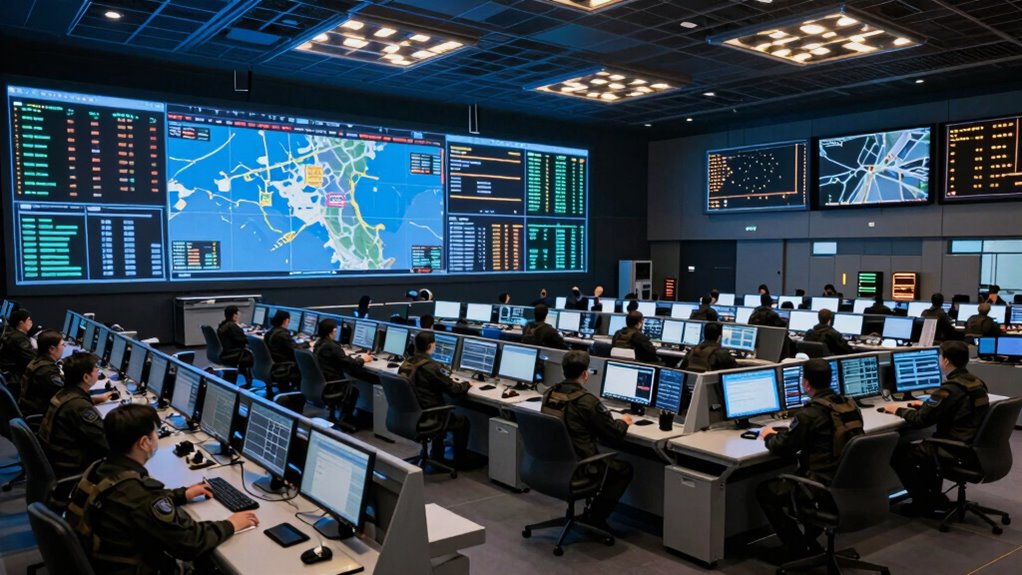

Command and control infrastructure acts as the central nervous system of military ops, connecting units and technologies for seamless coordination. You’ll find it managing real-time communication through radio, satellite, and fiber optics, ensuring quick decision-making and movement. It’s designed with cybersecurity and redundancy to protect against disruptions and cyber threats. By integrating automation and analytics, it helps commanders respond swiftly. Keep exploring to see how these systems work together to maintain operational success under pressure.

Get privacy and security gear delivered free with Prime
- Fast, free delivery on millions of items
- Prime Video, Amazon Music and more included
- Member-only deals all year
Key Takeaways
- Acts as the central hub linking units and technologies for coordinated decision-making and communication.
- Integrates multiple communication channels like radio, satellite, and fiber optics for seamless information flow.
- Employs cybersecurity protocols to protect sensitive data and prevent disruptions from malicious threats.
- Utilizes redundancy, backup systems, and fail-safe procedures to ensure resilience during failures or attacks.
- Leverages automation and data analytics to enhance decision speed, threat identification, and resource allocation.

Have you ever wondered how organizations coordinate complex operations seamlessly? At the heart of this coordination lies command and control infrastructure, a sophisticated system designed to guarantee that every movement, decision, and communication happens smoothly and efficiently. This infrastructure acts as the nerve center, linking various units and technologies to maintain oversight and enable rapid responses to changing situations. But to keep such a system operational, organizations must prioritize cybersecurity protocols to protect against cyber threats that could disrupt or compromise their operations. These protocols include encryption, secure communication channels, and regular security audits, all aimed at safeguarding sensitive information and preventing unauthorized access. Without robust cybersecurity measures, malicious actors could infiltrate the system, causing chaos or extracting critical data, which makes cybersecurity protocols indispensable to maintaining the integrity of command and control operations. Additionally, integrating cybersecurity protocols into infrastructure design ensures that the entire system remains protected from evolving threats.
Robust cybersecurity is essential to protect command systems from threats and ensure operational integrity.
In addition to cybersecurity, infrastructure resilience plays a key role in assuring continuous operation. Resilience refers to the system’s ability to withstand disruptions—be they technical failures, natural disasters, or cyberattacks—and recover swiftly. This involves designing redundant pathways for data transmission, deploying backup power supplies, and establishing fail-safe procedures. When one part of the infrastructure encounters a problem, the system’s resilience allows it to reroute operations without significant delays, maintaining mission continuity. Implementing redundant systems is crucial for this purpose, as it minimizes downtime and supports rapid recovery. It’s like having a safety net that catches and corrects issues before they escalate into full-blown failures. Incorporating infrastructure resilience is essential for ensuring operational continuity in unpredictable environments, especially where delays could have serious consequences. Furthermore, understanding the importance of system interoperability can greatly enhance the effectiveness of command and control systems by enabling smooth integration of diverse technologies and platforms. Leveraging emerging technologies can further enhance system resilience by providing innovative solutions to unforeseen challenges.
Furthermore, command and control infrastructure integrates various communication technologies—radio, satellite, fiber optics—to facilitate real-time information sharing across different locations. This interconnected web ensures that commanders receive up-to-the-minute updates, enabling quick decision-making. The system also incorporates automation and data analytics to process vast amounts of information swiftly, helping leaders identify threats, allocate resources, and coordinate responses effectively. All these elements work together to create an adaptive, robust network capable of managing complex operations under pressure. The seamless functioning of such systems depends on the careful balance of cybersecurity protocols and infrastructure resilience, which together safeguard the command structure from external threats and internal failures.
military communication radio systems
As an affiliate, we earn on qualifying purchases.
As an affiliate, we earn on qualifying purchases.
Frequently Asked Questions
How Is Command and Control Infrastructure Secured Against Cyber Attacks?
You secure command and control infrastructure by implementing robust cybersecurity protocols, including firewalls, intrusion detection systems, and access controls. You also use encryption techniques to protect data in transit and at rest, preventing unauthorized access. Regularly updating software and conducting security audits help identify vulnerabilities. Training personnel on cybersecurity best practices reduces human error. Together, these measures create a layered defense, making cyber attacks considerably harder to succeed against your infrastructure.
What Are the Key Components of a Command and Control System?
You need to understand that key components of a command and control system include secure data transmission, which relies on data encryption to protect sensitive information, and robust network segmentation to isolate critical parts of the infrastructure. These elements prevent unauthorized access and contain potential breaches. Additionally, secure servers, reliable communication channels, and real-time monitoring are essential, ensuring the system remains resilient and responsive under attack or failure conditions.
How Do Organizations Detect Breaches in Command and Control Networks?
You detect breaches in command and control networks through proactive cyber threat hunting, which involves actively searching for signs of malicious activity. You monitor network traffic for unusual patterns that might indicate insider threats or external intrusions. By analyzing logs, leveraging intrusion detection systems, and staying alert to anomalies, you can identify breaches early, allowing you to respond swiftly and minimize potential damage.
What Role Does AI Play in Modern Command and Control Systems?
AI plays a vital role in modern command and control systems by enabling autonomous decision-making and leveraging predictive analytics. You benefit from AI’s ability to quickly analyze vast data, identify patterns, and anticipate threats, allowing for faster, more accurate responses. This automation reduces human workload, enhances operational efficiency, and improves threat detection, ensuring your command infrastructure stays resilient against evolving cyber and physical attacks.
How Is Redundancy Maintained in Critical Command and Control Infrastructure?
Redundancy in critical command and control infrastructure is like a safety net, catching you when others fail. You achieve this through redundancy planning, which involves creating multiple backup systems that activate instantly if primary ones go down. Infrastructure resilience is key, ensuring systems stay operational despite failures or attacks. You continuously test these backups, update protocols, and incorporate diverse communication channels to keep control intact under any circumstance.
As an affiliate, we earn on qualifying purchases.
Conclusion
You might find it surprising how seamlessly command and control infrastructures operate behind the scenes, almost like an unseen hand guiding complex systems. It’s a coincidence, perhaps, that these intricate networks often mirror the very chaos they’re designed to manage. As you’ve seen, understanding their true function reveals not just technology, but a delicate dance of coordination. In the end, it’s this hidden harmony that keeps everything running smoothly—an elegant coincidence in the world of control.
As an affiliate, we earn on qualifying purchases.
cybersecurity for communication infrastructure
As an affiliate, we earn on qualifying purchases.
As an affiliate, we earn on qualifying purchases.
Fall Picks
fall essentials
As an affiliate, we earn on qualifying purchases.