
Public key cryptography is a simple yet powerful way to keep your online communications secure. It uses two keys: a public key that anyone can access, and a private key that you maintain secret. When you want to send a message, you encrypt it with the recipient’s public key so only they can read it with their private key. This method ensures that your messages stay safe and authentic. There’s much more to explore about how this technology enhances your digital safety.
Key Takeaways
- Public key cryptography secures digital communication by using a pair of keys: one public and one private.
- The public key encrypts messages, ensuring only the intended recipient can decrypt them with their private key.
- Digital signatures verify message authenticity, acting like a handwritten signature in the digital realm.
- Key exchange allows parties to share public keys securely, enabling encrypted communication without a secure channel.
- It is widely used in online banking, secure emails, and protecting sensitive information across various digital platforms.
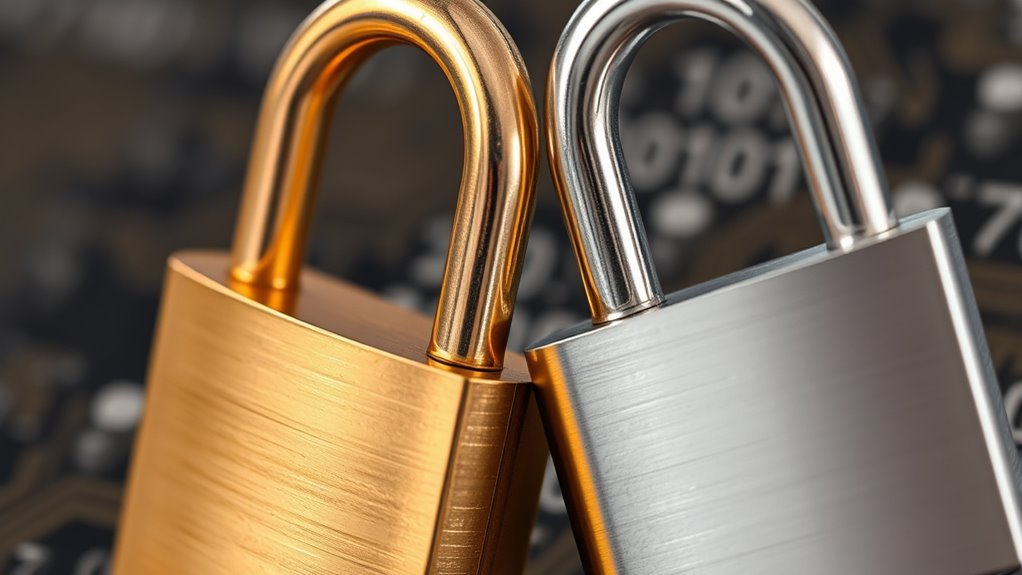
Public key cryptography is a revolutionary approach to securing digital communications. It allows you to exchange information safely and guarantees that only the intended recipient can read it. Imagine sending a secret message to a friend without worrying about anyone else intercepting it. With public key cryptography, that’s exactly what you can do. This method uses a pair of keys: one public and one private. The public key is shared with everyone, while the private key is kept secret. When you want to send a secure message, you use your friend’s public key to encrypt it. Only your friend, with their private key, can decrypt the message and read it.
A vital aspect of public key cryptography is the concept of digital signatures. When you send a message, you can add a digital signature using your private key. This signature acts like a handwritten signature, verifying that the message indeed comes from you. When your friend receives the message, they can use your public key to check the signature. If it matches, they know the message hasn’t been tampered with and that it truly came from you. This process builds trust in digital communications, guaranteeing that both parties can verify each other’s identity.
Key exchange is another essential component of this cryptographic method. In a typical scenario, two people want to communicate securely. They need to exchange keys without anyone else getting access to them. Public key cryptography simplifies this process. You can send your public key to your friend, while they send you theirs. Once you both have each other’s public keys, you can securely exchange messages. This eliminates the need for a secure channel to transmit keys, making it much easier to establish a secure line of communication.
Key exchange in public key cryptography allows secure communication without needing a secure channel, simplifying the process for everyone involved.
Moreover, public key cryptography extends beyond simple message exchanges. It’s used in various applications, from securing online banking transactions to enabling secure email communications. As you navigate the digital world, understanding this technology helps you appreciate the safety measures in place to protect your information. Additionally, mindful decluttering strategies can help you organize your digital files, ensuring that sensitive information is easily accessible and securely stored.
Frequently Asked Questions
How Do I Generate My Own Public and Private Keys?
To generate your own public and private keys, you can use software tools like OpenSSL or GnuPG. These tools offer a key generation feature that guarantees key security. Start by installing the software, then run the appropriate command for key generation. You’ll create a private key that only you control and a corresponding public key that you can share. Always store your private key securely to protect your sensitive information.
Can Public Key Cryptography Be Hacked?
Yes, public key cryptography can be hacked, especially with emerging quantum threats. Current algorithms rely on key lengths that may not be secure against powerful quantum computers. As technology advances, hackers could exploit shorter key lengths, making your encryption vulnerable. To protect your data, consider using longer keys and stay updated on cryptographic advancements. It’s vital to anticipate these threats and adapt your security measures accordingly to keep your information safe.
What Are Real-World Uses of Public Key Cryptography?
You’ll find public key cryptography used in various real-world applications. It’s vital for secure email communications, ensuring that your messages remain confidential and tamper-proof. Additionally, digital signatures rely on this technology to verify the authenticity of documents, allowing you to trust their origins. Whether you’re signing a contract or sending sensitive information, public key cryptography plays a pivotal role in keeping your data safe and secure in today’s digital world.
How Does Public Key Infrastructure (PKI) Work?
Think of public key infrastructure (PKI) like a library. In this library, digital certificates are the books, proving identities and securing communication. When you want a book, you trust the librarian, who’s your certificate authority. They verify the book’s authenticity, ensuring you’re reading something credible. So, when you use PKI, you’re relying on these digital certificates and certificate authorities to keep your digital interactions safe and trustworthy, just like a library keeps its books secure.
Is Public Key Cryptography Suitable for Small Businesses?
Yes, public key cryptography is definitely suitable for small businesses. It helps you secure email communications and verify identities through digital signatures. By implementing this technology, you can protect sensitive information and build trust with your customers. It’s not only affordable but also easy to use, making it an ideal choice for small operations looking to enhance their security. Embracing public key cryptography can profoundly improve your business’s overall cybersecurity posture.
Conclusion
In a world where secrets can feel heavy and burdensome, public key cryptography acts like a light, effortlessly securing your messages. Just as a locked box keeps your treasures safe, your public key allows others to send you encrypted messages, while your private key is the only way to open them. This balance between sharing and safeguarding illustrates how trust can flourish in an otherwise chaotic digital landscape, empowering you to communicate freely without fear.