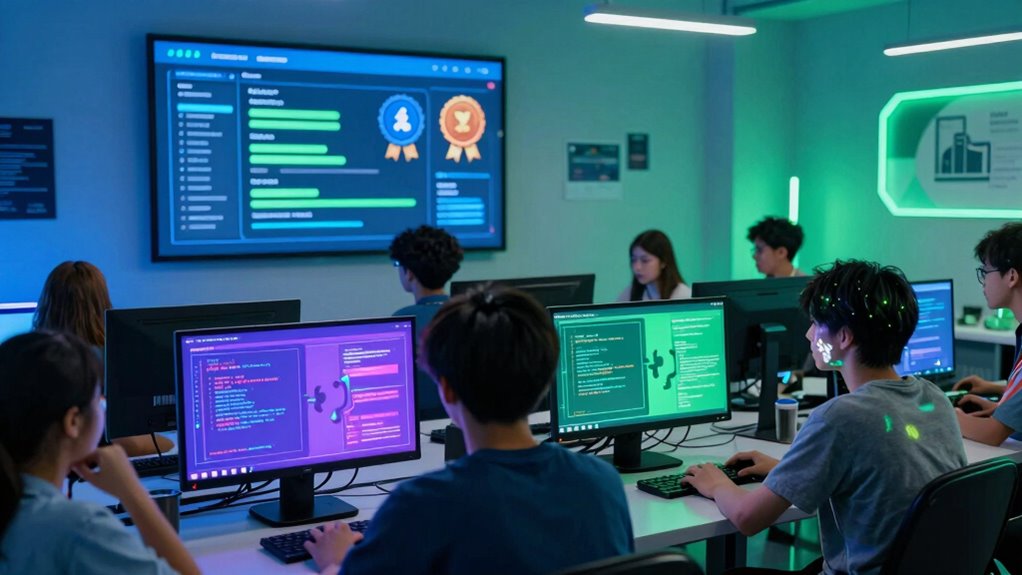

Gamifying cybersecurity can turn you into a better defender by boosting your engagement, knowledge retention, and behavioral skills. Interactive game elements like points, badges, and simulations make training more motivating and effective. Employees who participate in gamified programs report threats more accurately and respond faster, leading to fewer security incidents. If you want to discover how these engaging methods can transform your security approach, there’s much more to explore below.

Get privacy and security gear delivered free with Prime
- Fast, free delivery on millions of items
- Prime Video, Amazon Music and more included
- Member-only deals all year
Key Takeaways
- Gamification increases engagement and motivation, leading to more consistent cybersecurity training and better skill development.
- Interactive, game-based learning improves knowledge retention and enhances threat detection capabilities.
- Gamified simulations significantly reduce security incidents and foster proactive threat reporting behaviors.
- Feedback, leaderboards, and rewards boost confidence, vigilance, and sustained behavioral change in employees.
- Organizations using gamification see measurable improvements in security awareness and incident response effectiveness.

Have you ever wondered how to make cybersecurity training more engaging and effective? The answer might be right in front of you: gamification. When you turn training into a game, participation skyrockets, with engagement rates exceeding 60%, far surpassing traditional methods. Incorporating elements like points, leaderboards, and badges can boost activation rates by 43%. Most employees—about 83%—report feeling more motivated when training includes gamified modules, and organizations using these methods see 9 to 10 times higher overall engagement. This heightened involvement isn’t just superficial; it translates into better awareness and teamwork, with 96% of workers in gamified exercises noting these benefits.
Gamification boosts engagement by over 60%, motivating employees and enhancing cybersecurity awareness and teamwork.
Gamification also markedly improves knowledge retention. Interactive, game-like content can boost understanding by 30 to 40%, helping employees remember critical security concepts longer. Traditional training often leads to quick forgetting—only 40% retention after 20 minutes—but gamified approaches can push retention to 90% after a month. This sustained knowledge helps employees develop lasting behavioral changes, like reporting phishing attempts six times more accurately over six months. Continuous gamified challenges lead to over 75% increases in threat reporting, making your team more vigilant and responsive.
The impact extends beyond awareness. Organizations that use gamified simulations see an 86% reduction in phishing incidents and a tenfold increase in real threat detection within a year. These programs prepare your team to identify, escalate, and neutralize threats that might slip past filters. Tailored programs foster secure behaviors, reducing potential harm, while regular audits help identify and mitigate residual risks. Employees learn to think like hackers, applying their skills in risk-free environments, which accelerates their mastery of cybersecurity techniques. Cybersecurity awareness is enhanced when employees participate in these immersive, game-based activities.
Behavioral change is at the core of gamification’s success. Structured feedback loops and competitive elements improve threat reporting ratios, boosting confidence and vigilance. Gamified training also increases completion rates by up to 60%, making sure more employees stay engaged and learn effectively. Metrics like reporting rates, threat detection, and risk scores are tracked through leaderboards, badges, and points, reinforcing secure habits. Employees report feeling more positive—88% in a 2019 survey—when participating in gamified training, further fueling their motivation.
Studies back up these results: data from platforms like Hoxhunt and SoSafe demonstrate that gamification can lead to a sixfold increase in reporting accuracy, 86% fewer incidents, and a tenfold rise in threat detection. By making cybersecurity training interactive, competitive, and rewarding, you build a resilient, knowledgeable team ready to defend your organization. Playing games isn’t just fun—it’s a powerful way to turn your team into skilled, alert defenders.
Products Worth Considering

LG UltraGear 32GX850A-B 32-Inch 4K UHD Glossy OLED Gaming Monitor

Jackery Explorer 300 Portable Power Station, 292Wh

DJI Osmo Mobile 7P with Mic Mini TX (Infinity Black) Gimbal Stabilizer
As an affiliate, we earn on qualifying purchases.
Frequently Asked Questions
How Cost-Effective Is Gamified Cybersecurity Training Compared to Traditional Methods?
Gamified cybersecurity training is highly cost-effective compared to traditional methods. You’ll see engagement rates soar by over 60%, and knowledge retention improves by 30-40%, reducing the need for frequent retraining. Plus, organizations report an 86% drop in phishing incidents and a tenfold increase in threat detection, saving money on incident response. The interactive nature motivates employees, making training more efficient and impactful, ultimately delivering better protection at a lower cost.
What Are the Best Practices for Designing Engaging Cybersecurity Gamification Programs?
To design engaging cybersecurity gamification programs, you should focus on making content interactive and relevant. Incorporate elements like points, badges, and leaderboards to motivate participation. Use real-world scenarios to enhance realism and retention. Guarantee challenges are well-balanced—neither too easy nor too hard—and provide immediate feedback. Regularly update content to keep learners interested, and tailor programs to your team’s specific threats and needs for maximum impact.
How Can Organizations Measure Long-Term Behavioral Changes From Gamified Training?
You can track long-term behavioral changes by monitoring key metrics like threat reporting rates, incident reduction, and risk scores over months. Use leaderboards, badges, and streaks to motivate continuous improvement. Regular assessments and feedback loops help identify sustained habits, while surveys gauge attitude shifts. Remember, if you’re not measuring, you’re guessing—so don’t rely on fleeting enthusiasm; instead, analyze data to prove that your gamified efforts truly stick.
Are There Industry-Specific Adaptations for Cybersecurity Gamification Strategies?
You should tailor your cybersecurity gamification strategies to your industry’s unique risks and workflows. For example, finance firms focus on phishing simulations, while healthcare organizations emphasize patient data protection. Customize scenarios to reflect real threats your team faces, and incorporate industry-specific compliance and regulations. This targeted approach boosts engagement, retention, and behavioral change, ensuring your training remains relevant and effective in reducing vulnerabilities specific to your sector.
What Challenges Might Organizations Face When Implementing Cybersecurity Gamification?
You might hit a few snags when rolling out cybersecurity gamification. Resistance from staff who see it as just a game can slow your progress, and designing engaging, relevant content takes time and resources. Technical glitches or lack of management buy-in could also derail efforts. But if you keep your eye on the prize and tailor programs to your team’s needs, you can turn these hurdles into stepping stones for stronger security habits.
Conclusion
Imagine turning cybersecurity into a game so immersive that hackers tremble at your skills! By gamifying training, you’ll become an unstoppable digital superhero, outsmarting threats before they even strike. It’s not just training—it’s a revolution that could make you invincible in the cyber world. So, are you ready to level up and defend your digital universe like a true champion? The future of cybersecurity is in your hands—game on!