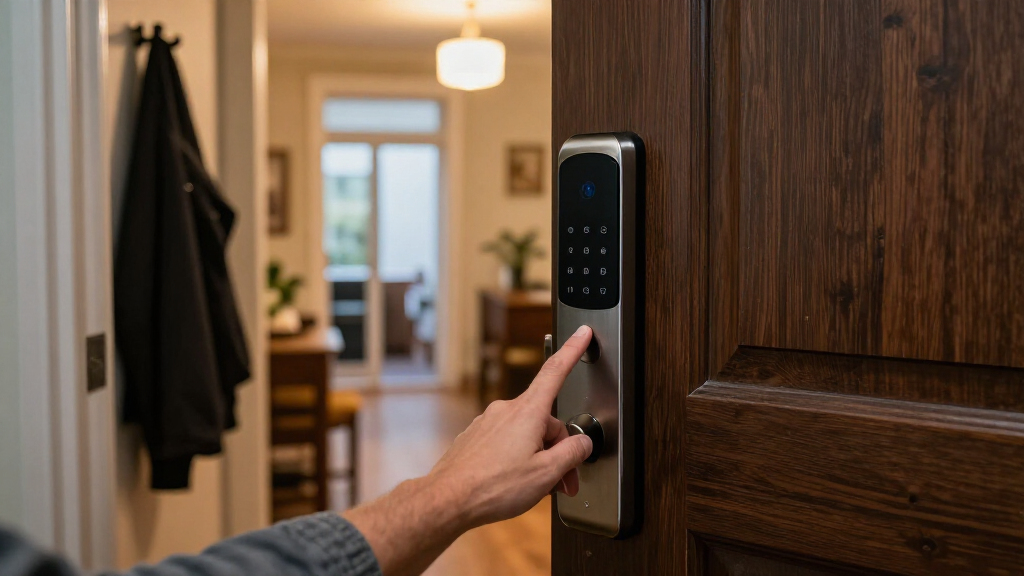

Smart locks with fingerprint readers make key-free entry quick, but the right choice depends on whether you need a deadbolt, knob, or full handle set—and how much you value app control. I’d put the eufy Security FamiLock C32 at the top for its combined fingerprint keypad and handle design; the eufy C220 stands out for a fingerprint-focused deadbolt format, while the Veise KS02A suits buyers who want a keypad deadbolt in an oil-rubbed bronze finish. The main tradeoffs are installation fit, backup entry options, and whether connected features add enough value for your household. Read on for the full breakdown of all 10 models and how I’d match each one to a buyer.

Get privacy and security gear delivered free with Prime
- Fast, free delivery on millions of items
- Prime Video, Amazon Music and more included
- Member-only deals all year
Key Takeaways
- The FamiLock C32 leads for all-in-one access: its fingerprint keypad and handle design make it the broadest fit for buyers replacing more than a deadbolt alone.
- Lock format matters as much as fingerprint access: deadbolt models such as the Veise KS02A and eufy C220 suit different door setups than knob or lever-handle products.
- Several entries target straightforward hardware swaps: the GHome and Yamiry knob models may appeal to shoppers replacing a knob, but they are not interchangeable with deadbolts.
- App control is not a universal advantage: models such as the KLLOQUE K10B and Veise VE017 make connected functions part of the choice, while buyers should weigh that against setup and connectivity needs.
- Finish and included hardware shape the shortlist: the Veise KS02A’s oil-rubbed bronze and the KS02B’s satin nickel lever handles address different door styles and replacement needs.
| eufy Security FamiLock C32 Smart Lock with Fingerprint Keypad and Handle |  | Best for Connected Interior Doors | Unlock methods: Fingerprint, PIN, physical keys | Fingerprint unlock time: About 0.3 seconds | Connectivity: Built-in 2.4 GHz Wi-Fi | VIEW LATEST PRICE | See Our Full Breakdown |
| Yamiry Smart Door Lock with Fingerprint Keypad |  | Best for Flexible Entry Methods | Unlock methods: Fingerprint, Bluetooth app, passcode, key fob, mechanical key, Alexa voice control | Remote access requirement: Separately sold Wi-Fi gateway | Door compatibility: Most standard American wooden doors | VIEW LATEST PRICE | See Our Full Breakdown |
| GHome 4-in-1 Smart Fingerprint Door Knob with Keypad |  | Best for Local, Bluetooth-Only Access | Unlock methods: Fingerprint, passcode, Bluetooth app, mechanical key | Fingerprint capacity: 20 fingerprints | Passcode capacity: 20 passcodes | VIEW LATEST PRICE | See Our Full Breakdown |
| Veise KS02A Fingerprint Keypad Deadbolt, Oil-Rubbed Bronze |  | Best Fingerprint Deadbolt | Access methods: Fingerprint, password, one-time code, mechanical key | Fingerprint capacity: Up to 20 | Password capacity: Up to 20 user passwords | VIEW LATEST PRICE | See Our Full Breakdown |
| Veise KS02B Fingerprint Door Lock with Two Lever Handles, Satin Nickel |  | Best Complete Lever-Handle Set | Entry methods: Fingerprint, passcode, backup key, one-time passcode | Fingerprint capacity: 20 | Passcode capacity: 20 family codes | VIEW LATEST PRICE | See Our Full Breakdown |
| Sifely S Fingerprint Smart Lock with Handle |  | Best for Flexible Shared Access | Unlock methods: Fingerprint, PIN code, Bluetooth app, RFID key fob, mechanical key | Connectivity: Bluetooth; remote internet control requires a compatible Wi-Fi Gateway | Material and protection: Zinc alloy; IP65 | VIEW LATEST PRICE | See Our Full Breakdown |
| Yamiry Fingerprint Smart Door Knob Lock with Keypad |  | Best for Straightforward DIY Setup | Model: YR05 | Unlock methods: App, passcode, key fob, fingerprint, physical key | Connectivity: Bluetooth; remote control requires a separately sold Wi-Fi gateway | VIEW LATEST PRICE | See Our Full Breakdown |
| KLLOQUE K10B Smart Fingerprint Door Knob with App Control, Silver |  | Best for Interior Privacy | Model: K10B | Unlock methods: Fingerprint, Bluetooth app, mechanical key | Operating modes: Passage, Normal with 7-second auto-lock, Privacy, Silent | VIEW LATEST PRICE | See Our Full Breakdown |
| Veise VE017 Fingerprint Smart Door Lock with App Control, Satin Nickel |  | Best for Access Monitoring | Model and finish: VE017; satin nickel | Unlock methods: Fingerprint, app, authorized access, fob card, code, code sharing, mechanical key | Fingerprint recognition: Under 0.2 seconds; claimed 99.99% accuracy | VIEW LATEST PRICE | See Our Full Breakdown |
| eufy Security Smart Lock C220 with Fingerprint Keyless Entry |  | Best for Built-In Remote Access | Model: T8506 | Unlock methods: Fingerprint, app, keypad, physical key, Apple Watch, Alexa or Google voice assistant | Connectivity: Built-in Wi-Fi; no bridge required | VIEW LATEST PRICE | See Our Full Breakdown |
| smart locks with fingerprint reader | Unlock methods | Power |
|---|---|---|
| eufy Security FamiLock C32 Sma | Fingerprint, PIN, physical keys | 4 AA batteries; USB-C emergency backup |
| Yamiry Smart Door Lock with Fi | Fingerprint, Bluetooth app, passcode, key fob, mechanical key, Alexa voice control | — |
| GHome 4-in-1 Smart Fingerprint | Fingerprint, passcode, Bluetooth app, mechanical key | — |
| Veise KS02A Fingerprint Keypad | — | 4 AA alkaline batteries, not included |
| Veise KS02B Fingerprint Door L | — | 4 AA batteries, not included |
| Sifely S Fingerprint Smart Loc | Fingerprint, PIN code, Bluetooth app, RFID key fob, mechanical key | 4 AA batteries, not included; Micro-USB emergency power port |
| Yamiry Fingerprint Smart Door | App, passcode, key fob, fingerprint, physical key | — |
| KLLOQUE K10B Smart Fingerprint | Fingerprint, Bluetooth app, mechanical key | — |
| Veise VE017 Fingerprint Smart | Fingerprint, app, authorized access, fob card, code, code sharing, mechanical key | 4 AA/LR6 alkaline batteries, not included; claimed battery life about 12 months, varying with use |
| eufy Security Smart Lock C220 | Fingerprint, app, keypad, physical key, Apple Watch, Alexa or Google voice assistant | — |
More Details on Our Top Picks
eufy Security FamiLock C32 Smart Lock with Fingerprint Keypad and Handle
The FamiLock C32 suits buyers who want fast fingerprint entry and remote management on a standard interior door. Its built-in 2.4 GHz Wi-Fi lets you manage access without buying a separate gateway, unlike the Yamiry Smart Door Lock, which needs one for remote control and Alexa. Fingerprint access is specified at about 0.3 seconds, and USB-C emergency power gives you a fallback if the four AA batteries run down. Alexa and Google Assistant support add convenient voice control.
The main limitation is placement: eufy does not recommend it for front doors, so the broader door use offered by the Veise KS02B makes that a meaningful distinction. Rekeying is also unsupported. I’d choose this for an interior entry where connected features matter more than exterior-door suitability or lock-cylinder flexibility.
Pros:- Fingerprint unlocking is specified at about 0.3 seconds.
- Built-in 2.4 GHz Wi-Fi enables remote management without a separate gateway.
- USB-C emergency power offers a backup if the AA batteries are depleted.
- Compatible with Amazon Alexa and Google Assistant.
Cons:- Not recommended for front-door use.
- Rekeying is not supported.
- Four AA batteries are specified for more than five months of use, so battery replacement remains part of upkeep.
Best for: Households seeking fingerprint entry and built-in remote access for a standard interior door, with Alexa or Google Assistant integration.
Not ideal for: Buyers securing a front door or anyone who needs a lock that supports rekeying.
- Unlock methods:Fingerprint, PIN, physical keys
- Fingerprint unlock time:About 0.3 seconds
- Connectivity:Built-in 2.4 GHz Wi-Fi
- Smart home compatibility:Amazon Alexa, Google Assistant
- Power:4 AA batteries; USB-C emergency backup
- Claimed battery life:Over 5 months
- Door compatibility:Standard interior doors; not recommended for front doors
- Installation:About 15 minutes; screwdriver required
Our verdict“Choose the FamiLock C32 for connected, quick fingerprint access on an interior door, but skip it for a front-door installation.”
Yamiry Smart Door Lock with Fingerprint Keypad
Yamiry is the entry-method variety pick: fingerprint, app, passcode, key fob, mechanical key, and Alexa control give different household members a way in. Its app also supports temporary passcodes, access management, and unlock records, making it more useful for guest access than the simpler Veise KS02A keypad deadbolt. A reversible handle and screwdriver installation without additional drilling can help when fitting a standard American wooden door.
That flexibility has a catch: Bluetooth app control is not the same as remote access, and remote management and Alexa require a separately sold Wi-Fi gateway. By contrast, the eufy FamiLock C32 includes Wi-Fi, though it is intended for interior doors. Yamiry is a better fit for buyers who value several local entry choices and broad door placement over an all-in-one connected setup; those with nonstandard door materials or dimensions should check fit before choosing it.
Pros:- Six listed unlocking methods include fingerprint, passcode, key fob, and mechanical key.
- App supports temporary passcodes, access management, and unlock records.
- Reversible handle accommodates left- or right-handed doors.
- Designed for screwdriver installation without additional drilling.
Cons:- Remote control and Alexa require a separately sold Wi-Fi gateway.
- Compatibility is specified for most standard American wooden doors, not every door type.
- The gateway dependency adds another component for buyers who want remote operation.
Best for: Households with varied access needs—such as family members who prefer fobs and guests who need temporary passcodes—on standard American wooden doors.
Not ideal for: Buyers who want remote access or Alexa control straight out of the box, or whose doors fall outside the stated standard wooden-door compatibility.
- Unlock methods:Fingerprint, Bluetooth app, passcode, key fob, mechanical key, Alexa voice control
- Remote access requirement:Separately sold Wi-Fi gateway
- Door compatibility:Most standard American wooden doors
- Handle orientation:Reversible for left- or right-handed doors
- Installation:DIY with screwdriver; no additional drilling
- Included access items:2 key fobs and 2 mechanical keys
- App functions:Access management, temporary passcodes, unlock records
Our verdict“Pick Yamiry if your household will use its varied entry methods and app tools, but factor in the separate gateway for remote control.”
GHome 4-in-1 Smart Fingerprint Door Knob with Keypad
GHome stands apart with a 0.2-second fingerprint recognition claim and local fingerprint storage, making it a sensible option for buyers who want biometric entry without cloud-stored fingerprint data. Its four methods—fingerprint, passcode, Bluetooth app, and mechanical key—cover everyday entry and provide a physical fallback. Compared with the Veise KS02A, which accepts one-time codes and has an adjustable auto-lock range, GHome emphasizes a rechargeable battery and short, five-second auto-lock delay.
The tradeoff is limited reach: app control works only over Bluetooth range, so it lacks the remote management available from the eufy FamiLock C32’s built-in Wi-Fi. Its stated fit is also limited to doors 1⅜–2¼ inches thick. Battery life depends on usage, despite the claim of up to 10,000 unlocks or 300+ days. I’d favor it for a compatible door and nearby control, not for remote guest access.
Pros:- Fingerprint recognition is specified at 0.2 seconds.
- Fingerprint data is stored locally rather than in the cloud.
- Four entry methods include a mechanical-key backup.
- Rechargeable 400 mAh battery and five-second auto-lock delay.
Cons:- App control is limited to Bluetooth range.
- Door compatibility is limited to 1⅜–2¼ inches thick.
- Battery life varies with usage, and a full charge takes 4–6 hours.
Best for: Privacy-minded buyers with a compatible interior door who want fingerprint access, local biometric storage, and Bluetooth app control nearby.
Not ideal for: People who need remote access, one-time passcodes, or a lock that fits doors outside the 1⅜–2¼-inch thickness range.
- Unlock methods:Fingerprint, passcode, Bluetooth app, mechanical key
- Fingerprint capacity:20 fingerprints
- Passcode capacity:20 passcodes
- Fingerprint recognition time:0.2 seconds
- Auto-lock delay:5 seconds
- Battery:Rechargeable 400 mAh; claimed up to 10,000 unlocks or 300+ days, depending on usage
- Charging time:4–6 hours
- Door thickness compatibility:1⅜–2¼ inches
Our verdict“Choose GHome for local fingerprint storage and nearby Bluetooth control, not for remote access or broad door compatibility.”
Veise KS02A Fingerprint Keypad Deadbolt, Oil-Rubbed Bronze
The KS02A is the clearest choice here for buyers who want a fingerprint deadbolt rather than a knob or lever set. It stores up to 20 fingerprints and 20 user passwords, and one-time codes offer another way to grant temporary entry. Adjustable auto-lock from 10 to 99 seconds lets households set a delay that better matches their routine. Compared with the Veise KS02B, this model focuses on a deadbolt format and does not include lever handles; that can suit an existing handle setup, but it means the lock alone does not replace a complete handle set.
Its zinc alloy body, IP54 rating, and stated operating range support use in varied conditions, while local encrypted storage keeps access data on the lock. The tradeoffs are practical: four AA batteries are not included, and installation calls for careful vertical alignment of the front and back panels. I’d choose it over the GHome knob when a deadbolt is the priority, but not when an included handle is needed.
Pros:- Accepts fingerprint, password, one-time code, and mechanical-key entry.
- Stores up to 20 fingerprints and 20 user passwords.
- Adjustable 10–99-second auto-lock and additional passage, vacation, and anti-peeping code modes.
- Zinc alloy construction with IP54 water resistance.
Cons:- Four AA alkaline batteries are not included.
- Does not include a handle.
- Front and back panels must be aligned perfectly vertically during installation.
Best for: Buyers replacing a compatible deadbolt who want fingerprint, password, and one-time-code access while keeping their existing handle.
Not ideal for: Anyone who needs a complete lock-and-handle set, dislikes careful installation alignment, or wants batteries included.
- Access methods:Fingerprint, password, one-time code, mechanical key
- Fingerprint capacity:Up to 20
- Password capacity:Up to 20 user passwords
- Auto-lock:Adjustable from 10 to 99 seconds
- Power:4 AA alkaline batteries, not included
- Door thickness compatibility:1⅜–2 inches
- Water resistance:IP54
- Material and finish:Zinc alloy, oil-rubbed bronze
Our verdict“Choose the KS02A when you want fingerprint access in a deadbolt and already have a suitable handle, but skip it if you need a full handle set.”
Veise KS02B Fingerprint Door Lock with Two Lever Handles, Satin Nickel
The KS02B makes the strongest case for buyers replacing both the lock and handles: two lever handles are included, along with fingerprint, passcode, backup-key, and one-time passcode entry. Its left- or right-handed fit and stated 1⅜–2-inch door range help it suit many standard doors. Compared with the Veise KS02A deadbolt, this is the more complete hardware swap; the KS02A is the better match if you want a deadbolt while retaining your existing handle.
Auto-lock, one-touch locking, and passage, silent, and vacation modes give the KS02B more day-to-day control than a basic fingerprint knob such as GHome’s. Its ANSI/BHMA Grade 3 certification and IP54 water resistance are useful differentiators for interior or exterior doors. The limits are a narrow stated door-thickness range and four AA batteries that are not included. I’d shortlist it for a standard door where matching lever hardware matters.
Pros:- Includes two lever handles and supports left- or right-handed doors.
- Fingerprint, passcode, backup-key, and one-time passcode entry.
- Auto-lock, one-touch locking, and passage, silent, and vacation modes.
- IP54 water resistance and ANSI/BHMA Grade 3 certification.
Cons:- Four AA batteries are not included.
- Fits doors only 1⅜–2 inches thick.
- A lever-handle set is not the right format for buyers replacing only a deadbolt.
Best for: Buyers replacing a standard left- or right-handed door’s lock and lever handles who want fingerprint entry and multiple operating modes.
Not ideal for: People with doors outside the 1⅜–2-inch thickness range, or buyers who want batteries included or a deadbolt-only replacement.
- Entry methods:Fingerprint, passcode, backup key, one-time passcode
- Fingerprint capacity:20
- Passcode capacity:20 family codes
- Included hardware:Two lever handles; 2 backup keys
- Auto-lock delay:10–99 seconds
- Door compatibility:1⅜–2 inches thick; left- or right-handed
- Certification and water resistance:ANSI/BHMA Grade 3; IP54
- Power:4 AA batteries, not included
Our verdict“Pick the KS02B for a standard-door upgrade that includes lever handles and multiple fingerprint-friendly access options; choose the KS02A for a deadbolt-only setup.”
Sifely S Fingerprint Smart Lock with Handle
The Sifely S makes the most sense for households that need more than one way to hand out entry: it combines a fingerprint reader, keypad, Bluetooth app, RFID fob, and physical key. Permanent, timed, one-time, and recurring codes suit guests or service visits better than a lock with fewer access options, such as the KLLOQUE K10B, which focuses on fingerprint, app, and key access. Passage and Privacy modes also let you adapt the lock to different routines, while its reversible lever can fit either door handing if the measurements match.
The tradeoff is that Bluetooth control is local: remote access and voice features need a separate Wi-Fi Gateway. Four AA batteries are not included, and door bore and backset compatibility need checking before purchase. I’d choose it for access flexibility, not for out-of-box remote control.
Pros:- Five entry methods, including fingerprint, RFID fob, and mechanical key
- Supports permanent, timed, one-time, and recurring access codes
- Passage and Privacy modes, plus auto-lock
- Reversible lever accommodates compatible left- or right-handed doors
Cons:- Remote internet control and supported voice features require a separately sold Wi-Fi Gateway
- Four AA batteries are required and not included
- Door measurements must match the lock’s bore, backset, and thickness requirements
Best for: Households that regularly share access with guests, cleaners, or family members and want several credential types plus scheduled codes.
Not ideal for: Buyers who want remote control without extra hardware, or anyone whose door dimensions do not match the listed bore, backset, and thickness range.
- Unlock methods:Fingerprint, PIN code, Bluetooth app, RFID key fob, mechanical key
- Connectivity:Bluetooth; remote internet control requires a compatible Wi-Fi Gateway
- Material and protection:Zinc alloy; IP65
- Door thickness:1-3/8 to 2-1/4 inches
- Door bore:2-1/8 inches
- Backset:2-3/8 or 2-3/4 inches
- Power:4 AA batteries, not included; Micro-USB emergency power port
- Handle:Reversible lever
Our verdict“Choose the Sifely S if you need flexible credentials and scheduled codes, but skip it if remote control without an added gateway is a priority.”
Yamiry Fingerprint Smart Door Knob Lock with Keypad
The Yamiry YR05 is a practical pick for buyers who want a fingerprint lock with several backup options but prefer a simple, screwdriver-based installation on a compatible American-standard door. Its five entry methods—app, passcode, key fob, fingerprint, and physical key—give it broader credential flexibility than the KLLOQUE K10B, which has no keypad or fob access. Capacity for up to 50 passwords, fingerprints, and key fobs gives a busy household room to add users without relying on a single shared credential.
Its limits are clear: Bluetooth app control works nearby, and remote access requires a separate Wi-Fi gateway. The product data also gives less detail about access scheduling and operating modes than the Sifely S. I’d shortlist Yamiry for a basic multi-user setup, not for buyers who need clearly specified guest-code schedules or built-in remote connectivity.
Pros:- Five unlocking methods, including fingerprint, passcode, key fob, and physical key
- Capacity for up to 50 passwords, fingerprints, and key fobs
- Designed for installation on most American-standard doors with a screwdriver
- Supports auto-lock and Bluetooth app control
Cons:- Remote control requires a separately sold Wi-Fi gateway
- Bluetooth limits app control to nearby use without the gateway
- Published product details do not specify scheduled access-code options
Best for: Renters or homeowners with a compatible standard door who want fingerprint, keypad, and fob entry in a DIY-friendly lock.
Not ideal for: Buyers who need remote access without an added gateway, or who need detailed access scheduling and mode controls spelled out.
- Model:YR05
- Unlock methods:App, passcode, key fob, fingerprint, physical key
- Connectivity:Bluetooth; remote control requires a separately sold Wi-Fi gateway
- Credential capacity:Up to 50 passwords, fingerprints, and key fobs
- Material and finish:Aluminum; brushed finish; matte black
- Dimensions:5.62 × 2.69 × 3 inches
- Door compatibility:Designed for most American-standard doors
- Included backup access:2 physical keys and 2 key fobs
Our verdict“Pick the Yamiry YR05 for a multi-user fingerprint lock with fob and keypad access, provided local Bluetooth control is enough for you.”
KLLOQUE K10B Smart Fingerprint Door Knob with App Control, Silver
For an interior door, the KLLOQUE K10B stands apart from the deadbolt-focused eufy Security Smart Lock C220 by offering modes suited to room privacy: Passage, Normal, Privacy, and Silent. That makes it a more natural fit for a home office or bedroom than a lock built around front-door remote access. Fingerprint and mechanical-key entry keep access simple, while Bluetooth app controls can support fingerprint setup, access records, and sharing when you are nearby.
The rechargeable battery, with USB Type-C charging and a low-battery app alert, avoids the AA-battery setup used by the eufy and several other picks here. But the convenience comes with limits: remote app control requires a separate gateway, and the lock is not suitable for doors with weather strips. I’d choose it for a compatible interior door, not as a connected exterior lock.
Pros:- Passage, Normal, Privacy, and Silent operating modes
- Rechargeable battery uses USB Type-C and can last up to one year
- App supports fingerprint setup, access records, and access sharing
- Fingerprint entry is backed up by a mechanical key
Cons:- Remote app control requires a separately purchased gateway
- Bluetooth app control is limited to nearby range without the gateway
- Not suitable for doors with weather strips
Best for: Homeowners who want fingerprint access and privacy modes for a compatible interior bedroom, office, or other indoor room.
Not ideal for: Anyone fitting a weather-stripped door or seeking an exterior lock with built-in Wi-Fi and remote access.
- Model:K10B
- Unlock methods:Fingerprint, Bluetooth app, mechanical key
- Operating modes:Passage, Normal with 7-second auto-lock, Privacy, Silent
- App connectivity:Bluetooth range; separate gateway required for remote control
- Battery and charging:Rechargeable battery; USB Type-C; up to one year of use
- Low-battery alert:App notification below 22%
- Compatibility:Interior doors; not suitable for doors with weather strips
- Installation:Screwdriver installation
Our verdict“Choose the K10B for a compatible interior door where privacy modes and rechargeable power matter more than remote access.”
Veise VE017 Fingerprint Smart Door Lock with App Control, Satin Nickel
The Veise VE017 is the strongest fit here for buyers who want to track entry as well as grant it. Its on-device AES-128 encryption, activity logs, and door-event alerts add an information layer that the simpler Yamiry YR05 does not spell out in its product details. Fingerprint, code, fob card, app, and mechanical-key entry also give a household several ways to get inside, while configurable auto-lock and anti-peeping PIN entry help tailor everyday use.
Compared with the eufy Security Smart Lock C220, the Veise needs a separately sold G1 Gateway for remote access and voice-assistant integration; eufy includes Wi-Fi in the lock. The VE017 does offer an emergency USB-C port and supports either door handing, but its four AA batteries are not included, and its stated battery life varies by use. I’d pick it for access records and local data protection, not for bridge-free smart-home control.
Pros:- Fingerprint, app, code, fob card, and mechanical-key access
- Stores access data on-device with AES-128 encryption and provides activity logs
- Configurable auto-lock and anti-peeping PIN entry
- Emergency USB-C power port and screwdriver-based DIY installation
Cons:- Remote access and Alexa or Google Assistant integration require a separately sold G1 Gateway
- Four AA batteries are not included
- Battery life varies with usage
Best for: Households that want multiple entry methods, on-device access-data protection, and event logs or alerts for a main entry door.
Not ideal for: Buyers who want built-in Wi-Fi, remote control without a gateway, or voice-assistant use without buying additional hardware.
- Model and finish:VE017; satin nickel
- Unlock methods:Fingerprint, app, authorized access, fob card, code, code sharing, mechanical key
- Fingerprint recognition:Under 0.2 seconds; claimed 99.99% accuracy
- Access-data storage:On-device AES-128 encryption
- Auto-lock delay:0–180 seconds
- Power:4 AA/LR6 alkaline batteries, not included; claimed battery life about 12 months, varying with use
- Emergency power:USB-C port
- Protection and material:IP55; zinc alloy, all-metal construction
- Smart-home connectivity:Alexa and Google Assistant require a separately sold Veise G1 Gateway
Our verdict“Choose the VE017 if activity records and locally encrypted access data matter more than having remote control built in.”
eufy Security Smart Lock C220 with Fingerprint Keyless Entry
The eufy Security Smart Lock C220 earns its place for one clear reason: built-in Wi-Fi enables remote app control without a separate bridge. That is a meaningful advantage over the Sifely S and Veise VE017, both of which need separately sold gateways for remote features. Its six unlocking methods—including fingerprint, keypad, physical key, Apple Watch, and voice assistant—also make it the most connected option in this group for households with varied routines.
Installation is designed to fit many standard deadbolts without drilling, and BHMA Grade 3 certification plus an IP53 rating provide useful durability context. The tradeoff is power: eight AA batteries are required, with claimed use of up to eight months, so battery replacement is a more frequent planning item than the longer claimed intervals on some other locks. I’d choose the C220 for bridge-free connectivity, not for minimizing battery count.
Pros:- Built-in Wi-Fi supports remote app control without a separate bridge
- Six unlocking methods, including fingerprint, keypad, Apple Watch, and voice assistant
- Designed to fit many standard deadbolts and install without drilling
- BHMA Grade 3 certification and IP53 rating
Cons:- Requires eight AA batteries
- Claimed battery life is up to eight months and varies with use
- Compatibility is limited to suitable standard deadbolts
Best for: Homeowners who want fingerprint entry and remote app control on a compatible standard deadbolt without adding a Wi-Fi bridge.
Not ideal for: Buyers who prefer fewer batteries, need a lock with stronger stated water protection, or have a deadbolt outside the listed compatibility.
- Model:T8506
- Unlock methods:Fingerprint, app, keypad, physical key, Apple Watch, Alexa or Google voice assistant
- Connectivity:Built-in Wi-Fi; no bridge required
- Battery:8 AA batteries; claimed use up to 8 months
- Installation:Fits many standard deadbolts; designed for installation without drilling
- Bore compatibility:Under 54 mm with spacer removed
- Durability certification:BHMA Grade 3; tested for more than 100,000 lock and unlock cycles
- Water resistance:IP53
- Warranty:36 months for mechanical parts; 18 months for electronic parts
Our verdict“Pick the C220 if you want remote access without a separate gateway and accept its eight-battery power setup.”
How We Picked
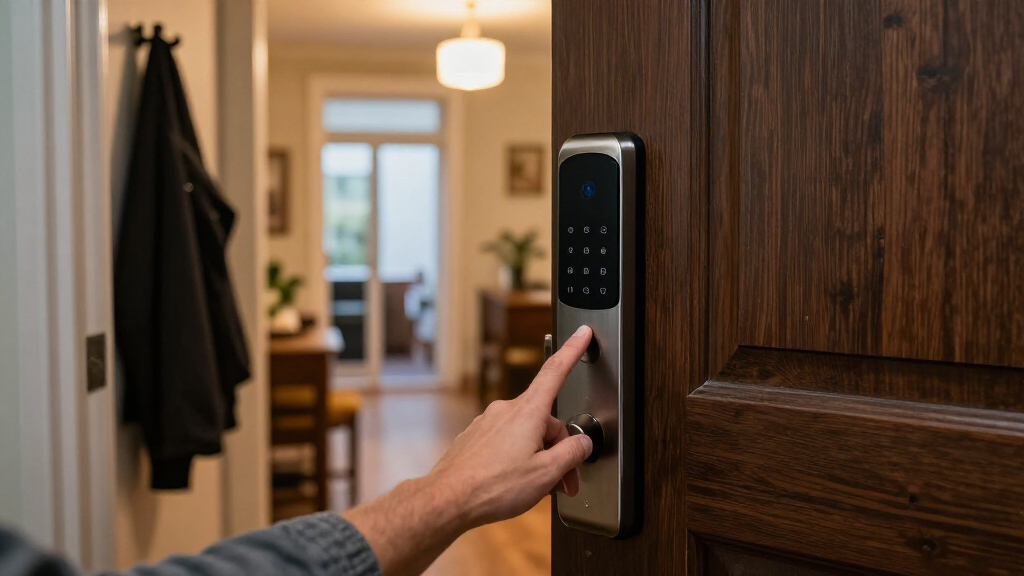
I ranked these smart locks with fingerprint readers by how well their format and access options answer common household needs. I gave priority to clear fingerprint entry paired with practical alternatives such as keypad codes, keys, or app access, where listed. I also weighed whether each product is a deadbolt, knob, or handle set, since those formats affect both compatibility and the scope of a replacement.
The FamiLock C32 ranks first because its fingerprint keypad and handle combination offers the widest fit for buyers seeking an all-in-one change. The other positions reflect narrower strengths: dedicated deadbolt formats, knob replacements, lever-handle sets, and app-oriented designs. I did not treat feature count as an automatic win; a more connected lock may be a poor match for someone seeking a simple local entry method, and a knob lock cannot stand in for a deadbolt where the door requires one. Buyers should verify door measurements and installation requirements against the manufacturer’s instructions before choosing.
Factors to Consider When Choosing Smart Locks With Fingerprint Readers
Before choosing among fingerprint locks, I’d start with the door and household routine rather than the app feature list. These broader checks can prevent a promising lock from becoming the wrong hardware replacement or a poor fit for how people actually enter.
Match the lock format to the door
A knob, lever set, and deadbolt are different pieces of door hardware, even when each offers fingerprint entry. Check what you are replacing and whether the product is intended to replace that specific hardware or work alongside it. A knob lock may add convenient entry, but it should not be assumed to replace a deadbolt’s role. Measure the door thickness, backset, and existing bore holes using the product’s installation requirements. A common mistake is choosing by finish or app features first and discovering later that the lock does not fit the door preparation. If the door needs a full handle set, a deadbolt-only model may leave you with extra hardware to buy or install.
Decide how you want to get in when a fingerprint fails
Fingerprint readers can be convenient, but no household should rely on a single entry method. Check which backup methods are actually included—such as a keypad, physical key, or app—and whether they work when the phone or network is unavailable. This matters for children, visitors, and anyone whose fingerprint may be hard for the reader to recognize consistently. Consider keeping a backup method accessible to a trusted household member rather than assuming every resident will use the reader the same way. A model with more entry options can reduce lockout risk, though each extra method can add setup or management. Choose backups that suit your routines, not simply the longest feature list.
Treat app access and connectivity as separate needs
“App control” can mean different things, so check what functions are supported and whether remote access depends on an added hub or other equipment. If you only want to unlock the door at the keypad, a connected lock may add setup without changing your routine. If you need to manage access while away, confirm the remote features, connectivity requirements, and any account or network dependencies before buying. Also consider who will manage app permissions when household members change. One frequent mistake is assuming that a lock with an app can be controlled remotely in every configuration. Pay for connected features when they solve a real access-management problem, not just because they appear on a product page.
Check how fingerprint access will work for everyone
Think about the people who will use the lock every day: adults, children, older relatives, and occasional guests may have different comfort levels with biometric entry. Look for clear information about how many fingerprints can be stored, how enrollment works, and how profiles can be removed when access changes. A keypad can make the lock more flexible for guests who should not enroll a fingerprint. If a household member’s fingerprints are difficult for readers to detect, a code or key backup may matter more than the reader’s advertised speed. Avoid assuming that one enrollment process will work equally well for every person. A lock is only convenient when its access methods fit the whole household.
Plan for power, maintenance, and lockouts
Battery-powered smart locks need periodic attention, so review the manufacturer’s battery guidance and low-power warnings before installation. Find out what backup access remains if the batteries run down and whether the lock gives enough warning to act. The placement of a physical keyway or emergency power method can matter as much as the fingerprint reader when a lock stops responding. Set a simple maintenance reminder rather than waiting for a warning to appear at a busy moment. If the lock will serve an entry used every day, reliable backup access should rank above novelty features. Buyers who prefer minimal upkeep may be better served by a simpler configuration with fewer connected functions to manage.
Pay for the features your door and routine need
A higher-feature lock makes sense when its hardware replaces more components, supports the entry methods your household uses, or provides access management you will actively use. It is harder to justify added complexity when all you need is local fingerprint and keypad entry. Compare included handles or levers, required accessories, and installation demands—not just the lock’s headline feature. Finish also matters when replacing visible door hardware, but it should not outweigh compatibility or backup access. A useful way to narrow the field is to write down your must-haves, then reject any model that misses one before comparing extras. This keeps a door-style preference from distracting from practical fit.
Frequently Asked Questions
Can I replace my deadbolt with a fingerprint knob lock?
Usually, a knob lock and a deadbolt are separate hardware types, so one should not be treated as a direct substitute for the other. A fingerprint knob may replace an existing knob, but it may leave the deadbolt in place or require a different installation plan. Check your door’s current hardware and the product’s installation instructions before ordering. If you want fingerprint entry while keeping a separate deadbolt, confirm that both pieces can fit and operate together. For a one-for-one deadbolt replacement, shortlist deadbolt models such as the Veise KS02A or eufy C220 instead.
Is fingerprint access enough, or should I require a keypad too?
A keypad is useful when fingerprints are not recognized, when a guest needs temporary access, or when a household member does not want to enroll a fingerprint. It also gives you a backup route that does not depend on a phone app. A fingerprint-only approach may suit a small household with consistent users, but it leaves fewer alternatives if the reader has trouble. Check whether codes can be managed in the way you need, especially if access changes often. In this roundup, several models pair fingerprint entry with a keypad, making them more flexible for mixed households.
Do smart locks with fingerprint readers work without Wi-Fi?
Fingerprint recognition and local keypad entry may work without an internet connection, but remote app functions can depend on Wi-Fi, a hub, or other product-specific requirements. Do not assume that an app listing means you can lock or unlock the door from anywhere. Check the manufacturer’s instructions for which functions remain available offline and what equipment remote control requires. If your priority is reliable entry during network outages, focus on local methods such as fingerprints, codes, or a physical key. If remote access is a must, confirm that the full setup supports it before buying.
What should I measure before ordering a fingerprint smart lock?
Start by identifying whether you are replacing a deadbolt, knob, or lever set, then compare your door’s measurements with the lock’s stated requirements. Common checks include door thickness, backset, hole placement, and the spacing or shape of existing hardware. A product with the right finish can still be incompatible if its mechanical dimensions do not match your door. Review the installation guide rather than relying on the product name or photos. If your door has unusual preparation or existing hardware you want to retain, confirm compatibility with the manufacturer before purchasing.
When is it worth choosing a connected model over a simpler fingerprint lock?
A connected model is more useful when you need to manage access from away from home, change permissions for other people, or use supported app features regularly. If you only want quick local entry, connectivity may add setup and maintenance without much benefit. Check whether remote functions require extra equipment and whether the lock still offers convenient access during an internet or power interruption. Also consider who will maintain the app and access list over time. I’d choose connectivity to solve a specific household need, not as a substitute for checking fit, backups, and everyday usability.
Conclusion
For the broadest all-in-one pick, I’d choose the eufy Security FamiLock C32; its fingerprint keypad and handle format make it the best overall fit in this lineup. For a buyer comparing simpler entry hardware, the Yamiry Smart Door Lock and GHome 4-in-1 knob are value-oriented options to investigate, provided their format matches the door. The eufy C220 is my premium-leaning choice for someone who specifically wants a fingerprint deadbolt, while the keypad-and-handle design of the C32 also makes it a more approachable starting point for buyers replacing several components at once. For a specific finish or hardware need, choose the Veise KS02A for an oil-rubbed bronze deadbolt or the KS02B for satin nickel lever handles. Before deciding, confirm door fit and backup entry methods; those details matter more than adding features you will not use.