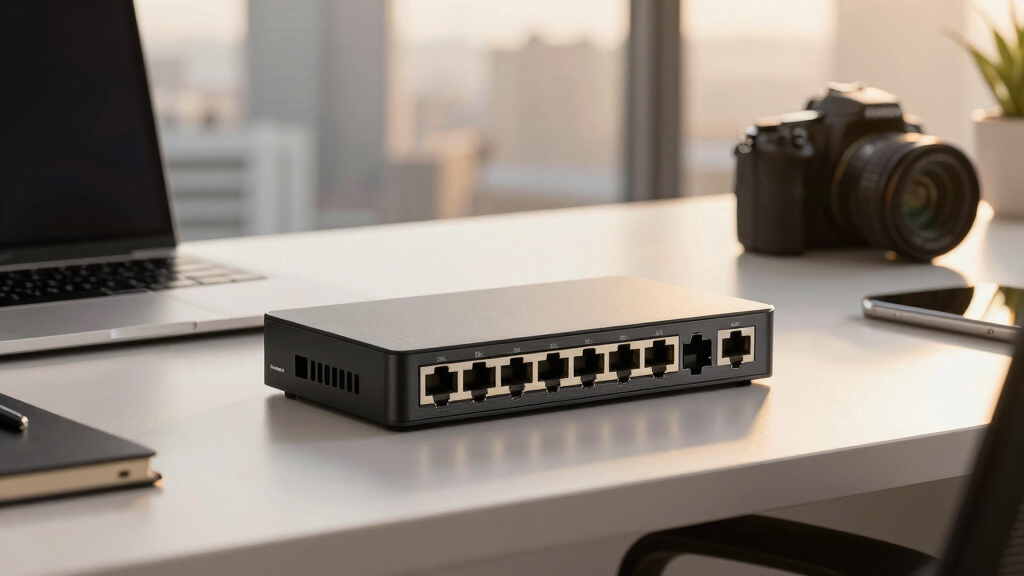

For professional networks requiring high power and reliability, PoE switches over $500 deliver advanced features and robust build quality. The Omada SG3428XPP-M2 stands out as the best overall, offering a balance of performance and manageability. The HPE Networking Instant On 1930 provides excellent smart management for mid-sized setups, while the Ubiquiti UniFi US-24-250W excels in scalability and integration. These switches face tradeoffs like higher costs versus extensive feature sets and ease of use. Keep reading for a detailed breakdown of options tailored to different needs in 2026.

Get privacy and security gear delivered free with Prime
- Fast, free delivery on millions of items
- Prime Video, Amazon Music and more included
- Member-only deals all year
Key Takeaways
- The top-ranking switches combine high port counts with advanced Layer 2+ or Layer 3 features, suitable for complex enterprise setups.
- Managed switches with cloud or app-based management are favored for remote administration, but they often come at a premium price.
- Power delivery varies significantly, with some switches supporting up to 30W per port, critical for powering high-demand devices.
- Build quality and cooling solutions are vital for long-term reliability, especially in rack-mounted configurations.
- Price differences among switches over $500 often reflect additional features like SFP+ ports, higher throughput, or enterprise-level security.


More Details on Our Top Picks
Omada SG3428XPP-M2, 24 Port 2.5GB L2+ Smart Managed PoE Switch
The Omada SG3428XPP-M2 stands out for its impressive 2.5Gbps ports, making it ideal for high-bandwidth environments. Unlike the NETGEAR GS752TP, which offers a higher port count but at gigabit speeds, this switch provides faster data transfer for demanding applications. Its extensive PoE+ and PoE++ support, combined with cloud management and advanced security features, makes it suitable for enterprise deployments. The main tradeoff is its complex setup process, which can be daunting without technical experience. Furthermore, some features are upcoming, requiring firmware updates. Compared to the HPE 1930, which is simpler to manage, the Omada offers more advanced security options. This switch makes the most sense for organizations needing robust, high-speed connectivity with centralized control.Pros:- High-speed 2.5Gbps ports support demanding data loads
- Supports extensive PoE+ and PoE++ power requirements
- Cloud management enables remote network oversight
- Advanced security features protect against threats
Cons:- Complex setup may require technical expertise
- No detailed pricing info available upfront
- Upcoming features might necessitate firmware updates
Best for: Large enterprises or data centers requiring high-speed, secure, managed PoE with centralized cloud control
Not ideal for: Small offices or users seeking straightforward plug-and-play solutions without extensive configuration
- Number of Ports:24
- Port Speed:2.5Gbps
- Uplink Ports:4 x 10 GE SFP+
- PoE+ Ports:16
- PoE++ Ports:8
- PoE Power Budget:500W
- Standards Supported:802.3at/af, 802.3bt/at/af
Our verdict“This pick is best suited for large, tech-savvy organizations needing high-performance, managed PoE switches with central control.”
HPE Networking Instant On 1930 24-Port Gb Smart-Managed Layer 2+ Ethernet Switch with PoE
The HPE Instant On 1930 offers a straightforward management experience with 24 PoE ports and 4 SFP+ uplinks, making it ideal for SMBs. While NETGEAR GS752TP provides more advanced security options, the HPE excels in simplicity, thanks to its intuitive mobile app and web interface. Its 195W PoE budget is sufficient for typical small business needs, but may fall short for larger deployments. The lack of detailed performance metrics can be a drawback for users seeking granular control. Compared to the Ubiquiti US-24-250W, which supports higher throughput, the HPE prioritizes ease of use over raw speed. This switch is best for SMBs needing reliable, manageable PoE networks without complex configuration.Pros:- Simple setup via mobile app or web interface
- Supports PoE on all 24 ports with decent power budget
- Flexible installation options with rack or desktop mount
- Includes industry-leading lifetime warranty
Cons:- Limited advanced configuration options
- No specific performance benchmarks provided
- Higher cost for small-scale deployments
Best for: Small to medium-sized businesses seeking easy-to-manage, reliable PoE switches with minimal fuss
Not ideal for: Large networks or enterprises requiring high-speed performance and advanced security features
- Ports:28 active (24 Gb + 4 SFP+)
- Gigabit Ports:24
- SFP+ Ports:4
- PoE Power Budget:195W
- Form Factor:Rack-mountable or desktop
Our verdict“Ideal for SMBs wanting an easy-to-manage PoE switch with decent capacity and straightforward setup.”
NETGEAR 52-Port PoE Gigabit Ethernet Smart Managed Network Switch (GS752TP)
The NETGEAR GS752TP offers 48 PoE+ ports, making it a top choice for powering multiple IP cameras, VoIP phones, or access points simultaneously. Compared with the Ubiquiti US-24-250W, which supports higher throughput, the GS752TP emphasizes port density and power delivery. Its 380W PoE budget supports many devices, but its lack of detailed throughput specs can make performance predictions tricky. The inclusion of fiber SFP ports adds flexibility for network expansion, yet its management options are less advanced than the NETGEAR Insight system. This switch is best for users who prioritize device power and port count over raw speed or advanced Layer 3 features.Pros:- High port density with 48 PoE+ ports
- Includes fiber optic SFP ports for flexible connectivity
- Remote management with NETGEAR Insight
- Compact metal design for versatile deployment
Cons:- Lacks detailed throughput or latency data
- High power consumption with 380W budget
- Limited advanced layer management features
Best for: Network installers and security-focused environments needing dense PoE device support
Not ideal for: Large data centers or users demanding high throughput and complex routing capabilities
- Number of Ethernet ports:48
- PoE+ ports:48
- PoE power budget:380W
- SFP ports:4
- Management:SNMP, NETGEAR Insight
- Mounting options:Desktop or rack-mount
Our verdict“Best suited for environments with many PoE-powered devices where device density and power are priorities over raw throughput.”
Ubiquiti UniFi Switch US-24-250W 24-Port Managed PoE+ Gigabit Switch with SFP
The Ubiquiti UniFi US-24-250W offers a non-blocking throughput of 26 Gbps, supporting high data loads across 24 PoE+ ports. Its Layer-2 management and SFP uplinks make it a flexible choice for expanding networks. Compared to the NETGEAR GS348TPv2, which emphasizes high port count, the Ubiquiti focuses on throughput efficiency and scalability. Its support for passive PoE also adds versatility for powering a variety of devices. The main tradeoff is its complexity; beginners may find the Ubiquiti interface less intuitive. Its 250W power budget may be limiting for larger, power-hungry deployments. This switch makes the most sense for network administrators looking for high throughput and future-proofing in a manageable, scalable package.Pros:- High non-blocking throughput of 26 Gbps supports demanding traffic
- Supports PoE+ and passive PoE for power flexibility
- Includes SFP ports for high-capacity uplinks
- Advanced Layer-2 features and layer-3 routing capabilities
Cons:- Potential complexity for users unfamiliar with managed switches
- Limited to 24 ports, which may not suit very large networks
- Requires Ubiquiti’s ecosystem for full management features
Best for: Growing organizations needing high throughput, scalable PoE, and Layer-2 management
Not ideal for: Home users or small setups that prefer plug-and-play simplicity over advanced features
- Number of Ports:24
- Data Transfer Rate:26 Gbps
- Maximum Power:250W
- Compatible Devices:Desktop
- Interface:PoE, RJ45
- Switch Type:managed
Our verdict“Ideal for network professionals seeking a high-throughput, scalable PoE switch for expanding enterprise networks.”
NETGEAR 52-Port Gigabit Ethernet PoE Smart Managed Switch (GS348TPv2)
The NETGEAR GS348TPv2 offers a solid balance with 48 PoE+ ports and 4 SFP ports, making it suitable for high-speed, device-rich environments. While it’s similar to the NETGEAR GS752TP in port count, it operates at gigabit speeds, which may limit performance for very data-intensive tasks. Its 380W PoE budget supports multiple devices, but management features are more basic, focusing on SNMP rather than advanced Layer 3 routing. The design is compact and durable, fitting well in varied deployment scenarios. Compared with the HPE 1930, it offers more flexibility in management options, but less simplicity. This switch is best for organizations requiring a reliable, high-density PoE platform with straightforward management.Pros:- 48 PoE+ ports support many devices simultaneously
- Includes fiber SFP ports for network expansion
- Versatile mounting options for different environments
- Good balance of capacity and manageability
Cons:- Lacks advanced management beyond SNMP
- Potentially high power consumption
- No detailed throughput or latency specifications
Best for: Businesses needing a high-density, managed PoE switch with a focus on network expansion and device support
Not ideal for: Large-scale data centers or users requiring advanced routing and security features
- Number of Ethernet ports:48
- Ethernet speed:1.0Gbps
- PoE+ ports:48
- PoE power budget:380W
- SFP ports:4
- Mounting options:Desktop or rack-mount
Our verdict“Best suited for organizations needing a high-capacity, manageable PoE switch with flexible deployment options.”
NETGEAR 28-Port PoE Gigabit Ethernet Smart Switch (GS728TPP)
The NETGEAR GS728TPP stands out for its combination of high PoE+ capacity and fiber connectivity, making it ideal for complex enterprise environments that need flexible expansion. Compared to the Omada SG3452XP, it offers a simpler yet reliable management interface via NETGEAR Insight, though it lacks advanced Layer 3 features. Its 24 PoE+ ports with a 380W budget support a variety of devices, and the fiber SFP ports provide scalability that many competitors can’t match at this price point. Its fanless design ensures silent operation, which is crucial for office or retail settings. However, its management capabilities require some network experience, and it is limited to North American deployment. This switch makes the most sense for organizations seeking a robust, managed switch with fiber options and straightforward remote management.
Pros:- Supports 24 PoE+ ports with a high power budget for multiple devices
- Includes 4 SFP ports for fiber connectivity, enabling network expansion
- Remote management via NETGEAR Insight simplifies control
- Fanless design ensures silent operation
Cons:- Limited to use in U.S. & CA regions, reducing global flexibility
- Requires some network expertise for optimal setup and management
- No advanced Layer 2/3 features for routing or complex configurations
Best for: Small to medium-sized enterprise networks needing flexible PoE and fiber support with remote management.
Not ideal for: Home offices or small setups that don’t require fiber connectivity or advanced management features.
Our verdict“This is the best choice for managed networks that need fiber integration and remote management without advanced routing.”
Hewlett Packard Enterprise Networking Instant On Switch Series 1930 48-Port Gb Smart-Managed Layer 2+ Ethernet Switch with PoE
The HPE 1930 series offers a solid 48-port Layer 2+ switch tailored for SMBs that need reliable PoE coverage and straightforward management. Compared with the TP-Link TL-SG3452P, it provides a web-based GUI and mobile app for easier control, making it more accessible for less technical users. Its 520W power budget supports IP phones, cameras, and other PoE devices efficiently, while the metal chassis enhances durability. However, its limited to 120V power and lack of detailed advanced features may restrict its use in some regions or more complex network environments. It also lacks detailed management features that enterprise-grade switches might offer. This switch suits small to medium businesses seeking simple, reliable Layer 2+ PoE management with robust build quality.
Pros:- Supports 48 PoE devices with a 520W power budget
- Includes security controls and management via mobile app and web GUI
- Durable metal case enhances longevity
- Multiple SFP ports for fiber uplinks
Cons:- Limited to 120V power, may need adapters elsewhere
- No advanced Layer 3 routing features
- Less detailed management features compared to higher-end switches
Best for: SMBs requiring a managed PoE switch with good port density and straightforward controls.
Not ideal for: Large enterprise environments needing Layer 3 routing or advanced network features.
Our verdict“Ideal for SMBs seeking an easy-to-manage, reliable PoE switch with fiber uplink options.”
Omada SG3452XP 48-Port Gigabit L2+ Managed PoE Switch
The Omada SG3452XP excels with its 10G uplinks and high PoE power budget, making it a prime choice for networks demanding fast data transfer and centralized control. Compared to the TP-Link TL-SG3452P, it offers 4 SFP+ ports supporting 10G speeds, which significantly reduces bottlenecks in busy setups. Its cloud management allows for easy remote network control, suited for growing organizations. However, the setup complexity and higher price point may deter smaller or less technical users, and limited details on cloud subscription plans could cause uncertainty. This switch is best for tech-savvy teams needing high bandwidth and centralized cloud management for larger or bandwidth-hungry networks.
Pros:- Supports 10G SFP+ uplinks for fast data transfer
- High PoE power budget of 500W supports multiple devices
- Cloud management for remote control
- Advanced security features
Cons:- Setup can be complex for non-technical users
- Higher cost due to advanced features
- Limited clarity on cloud service plans
Best for: IT teams managing high-traffic, scalable networks requiring 10G uplinks and cloud control.
Not ideal for: Small offices or users with limited technical experience seeking plug-and-play simplicity.
Our verdict“Best suited for organizations needing high bandwidth uplinks and centralized cloud management for large, demanding networks.”
TP-Link TL-SG3452P 48-Port Gigabit L2+ Managed PoE Switch
The TP-Link TL-SG3452P offers a robust 48-port PoE+ solution with up to 30W per port and a 384W total budget, ideal for deploying extensive device networks. Its support for Omada SDN enables centralized control, making it appealing for larger deployments that require uniform policy enforcement. Compared with the HPE 1930, it provides more management options, including CLI, SNMP, and RMON, which give greater control for experienced administrators. Its 5-year warranty adds peace of mind, but the need for SDN-compatible devices to unlock full SDN benefits and the complex setup can be challenging for beginners. This switch suits larger networks where centralized management and security are priorities.
Pros:- Supports 48 PoE+ ports with 384W power budget
- Supports centralized management via Omada SDN
- Advanced security features for network protection
- Multiple management options including CLI and SNMP
Cons:- Requires SDN-compatible devices for full SDN features
- Setup may be complex for less experienced users
- No specific pricing or user reviews available
Best for: Medium to large businesses seeking centralized control with extensive PoE device support.
Not ideal for: Home or small office environments without dedicated IT staff or SDN infrastructure.
Our verdict“Ideal for larger organizations that need centralized, secure PoE management across many devices.”
NETGEAR 48-Port PoE Gigabit Ethernet Unmanaged Network Switch (GS348PP)
The NETGEAR GS348PP provides a straightforward, plug-and-play 48-port solution with PoE+ support, making it suitable for environments where ease of use outweighs advanced management. Compared with the HPE 1930, it lacks management features, which limits customization but simplifies deployment. Its 380W power budget supports multiple PoE devices, and the fanless, energy-efficient design ensures quiet operation—ideal for office environments. The main tradeoff is that it offers no remote management or security controls, which may be a concern for more security-sensitive setups. This switch is best for small to medium offices that need reliable connectivity without complex configuration.
Pros:- High port density with 48 ports for extensive connectivity
- PoE+ support with a 380W budget
- Fanless, silent operation suitable for quiet settings
- Plug-and-play setup for quick deployment
Cons:- No management features for network customization
- Limited to unmanaged, basic configuration
- No remote management or security controls
Best for: Small to medium-sized environments requiring simple, reliable connectivity with PoE support.
Not ideal for: Networks requiring advanced management, security features, or remote control capabilities.
Our verdict“Best for environments needing simple, reliable PoE connectivity without the complexity of management features.”
Ubiquiti USW-Pro Max 48 PoE Layer 3 Switch
The Ubiquiti USW-Pro Max 48 stands out for its high port density and advanced Layer 3 features, making it ideal for large, complex networks. Unlike the Omada SG3428XPP-M2, which focuses on Layer 2 management, this switch supports routing functions, providing greater flexibility in network segmentation. Its 48 ports, including 2.5 GbE and 10G SFP+ options, enable high-speed connections and future-proofing for bandwidth demands. The PoE++ capability allows powering multiple high-power devices simultaneously, a step beyond typical PoE+ switches. However, its setup can be complex, especially for those unfamiliar with Ubiquiti’s UniFi ecosystem, and the absence of clear pricing information may complicate budgeting. The switch’s plastic case might also be a concern for those prioritizing durability in rugged environments.
Pros:- High port density with 48 ports including 2.5 GbE and 10G SFP+ options
- Supports PoE++ for high-power device connectivity
- Layer 3 management with routing capabilities
Cons:- Complex setup process requiring technical expertise
- Limited aesthetic appeal due to plastic case
Best for: Large enterprise IT departments or data centers needing extensive PoE coverage with Layer 3 routing support.
Not ideal for: Small office setups or residential users who don’t require advanced routing or high port counts, as the complexity and cost are unnecessary.
- Number of Ports:48
- Compatible Devices:Desktop, Gaming console, Router, Printer, Laptop, Camera
- Voltage:120 volts
- Maximum Power:100 watts
- Data Transfer Rate:48 gigabits_per_second
- Interface:RJ45
- Switch Type:Layer 3 Managed
- Dimensions:15.7″ L x 17.4″ W x 1.7″ H
- Item Weight:13.7 pounds
Our verdict“This switch is best suited for organizations that need extensive, high-speed PoE connectivity combined with advanced routing features, despite its setup complexity.”

How We Picked
Our evaluation focused on performance, scalability, manageability, build quality, and future-proofing. We prioritized switches that offer a solid balance of high port density, PoE power capacity, and ease of remote management. Cost was a secondary factor, with a preference for features that justify the premium price. We also considered user feedback and industry reputation to ensure these switches meet enterprise standards. The ranking reflects a mix of top-tier features and value for different professional networking needs.Factors to Consider When Choosing Best PoE Switches Over $500
Choosing the best PoE switch over $500 involves understanding several key factors that impact performance, scalability, and management. While higher-priced switches typically offer more robust features, not every feature is necessary for all setups. It’s important to match a switch’s capabilities with your network’s current and future needs to avoid overpaying or underperforming.Port Count and Power Budget
High port counts allow for more devices to connect without additional switches, reducing complexity. Pay attention to the power budget per port, especially if you plan to power high-demand devices like PTZ cameras or wireless access points. Some switches support up to 30W per port, which is essential for future-proofing and avoiding additional power injectors.
Layer 2+ and Layer 3 Features
Switches with Layer 2+ or Layer 3 capabilities enable advanced routing, VLAN segmentation, and network security. These features improve performance and security in enterprise environments. For most over-$500 options, a balance of managed Layer 2+ features with some Layer 3 functions provides flexibility without complexity.
Management and Remote Access
Managed switches with cloud or app-based management tools simplify configuration and monitoring, especially for remote or distributed networks. Consider whether you need SNMP, CLI access, or integrations with network management systems. While managed switches cost more, they reduce operational overhead and troubleshooting time.
Build Quality and Reliability
Since these switches are costly, investing in units with solid construction, good cooling, and reliable hardware is wise. Rack-mount designs with robust chassis and efficient fans tend to last longer in demanding environments. Cheaper, less durable models may save money upfront but can lead to higher maintenance costs.
Future-Proofing and Scalability
Look for switches supporting higher speeds like 10GbE SFP+ ports or stacking options. These features make it easier to expand your network without replacing core hardware. A switch with ample uplink options ensures your network can grow seamlessly as demands increase.
Frequently Asked Questions
Is it worth paying over $500 for a PoE switch?
Paying over $500 typically grants access to enterprise-grade features, higher power budgets, and better build quality. If your network demands high reliability, scalability, or advanced management, this investment can be justified. For smaller or less complex setups, a less expensive managed switch might suffice, but in demanding environments, the extra cost often translates into longer lifespan and lower operational issues.
What should I prioritize: port count or PoE power capacity?
Both are important but depend on your needs. If you have many devices to connect, prioritize port count; if powering high-demand devices like PTZ cameras or Wi-Fi 6 access points, focus on the power budget. Ideally, choose a switch that balances both, ensuring you can connect all devices while providing sufficient power without additional equipment.
Are managed switches over $500 worth the extra cost?
Managed switches over this price point typically offer better control, security, and remote management options, which are essential in enterprise environments. If you operate a large or distributed network, these features improve uptime and troubleshooting. For small networks or simple setups, unmanaged switches might still be adequate, but for long-term scalability, managed options deliver significant value.
How important is build quality in high-end PoE switches?
Build quality affects longevity, reliability, and heat dissipation. In high-performance switches, a durable chassis and efficient cooling are vital for continuous operation in rack-mounted environments. Cheaper plastics or poor cooling can lead to premature failure, especially under heavy loads. Investing in well-built hardware reduces maintenance and replacement costs over time.
Should I consider future-proofing features like 10GbE uplinks?
Yes, future-proofing features such as 10GbE uplinks or stacking capabilities allow your network to scale smoothly as bandwidth needs grow. While these features increase upfront costs, they prevent the need for early upgrades, saving money and reducing disruption. If you expect your network to expand or handle high data loads, prioritizing switches with these options makes sense.
Conclusion
For most enterprise networks, the Omada SG3428XPP-M2 offers a balanced mix of performance, manageability, and future-proofing, making it the best overall choice. The HPE Networking Instant On 1930 is ideal for mid-sized setups valuing smart management at a slightly lower cost. Budget-conscious buyers or smaller deployments may find the NETGEAR GS348TPv2 or NETGEAR GS348PP sufficient for their needs, despite being slightly below the top tier. For those seeking premium features like high port density and advanced Layer 3 capabilities, the Ubiquiti USW-Pro Max or Omada SG3452XP are excellent options. Ultimately, your choice should align with your network size, management preferences, and future growth plans.
Halloween Picks
halloween
As an affiliate, we earn on qualifying purchases.