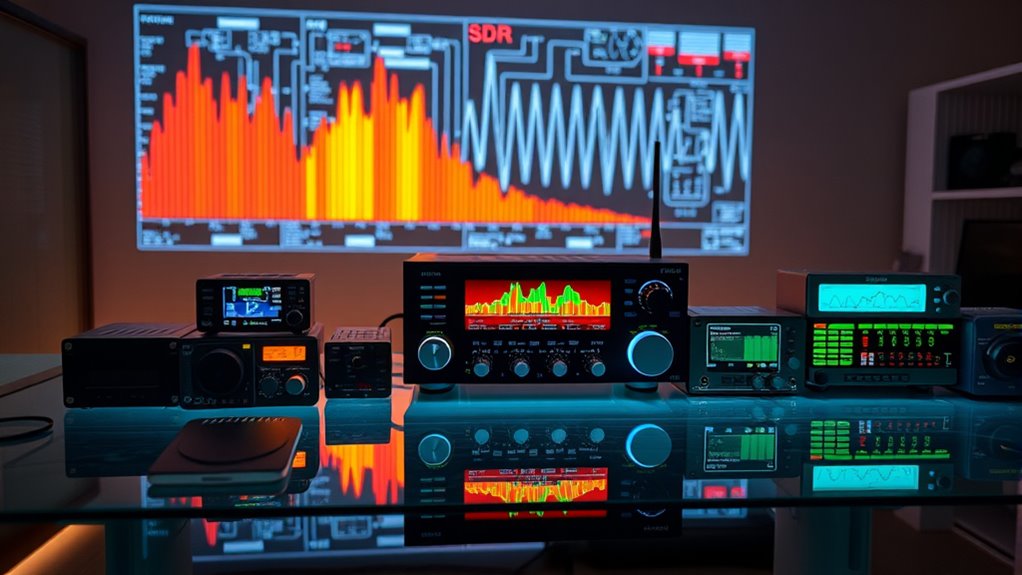

For anyone interested in radio experimentation or communications, softwaredefined radios (SDRs) open up a world of possibilities. The best SDRs offer wide tuning ranges, good sensitivity, and user-friendly interfaces, but they can vary greatly in complexity and price. The Nooelec NESDR SMArTee v2 stands out as the best overall, thanks to its reliable performance and versatile features. Meanwhile, the AURSINC SDR Radioberry provides excellent options for Raspberry Pi integrations, and the Portable SDR DSP Radio Receiver offers portability for on-the-go use. The main tradeoffs involve balancing performance, price, and ease of use, so keep reading for the full breakdown to find your perfect match.

Get privacy and security gear delivered free with Prime
- Fast, free delivery on millions of items
- Prime Video, Amazon Music and more included
- Member-only deals all year
Key Takeaways
- Wide frequency coverage and tunability remain key factors in differentiating top SDRs.
- Build quality and stability are critical, especially for prolonged or demanding use cases.
- Entry-level options often compromise on tuning range or sensitivity but excel in simplicity and affordability.
- Premium models offer extended features like better filters, higher sampling rates, and integrated transceivers.
- Portability and form factor are important considerations for on-the-move applications, but may limit some performance features.
| Nooelec NESDR SMArt HF Bundle: Software Defined Radio Set for HF/UHF/VHF (100kHz-1.7GHz) |  | Best Overall for HF Enthusiasts | Frequency Range: 100kHz-1.7GHz | Includes: Ham It Up v1.3 upconverter, RTL-SDR, antennas, balun, adapters | Manufacturer: NooElec | VIEW ON AMAZON | See Our Full Breakdown |
| Nooelec RTL-SDR v5 Bundle – NESDR Smart HF/VHF/UHF Software Defined Radio |  | Best Value for Versatile RF Monitoring | Frequency Range: 100kHz – 1.75GHz | Instantaneous Bandwidth: 3.2MHz | Includes: RTL-SDR, magnetic antenna base, 3 antennas | VIEW ON AMAZON | See Our Full Breakdown |
| NESDR SMArTee v2 Bundle – Premium RTL-SDR with Integrated Bias Tee, Aluminum Enclosure, 0.5PPM TCXO, SMA Input, Antenna Base & 3 Antennas |  | Best for Precise, Stable Reception | Frequency Range: 25MHz-1700MHz | Noise Floor: Ultra-low | TCXO: 0.5PPM | VIEW ON AMAZON | See Our Full Breakdown |
| Nooelec NESDR SMArt XTR HF Bundle: Software Defined Radio Set for 300Hz-2.3GHz |  | Best for Wide-Band HF and General RF Enthusiasts | Frequency Range: 300Hz-2.3GHz | Includes: Ham It Up Plus v2 upconverter, NESDR SMArt XTR, antennas, noise source | Connector Types: SMA, F-connector, Belling-Lee | VIEW ON AMAZON | See Our Full Breakdown |
| NooElec NESDR Nano 3 – Tiny RTL-SDR with Aluminum Enclosure, 0.5PPM TCXO, SMA & MCX Inputs |  | Best Compact SDR for Portability | Dimensions: 17mm x 8mm x 20mm | Weight: 15g | Enclosure: Aluminum | VIEW ON AMAZON | See Our Full Breakdown |
| NESDR SMArt v5 RTL-SDR Essentials Starter Kit |  | Best Overall Beginner Kit | Frequency Range: 100kHz-1700MHz | Included: RTL-SDR, 3 antennas, FM bandstop filter, 10 adapters & cables, carrying case | Manufacturer: Nooelec | VIEW ON AMAZON | See Our Full Breakdown |
| Nooelec NESDR Smart XTR v2 HF Bundle: 300Hz-2.3GHz SDR Set for LF/HF/UHF/VHF |  | Best for Wide-Band HF and VHF/UHF Coverage | Frequency Range: 300Hz-2.3GHz | Includes: RTL-SDR, Ham It Up Plus v2 Upconverter, antennas, accessories | Warranty: 2 years | VIEW ON AMAZON | See Our Full Breakdown |
| AURSINC SDR Radioberry HF SDR Transceiver Pi Hat for Raspberry Pi 4 |  | Best for Raspberry Pi-based HF Transceivers | Supported Spectrum: 0-30 MHz | Maximum Receiving Bandwidth: 384 kHz | Output Power: up to 10 dBm | VIEW ON AMAZON | See Our Full Breakdown |
| RTL-SDR V4 R828D Software Defined Radio Receiver with Multipurpose Antenna |  | Best Portable High-Performance Receiver | Size: 9.5*3*1 cm | Type: Signal Receiver | Model Number: SDR-V4 | VIEW ON AMAZON | See Our Full Breakdown |
| NooElec NESDR Smart XTR SDR – Premium RTL-SDR with Extended Tuning Range |  | Best Wide-Range SDR with Stability | Frequency Range: approximately 65MHz-2300MHz | Extended Tuning Range: down to 100kHz with optional Ham It Up | Enclosure: Aluminum | VIEW ON AMAZON | See Our Full Breakdown |
| Nooelec RTL-SDR v5 SDR – NESDR Smart HF/VHF/UHF (100kHz-1.75GHz) Software Defined Radio |  | Best Overall for Versatility and Compatibility | Frequency Range: 100kHz to 1.75GHz | Instantaneous Bandwidth: up to 3.2MHz | Input: SMA | VIEW ON AMAZON | See Our Full Breakdown |
| RTL-SDR Blog V3 R860 RTL2832U 1PPM TCXO SMA Software Defined Radio Dongle |  | Best for High-Precision Stable Tuning | Model: V3 R860 | Tuner: R860 RTL2832U | Frequency Range: 500 kHz to 1.7 GHz | VIEW ON AMAZON | See Our Full Breakdown |
| Practical SDR: Getting Started with Software-Defined Radio |  | Best for Beginners and Conceptual Learning | VIEW ON AMAZON | See Our Full Breakdown | |||
| Portable SDR DSP Radio Receiver with 4.3″ Touchscreen, 100KHz-149MHz, Full Band Shortwave, FM MW SSB CW HAM, Spectrum Display, Aluminum Alloy Case, Rechargeable Battery |  | Best for Portable Use and Outdoor Enthusiasts | Frequency Range: 100KHz-149MHz | Display: 4.3-inch IPS LCD touchscreen | Spectrum Resolution: 192kHz | VIEW ON AMAZON | See Our Full Breakdown |
| softwaredefined radios sdr | Frequency Range |
|---|---|
| Nooelec NESDR SMArt HF Bundle: | 100kHz-1.7GHz |
| Nooelec RTL-SDR v5 Bundle | 100kHz – 1.75GHz |
| NESDR SMArTee v2 Bundle | 25MHz-1700MHz |
| Nooelec NESDR SMArt XTR HF Bun | 300Hz-2.3GHz |
| NooElec NESDR Nano 3 | — |
| NESDR SMArt v5 RTL-SDR Essenti | 100kHz-1700MHz |
| Nooelec NESDR Smart XTR v2 HF | 300Hz-2.3GHz |
| AURSINC SDR Radioberry HF SDR | — |
| RTL-SDR V4 R828D Software Defi | — |
| NooElec NESDR Smart XTR SDR | approximately 65MHz-2300MHz |
| Nooelec RTL-SDR v5 SDR | 100kHz to 1.75GHz |
| RTL-SDR Blog V3 R860 RTL2832U | 500 kHz to 1.7 GHz |
| Practical SDR: Getting Started | — |
| Portable SDR DSP Radio Receive | 100KHz-149MHz |
More Details on Our Top Picks
Nooelec NESDR SMArt HF Bundle: Software Defined Radio Set for HF/UHF/VHF (100kHz-1.7GHz)
This bundle stands out for its broad frequency coverage from 100kHz to 1.7GHz, making it ideal for those interested in exploring HF bands without complex modifications. The included Ham It Up v1.3 upconverter significantly enhances HF reception, providing a clear advantage over simpler SDRs that rely solely on direct sampling. Compared with the Nooelec RTL-SDR v5 Bundle, this set offers a more comprehensive package for HF-focused users, though it requires some technical setup and familiarity with antenna configurations. Its full bundle of antennas and adapters makes it ready to operate right out of the box, but users must be comfortable with RF setup for optimal results. The 2-year warranty and 24/7 support add confidence for hobbyists and professionals alike. This option is perfect for those who want a reliable, all-in-one HF/UHF/VHF solution with room for customization, accepting a higher initial learning curve and setup effort.
Pros:- Wide frequency coverage from 100kHz to 1.7GHz
- Includes a high-quality upconverter for enhanced HF reception
- Comprehensive bundle with antennas, adapters, and support
Cons:- Requires technical knowledge for setup and operation
- Limited to users specifically interested in HF/UHF/VHF bands
Best for: Hobbyists and professionals who want a complete HF/UHF/VHF setup with reliable performance and are comfortable with some technical configuration.
Not ideal for: Beginners seeking a simple plug-and-play SDR, as this bundle demands RF knowledge and setup time.
- Frequency Range:100kHz-1.7GHz
- Includes:Ham It Up v1.3 upconverter, RTL-SDR, antennas, balun, adapters
- Manufacturer:NooElec
- Model Number:NooElec NESDR SMArt HF Bundle
- Item Weight:321 g
- UPC:616469146069
Our verdict“This bundle suits experienced hobbyists and professionals aiming for a versatile HF/UHF/VHF SDR with full accessories and performance confidence.”
Nooelec RTL-SDR v5 Bundle – NESDR Smart HF/VHF/UHF Software Defined Radio
The Nooelec RTL-SDR v5 Bundle offers a solid balance between performance and affordability, covering from 100kHz to 1.75GHz with multiple antennas and accessories that improve signal reception. Compared to the NESDR SMArTee v2, this model emphasizes durability with its aluminum enclosure and provides broader frequency coverage, though it may need additional antennas or upconverters for optimal HF performance. Its 2-year warranty and made-in-USA/Canada build quality ensure durability and reliability for hobbyists and semi-professional users. While setup can be complex, especially for newcomers, the included accessories help ease initial configuration. For those seeking a cost-effective, versatile SDR capable of handling a wide RF spectrum, this bundle offers significant value despite some setup complexity.
Pros:- Wide frequency coverage from 100kHz to 1.75GHz
- Includes multiple antennas and durable aluminum enclosure
- Improved signal-to-noise ratio over previous models
Cons:- Requires additional antennas or upconverters for full HF performance
- Setup can be complex for users unfamiliar with RF configurations
Best for: Hobbyists and semi-professional users seeking a durable, versatile SDR with wide frequency coverage at a reasonable price.
Not ideal for: Absolute beginners who prefer ready-to-use units without extensive antenna setup or additional accessories.
- Frequency Range:100kHz – 1.75GHz
- Instantaneous Bandwidth:3.2MHz
- Includes:RTL-SDR, magnetic antenna base, 3 antennas
- Enclosure:Aluminum
- Warranty:2 years
Our verdict“This SDR bundle offers excellent value for users comfortable with some setup effort, aiming for broad RF coverage and durability.”
NESDR SMArTee v2 Bundle – Premium RTL-SDR with Integrated Bias Tee, Aluminum Enclosure, 0.5PPM TCXO, SMA Input, Antenna Base & 3 Antennas
The NESDR SMArTee v2 Bundle is designed for users demanding high-precision and stable RF reception, thanks to its 0.5PPM TCXO oscillator and built-in bias tee for active antennas. Compared to the RTL-SDR v5 Bundle, this model emphasizes frequency stability and low noise, making it a top choice for monitoring and detailed signal analysis. While its frequency range stops at 1700MHz, this focus on stability benefits users working in sensitive RF environments. Its included accessories, like multiple antennas and an aluminum enclosure, support immediate setup. This SDR makes the most sense for those who need reliable, high-precision measurements, accepting the narrower frequency range and slightly higher price point.
Pros:- High-precision 0.5PPM TCXO for frequency stability
- Includes multiple antennas and durable aluminum enclosure
- Built-in bias tee for active antenna powering
Cons:- Limited frequency range up to 1700MHz
- Higher cost compared to basic SDRs
Best for: Hobbyists and professionals needing high frequency stability and low noise for precise RF work.
Not ideal for: Beginners or users requiring ultra-wide frequency coverage beyond 1700MHz, or those on a tight budget.
- Frequency Range:25MHz-1700MHz
- Noise Floor:Ultra-low
- TCXO:0.5PPM
- Enclosure:Aluminum
- Bias Tee:Always-on, 4.5V, 250mA
- Warranty:2 years
Our verdict“This SDR is well-suited for users who prioritize stability and precision over ultra-wide coverage, making it ideal for detailed RF analysis.”
Nooelec NESDR SMArt XTR HF Bundle: Software Defined Radio Set for 300Hz-2.3GHz
The Nooelec NESDR SMArt XTR HF Bundle extends the frequency range to 2.3GHz, including a Ham It Up Plus v2 upconverter for enhanced HF performance. Compared with the NESDR SMArTee v2, this set offers broader RF coverage, appealing to hobbyists wanting to explore from near-DC frequencies up into UHF. Its comprehensive kit includes antennas, adapters, and a noise source for RF testing, providing a flexible setup. However, the gap near 1.1GHz may limit some applications like ADS-B, and the complexity of setup can challenge beginners. Despite this, the upconverter and testing accessories make it a versatile choice for users who want maximum RF range with added testing capabilities.
Pros:- Wide frequency coverage from 300Hz to 2.3GHz
- Includes high-quality upconverter and testing accessories
- Versatile and expandable for advanced RF projects
Cons:- Limited availability for some frequencies like near 1.1GHz
- Setup complexity may deter less technical users
Best for: RF hobbyists and professionals seeking broad frequency coverage with testing features for experimental or detailed RF work.
Not ideal for: Beginners or users interested mainly in UHF/VHF because of the complexity and RF gaps near certain frequencies.
- Frequency Range:300Hz-2.3GHz
- Includes:Ham It Up Plus v2 upconverter, NESDR SMArt XTR, antennas, noise source
- Connector Types:SMA, F-connector, Belling-Lee
Our verdict“Ideal for advanced RF enthusiasts seeking expansive coverage and testing tools, though less suitable for newcomers or specific applications like ADS-B.”
NooElec NESDR Nano 3 – Tiny RTL-SDR with Aluminum Enclosure, 0.5PPM TCXO, SMA & MCX Inputs
The NooElec NESDR Nano 3 offers a remarkably small form factor without sacrificing high-precision timing, thanks to its 0.5PPM TCXO. Its tiny size—just 17mm x 8mm x 20mm—makes it perfect for portable setups or integration into embedded projects. Compared with larger models like the NESDR SMArTee v2, it focuses on mobility, though this limits the number of antennas you can connect simultaneously. Its aluminum enclosure helps with heat dissipation, and the SMA & MCX connectors provide flexible antenna options. While it’s ideal for space-constrained applications, it requires compatible software and may not be suitable for users needing extensive RF coverage or multiple simultaneous connections. It’s best for portable, low-profile RF monitoring where space is at a premium.
Pros:- Extremely compact and lightweight
- High-precision 0.5PPM TCXO for stable reception
- Versatile SMA & MCX antenna inputs
Cons:- Limited to a single USB port space and connection
- Requires compatible software and setup for operation
Best for: Field operators, portable radio experimenters, and embedded RF projects needing a compact, high-precision SDR.
Not ideal for: Users requiring multiple antenna connections or broad RF coverage, due to its limited size and input options.
- Dimensions:17mm x 8mm x 20mm
- Weight:15g
- Enclosure:Aluminum
- Crystal Oscillator:0.5PPM TCXO
- Input Connectors:SMA & MCX
Our verdict“This tiny SDR excels for portable RF applications where space is limited, with high accuracy but limited connection options.”
NESDR SMArt v5 RTL-SDR Essentials Starter Kit
This starter kit stands out for offering a comprehensive package that includes the highly regarded NESDR SMArt v5 RTL-SDR along with multiple antennas, a bandstop filter, and accessories, making it ideal for newcomers who want an all-in-one solution. Compared with more specialized or advanced options like the Nooelec NESDR Smart XTR v2, this kit provides everything needed to start exploring RF signals from 100kHz to 1700MHz, though it’s limited to that frequency range and requires some technical skill to operate effectively. The inclusion of software and hardware support makes it easier for beginners to get started, but the bundle’s availability may be limited due to its Amazon-exclusive packaging. Its broad frequency coverage and all-in-one approach make it a versatile choice for those just entering the SDR world, but experienced users seeking higher frequency ranges or more customization might find it restrictive.Pros:- All-in-one kit simplifies initial setup and exploration
- High-quality RTL-SDR with broad frequency range
- Includes multiple antennas and accessories for versatile use
- Support and software included for beginners
Cons:- Limited to RF signals from 100kHz to 1700MHz
- Requires some technical knowledge to operate effectively
- Availability may be restricted due to exclusive Amazon bundle
Best for: Beginners or hobbyists looking for a complete, ready-to-use SDR setup with wide frequency coverage within 1700MHz.
Not ideal for: Advanced users or professionals needing higher frequency ranges, extensive customization, or specialized antennas, since the kit is primarily designed for entry-level exploration.
- Frequency Range:100kHz-1700MHz
- Included:RTL-SDR, 3 antennas, FM bandstop filter, 10 adapters & cables, carrying case
- Manufacturer:Nooelec
- Warranty:2 years
Our verdict“A highly accessible starter kit perfect for newcomers seeking an all-inclusive SDR experience within its frequency range.”
Nooelec NESDR Smart XTR v2 HF Bundle: 300Hz-2.3GHz SDR Set for LF/HF/UHF/VHF
This bundle excels for users interested in HF bands and beyond, offering a broad frequency span from 300Hz to 2.3GHz, thanks to the included Ham It Up Plus v2 upconverter. Unlike the NESDR SMArt v5, which is more straightforward but limited to 1700MHz, the XTR v2 extends into lower HF frequencies, making it ideal for amateur radio operators focused on HF communications. Its inclusion of a high-quality upconverter enhances reception at lower frequencies, but it’s less suitable for applications like ADS-B, due to the frequency gap near 1.1GHz. The bundle’s comprehensive accessories and support make it appealing for enthusiasts willing to handle more complex setups but might be daunting for absolute beginners. Overall, it’s a flexible choice for those seeking extensive HF capabilities with moderate technical requirements.Pros:- Extensive frequency coverage from 300Hz to 2.3GHz
- Includes a high-quality upconverter for improved HF reception
- Comprehensive bundle with antennas and accessories
- Backed by a 2-year warranty and support
Cons:- Not recommended for ADS-B due to the frequency gap near 1.1GHz
- Requires technical knowledge for setup and operation
- More complex than basic SDR kits, potentially overwhelming for beginners
Best for: Amateur radio operators and hobbyists aiming for broad HF to UHF coverage with some technical experience.
Not ideal for: Beginners or users primarily interested in ADS-B or dedicated aircraft tracking, since the frequency gap near 1.1GHz limits that use case.
- Frequency Range:300Hz-2.3GHz
- Includes:RTL-SDR, Ham It Up Plus v2 Upconverter, antennas, accessories
- Warranty:2 years
- Manufacturer:Nooelec
Our verdict“Ideal for intermediate to advanced users seeking wide-band HF and VHF/UHF coverage with robust accessories.”
AURSINC SDR Radioberry HF SDR Transceiver Pi Hat for Raspberry Pi 4
The Radioberry stands out for enabling users to convert a Raspberry Pi 4 into a functioning HF transceiver covering 0-30 MHz, making it a compelling choice for DIY enthusiasts and those comfortable with technical setup. Compared to standalone SDR dongles like the RTL-SDR V4, the Radioberry provides transceiver capabilities, including output power up to 10 dBm, and supports multiple client software such as pihpsdr and SparkSDR. Its open-source firmware offers customization potential, but requires users to have a good grasp of SDR and Raspberry Pi configurations. The included heat dissipation fan and straightforward setup make it accessible for technically inclined hobbyists, yet it’s not suited for users seeking plug-and-play solutions or high-power transmissions.Pros:- Turns Raspberry Pi 4 into a full HF SDR transceiver
- Supports multiple SDR client software for flexibility
- Easy to set up with ready-to-use images
- Supports expansion with external power amplifiers
Cons:- Requires advanced technical knowledge to operate effectively
- Open-source firmware may need customization for advanced features
- Limited to users comfortable with configuring SDR hardware and software
Best for: Electronics enthusiasts and hobbyists interested in building a Raspberry Pi-based HF SDR transceiver with customization options.
Not ideal for: Beginners or those uncomfortable with Linux and SDR software setup, since operating the Radioberry demands technical skills and familiarity with SDR concepts.
- Supported Spectrum:0-30 MHz
- Maximum Receiving Bandwidth:384 kHz
- Output Power:up to 10 dBm
- Warranty:6 months
Our verdict“A powerful, DIY-focused HF SDR transceiver solution best suited for tech-savvy hobbyists with Raspberry Pi experience.”
RTL-SDR V4 R828D Software Defined Radio Receiver with Multipurpose Antenna
The SDR-V4 offers a compact design paired with the advanced R828D chip, providing a high-performance solution suitable for portable applications and signal processing projects. Unlike larger, more feature-rich SDRs such as the NooElec NESDR Smart XTR, the V4’s small size makes it ideal for field use or portable setups. Its included versatile antenna enhances reception, but limited information on software compatibility and a moderate review profile suggest it’s more suitable for DIYers with some experience rather than complete beginners. It’s a strong choice for those seeking a portable, capable receiver, though users should be prepared for some trial and error in setup.Pros:- High-performance R828D chip for quality reception
- Compact and portable size for field use
- Includes a versatile antenna for improved reception
- Compatible with multiple SDR software platforms
Cons:- Limited information on software compatibility details
- Customer reviews are limited, which may raise questions about reliability
- Moderate overall rating suggests some user experience variability
Best for: DIY enthusiasts and portable radio experimenters who need a compact, high-quality SDR receiver.
Not ideal for: Beginners or users seeking detailed software compatibility info or plug-and-play operation, due to limited documentation and moderate reviews.
- Size:9.5*3*1 cm
- Type:Signal Receiver
- Model Number:SDR-V4
- Manufacturer:zqingmaoyi
Our verdict“A portable SDR receiver ideal for hobbyists needing a compact, capable device for on-the-go signal processing.”
NooElec NESDR Smart XTR SDR – Premium RTL-SDR with Extended Tuning Range
The NESDR Smart XTR offers a substantial upgrade over basic SDRs, featuring a wide frequency span from approximately 65MHz to 2300MHz, thanks to its built-in TCXO and extended tuning capabilities. Its sleek aluminum enclosure enhances durability and reduces interference, making it suitable for serious radio hobbyists and professionals alike. Compared to the NESDR SMArt v5, the XTR provides a broader range and more stable signals, but it may require additional accessories like the Ham It Up for lower frequency coverage down to 100kHz. Its professional build quality and extended tuning range make it a versatile choice, though the complexity might challenge beginners without prior SDR experience.Pros:- Wide frequency coverage from approximately 65MHz to 2300MHz
- Low phase noise with 0.5PPM TCXO for signal stability
- Durable aluminum enclosure with professional design
- Supports multiple devices including Raspberry Pi
Cons:- May require additional accessories for full low-frequency coverage
- Complex setup for users unfamiliar with SDR configurations
- Higher price point compared to entry-level SDRs
Best for: Experienced radio enthusiasts and professionals seeking a stable, high-quality SDR with wide frequency coverage and durable construction.
Not ideal for: Absolute beginners or those primarily interested in simple, plug-and-play SDRs, as setup and understanding of additional accessories can be complex.
- Frequency Range:approximately 65MHz-2300MHz
- Extended Tuning Range:down to 100kHz with optional Ham It Up
- Enclosure:Aluminum
- TCXO:0.5PPM
- Warranty:2 years
Our verdict“A premium SDR choice for experienced users demanding wide frequency coverage and stable, high-quality signals.”
Nooelec RTL-SDR v5 SDR – NESDR Smart HF/VHF/UHF (100kHz-1.75GHz) Software Defined Radio
The Nooelec RTL-SDR v5 stands out for its broad frequency coverage from 100kHz to 1.75GHz, making it a versatile choice compared to the narrower range of the Portable SDR. Its improved signal-to-noise ratio enhances reception quality, especially for weak signals like weather satellites, while its compatibility across Windows, Mac OS, Linux, and Android broadens its usability. However, it requires additional antennas or upconverters for optimal HF reception, which adds to the setup complexity and cost. Compared with the more specialized Portable SDR, this model offers greater flexibility but at the expense of needing extra accessories and a slightly bulkier form factor. This pick makes the most sense for hobbyists and experimenters seeking a capable all-round SDR without breaking the bank.Pros:- Extensive frequency range from 100kHz to 1.75GHz for diverse applications
- Improved signal-to-noise ratio over earlier models enhances reception quality
- Compatible with Windows, Mac OS, Linux, and Android for broad usability
- Durable aluminum enclosure ensures robust protection
Cons:- Requires additional antennas or upconverters for optimal HF performance
- Some advanced features need extra accessories, increasing overall cost
Best for: Hobbyists and radio enthusiasts who want a flexible, multi-platform SDR capable of wide frequency reception.
Not ideal for: Beginner users who prefer a plug-and-play device with minimal setup, as this model needs additional antennas and configuration.
- Frequency Range:100kHz to 1.75GHz
- Instantaneous Bandwidth:up to 3.2MHz
- Input:SMA
- Enclosure:Aluminum
- Compatibility:Windows, Mac OS, Linux, Android
- Included:RTL-SDR v5 device
Our verdict“This SDR is ideal for experienced hobbyists seeking a versatile and compatible device with wide RF coverage.”
RTL-SDR Blog V3 R860 RTL2832U 1PPM TCXO SMA Software Defined Radio Dongle
The RTL-SDR Blog V3 R860 offers a notable upgrade with its 1 PPM TCXO oscillator, delivering exceptional frequency stability that surpasses the standard RTL-SDRs like the Nooelec v5 when precise tuning is critical. Its frequency range from 500 kHz to 1.7 GHz covers most amateur and commercial bands, but it cannot transmit signals, limiting its use to reception only—unlike transceiver options. The aluminum shielded case with passive cooling ensures stable operation, yet setup can be more involved due to driver and software installation. Compared to the Nooelec v5, this dongle emphasizes precision over broader frequency coverage, making it suitable for dedicated monitoring and decoding tasks. This device is best suited for users who require high stability and accuracy for radio experiments or spectrum analysis.Pros:- 1 PPM TCXO oscillator for highly stable frequency tuning
- Wide frequency coverage from 500 kHz to 1.7 GHz
- Robust aluminum shielded case with passive cooling for reliable operation
- Includes bias tee circuit for active antenna connections
Cons:- Limited to receive-only, with no transmission capabilities
- Requires driver installation and software setup, which can be complex
- Performance below 24 MHz may be limited in direct sampling mode
Best for: Radio hobbyists and engineers who need precise, stable reception for spectrum analysis or signal decoding.
Not ideal for: Casual users seeking an all-in-one SDR for general listening, since it lacks transmission capability and has a steeper setup process.
- Model:V3 R860
- Tuner:R860 RTL2832U
- Frequency Range:500 kHz to 1.7 GHz
- Bandwidth:up to 3.2 MHz
- Oscillator:1 PPM TCXO
- Connector:SMA
Our verdict“This dongle is best for users needing high-accuracy, stable reception for detailed spectrum work and decoding.”
Practical SDR: Getting Started with Software-Defined Radio
This book offers a straightforward introduction to SDR concepts, perfect for newcomers trying to grasp the fundamentals without diving into complex technical details like the Nooelec v5 or the precision-focused RTL-SDR Blog V3. It covers essential principles and practical applications, helping beginners understand how SDR works and what it can do. However, it doesn’t provide hardware or accessories, so readers will need to purchase a compatible SDR separately, such as the Portable SDR or Nooelec models. Compared with technical guides, this book simplifies concepts, making it accessible but less suitable for those seeking in-depth technical insights. It suits those starting their SDR journey who want a solid foundation before investing in hardware.Pros:- Clear, comprehensive overview of SDR concepts for beginners
- Practical explanations help demystify complex topics
- Ideal for those new to radio and SDR technology
Cons:- Lacks detailed technical depth for advanced users
- No included hardware or accessories, requiring additional purchases
Best for: Beginners and students interested in learning SDR fundamentals and practical applications without technical overwhelm.
Not ideal for: Experienced hobbyists or engineers seeking detailed technical analysis or hardware-specific guidance, as it offers limited depth.
Our verdict“This book is perfect for newcomers wanting an accessible, well-structured introduction to SDR fundamentals.”
Portable SDR DSP Radio Receiver with 4.3″ Touchscreen, 100KHz-149MHz, Full Band Shortwave, FM MW SSB CW HAM, Spectrum Display, Aluminum Alloy Case, Rechargeable Battery
The Portable SDR DSP Radio Receiver excels in outdoor settings thanks to its 4.3-inch touchscreen and rugged aluminum alloy case, making it a strong choice for field operation compared to stationary models like the Nooelec v5. Its spectrum display and waterfall visualization allow detailed signal analysis across the 100KHz to 149MHz range, covering most shortwave and amateur bands. While the resistive touchscreen may be less responsive than capacitive screens, its simplicity suits outdoor use better. Limitations include its narrow frequency range and unspecified battery life, which could impact extended field use. This device is perfect for amateur radio operators and outdoor enthusiasts who prioritize portability and real-time visual signal analysis in a rugged package.Pros:- High-resolution spectrum and waterfall display for detailed signal visualization
- Wide frequency coverage within 100KHz to 149MHz, suitable for shortwave and amateur bands
- Rugged aluminum alloy case ensures durability outdoors
- Easy-to-operate touchscreen interface for quick adjustments
Cons:- Resistive touchscreen may be less responsive than capacitive alternatives
- Limited frequency range restricts use for certain bands and transceiver applications
- Battery life details are not specified, which could affect long field operation
Best for: Amateur radio hobbyists and outdoor operators needing a portable, feature-rich SDR for on-the-go listening and analysis.
Not ideal for: Users wanting full spectrum coverage up to 2.3GHz or transceiver functionality, as it’s limited to 149MHz and reception only.
- Frequency Range:100KHz-149MHz
- Display:4.3-inch IPS LCD touchscreen
- Spectrum Resolution:192kHz
- Modes Supported:CW, AM, SSB, WFM, FM stereo
- Material:Aluminum alloy
- Dimensions:140x74x22mm
- Weight:315g
- Power:Rechargeable battery
Our verdict“This portable SDR is ideal for outdoor enthusiasts seeking a rugged, visual-focused receiver for amateur and shortwave listening.”

How We Picked
These SDRs were selected based on a combination of performance metrics, build quality, usability, and value for different user needs. We prioritized models that offer broad frequency ranges, stable reception, and user-friendly interfaces. Devices with flexible connectivity options and upgrade potential also ranked higher, as they better serve both hobbyists and professional users. Cost was considered relative to features, ensuring that the top picks provide a balanced mix of affordability and capability. The ranking reflects a focus on practical performance and versatility for a range of budgets and experience levels.Factors to Consider When Choosing Softwaredefined Radios Sdr
Choosing the right SDR involves weighing several factors beyond just specifications. Understanding your primary use case—whether it’s hobbyist experimentation, amateur radio, or professional development—will influence your ideal choice. Consider how much tuning range you need, how portable the device should be, and whether you value ease of use over advanced features. Also, think about compatibility with your existing hardware and software, as well as future upgrade options. This guide highlights key considerations to help you avoid common pitfalls and make an informed decision.Frequency Range and Tuning Capabilities
One of the most important factors is the SDR’s frequency coverage. Higher-end models often cover from a few kHz up to several GHz, enabling a wide variety of signals. Cheaper models might focus on just VHF/UHF or HF bands, limiting their versatility. Think about your primary interests—if you want to explore shortwave radio, ensure the device supports those frequencies. Remember, a broader range often means more complex hardware, which can impact cost and ease of use.
Ease of Use and Software Compatibility
Ease of setup and operation can make or break your experience. Many SDRs work with popular software like SDR# or GQRX, but some require specific drivers or custom configurations. Beginners should prioritize models with straightforward installation procedures and comprehensive documentation. Conversely, advanced users might prefer more customizable options with open-source firmware. Compatibility with your existing computer or Raspberry Pi setup is also worth considering to avoid extra hardware investments.
Build Quality and Portability
Durability and form factor are often overlooked but are essential for long-term use. Metal enclosures tend to be more robust than plastic ones, especially if you plan to transport your SDR frequently. Portable models, like handheld receivers or those with integrated batteries, enable on-the-go operation but might compromise some advanced features or sensitivity. Assess your typical use environment—stationary lab setups or fieldwork—to match the device’s robustness and size.
Performance and Sensitivity
Performance metrics such as sampling rate, selectivity, and noise floor directly affect signal clarity and the ability to pick up weak signals. Higher sampling rates allow for more detailed spectrum analysis, but they also demand better hardware and processing power. Sensitivity determines how well the SDR can detect faint signals; thus, investing in models with high-quality components, like low phase noise oscillators, can improve results. Balance these factors against your budget and technical skill for the best experience.
Upgradeability and Additional Features
Some SDRs come with modular components or firmware that can be upgraded, extending their lifespan and capabilities. Features like built-in filters, external antenna ports, or transceiver functionality are beneficial for specific applications like hobbyist radio or emergency communications. Be aware that more complex features often increase the learning curve and cost. Decide which features are essential for your projects and which you can do without, to avoid overpaying for capabilities you won’t use.
Frequently Asked Questions
Can I use an SDR for both listening and transmitting?
Most SDRs covered here are receive-only devices designed for listening to signals. Transmitting requires specialized hardware and compliance with regulatory standards to avoid interference. Some high-end transceivers with SDR technology can do both, but they tend to be significantly more expensive and complex. For most hobbyists, using an SDR solely for reception is safer and simpler, and many free software options can help you analyze signals without risking unintended transmissions.
What is the best SDR for a beginner on a tight budget?
For newcomers, affordability combined with usability is key. Models like the Nooelec NESDR Nano 3 or the RTL-SDR V3 offer solid performance at lower prices, with plenty of tutorials and community support. These options typically have limited tuning ranges compared to premium models but are sufficient for learning radio fundamentals. They also work well with free software, making them ideal starting points without a steep learning curve.
Are high-end SDRs worth paying extra for?
Higher-priced SDRs often provide better sensitivity, wider frequency coverage, and enhanced stability, which can be valuable for serious hobbyists or professionals. They tend to feature improved components like low phase noise oscillators and more sophisticated filtering, resulting in clearer signals and more accurate spectrum analysis. However, if your goals are basic listening or experimentation, mid-range models may offer better value. Evaluate your needs—if you plan to do detailed research or commercial work, investing in premium hardware makes sense.
How important is software support when choosing an SDR?
Software support is critical because it determines how easily you can operate and customize your SDR. Compatibility with popular, actively maintained programs like SDR# or GQRX can significantly reduce setup time and troubleshooting. Some SDRs come with proprietary software, which might limit flexibility but could offer better integration. Consider whether the software supports your platform (Windows, Mac, Linux, Raspberry Pi) and if it offers features you need, such as spectrum display or decoding capabilities.
What should I consider if I want an SDR for portable or field use?
Portability demands a compact, lightweight design with durable construction. Look for models with integrated batteries, or those that can operate directly off a USB power bank. Signal stability in portable setups can be affected by environmental factors, so choosing an SDR with good shielding and antenna connectivity options is essential. Also, consider ease of transport, whether it’s a handheld device or a small enclosure that can fit into a bag. Prioritize models with simple interfaces and minimal setup time for field use.
Conclusion
For general-purpose use and the best overall experience, the Nooelec NESDR SMArTee v2 makes the most sense, especially for hobbyists who want reliable performance without breaking the bank. Beginners or those on a tight budget will find the RTL-SDR V3 or Nooelec Nano 3 excellent starting points, thanks to their simplicity and community support. For advanced users seeking top-tier features, the AURSINC SDR Radioberry or premium models with extended frequency ranges are worth considering. Finally, portable options like the full-featured handheld receiver are perfect for fieldwork but come with some tradeoffs in complexity and cost. Tailor your choice to your specific needs, experience level, and budget to get the most out of your SDR experience.
As an affiliate, we earn on qualifying purchases.Fall Picks
fall essentials