

In the future, your next doctor could be an AI-powered system that diagnoses, personalizes treatments, and monitors your health through advanced data analysis and smart devices. AI-driven diagnostics and surgical tools are improving accuracy and safety, while telemedicine and wearables expand access to care. As technology evolves, trust in these tools grows, making healthcare faster, more affordable, and personalized. Stick around to discover how AI might become your trusted medical partner.
Listen free for 30 days with Audible
Thousands of audiobooks and originals — cancel anytime.
As an affiliate, we earn on qualifying purchases.
Key Takeaways
- AI-driven diagnostics and medical imaging enable faster, more accurate disease detection, potentially replacing traditional doctor-led assessments.
- Personalized treatment plans using genomics and digital twins allow AI to tailor therapies, enhancing patient outcomes.
- Remote monitoring and telemedicine powered by AI expand healthcare access, especially for underserved populations.
- Smart surgical tools and real-time tissue analysis supported by AI improve surgical safety and precision.
- AI chatbots and robotic health assistants are increasingly providing health education and support, functioning as virtual healthcare providers.
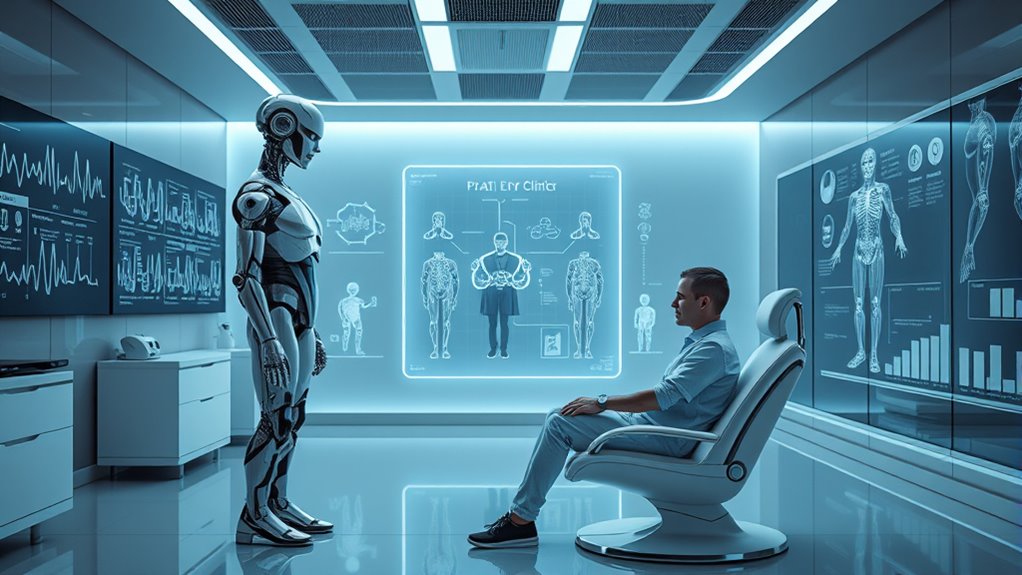
Are we on the cusp of a healthcare revolution driven by technology? It’s clear that AI and machine learning are transforming how you receive care, improve diagnoses, and manage your health. The global AI healthcare market is projected to skyrocket from around $11.8 billion in 2023 to over $102 billion by 2030, reflecting huge investments and rapid growth. Generative AI alone is expected to surpass $10 billion by 2030, powering advanced tools for clinical decision-making and research. These technologies promise to generate between $100 billion and $600 billion in healthcare savings by 2050, thanks to faster drug approvals, reduced hospital stays, and operational efficiencies.
AI is revolutionizing healthcare with rapid growth, cost savings, and personalized treatment options.
In practice, AI-driven diagnostics are becoming faster and more accurate, analyzing vast data sets to identify diseases early. Medical imaging AI models can triage or rule out conditions with high accuracy, helping you get quicker, more reliable results. Ambient listening devices are now standard, capturing clinical documentation seamlessly and freeing up clinicians’ time. This automation is expected to save billions annually by reducing administrative burdens. In the operating room, smart surgical instruments and augmented reality overlays are enhancing precision. AI systems analyze tissue during surgeries in real time, detecting anomalies and guiding surgeons with 3D visualizations, which reduces risks and improves outcomes. Smart surgical instruments are also capable of recording procedures internally and analyzing them with AI, leading to continuous improvements in surgical techniques. Additionally, integrating natural language processing can further streamline communication and documentation within healthcare settings.
Your care is becoming more personalized. AI maps your genome and digital twin models, enabling treatments tailored specifically to your biology. This technology supports personalized drug regimens, targeted therapies, and faster clinical trial matching. Telemedicine and remote monitoring are expanding access, especially for those in underserved areas or with mobility issues. Wearables and data integration allow continuous health tracking, giving your healthcare team real-time insights and enabling proactive care. Hospital-at-home models are developing, leveraging remote patient monitoring to deliver high-quality care outside traditional settings.
AI isn’t just improving diagnostics and personalization; it’s also revolutionizing pain management and brain health. Deep brain stimulation and sensor-enabled therapies are disrupting pain signals, while large language models and robots are providing health education and support in hospitals and homes. These advances, combined with shifting industry focus toward software, data analytics, and non-acute care, are reshaping the entire healthcare landscape. As these technologies become more integrated into your care, trust, transparency, and regulation will be key to ensuring safety and equity.
While the promise is enormous, challenges remain. Building trust, ensuring data quality, addressing biases, and charting regulatory landscapes are crucial steps. Still, with ongoing innovation and a focus on patient-centered solutions, your next doctor might very well be an AI—delivering faster, more precise, and more accessible care than ever before.

Kingston Ironkey Locker+ 50 128GB Encrypted USB Flash Drive | USB 3.2 Gen 1 | XTS-AES Protection | Multi-Password Security Options | Automatic Cloud Backup | Metal Casing | IKLP50/128GB
- Encryption Technology: XTS-AES encryption with attack protection
- Security Options: Multi-password admin and user access
- Cloud Backup: Automatic personal cloud backup
As an affiliate, we earn on qualifying purchases.
Frequently Asked Questions
How Will AI Handle Rare or Complex Medical Cases?
AI will handle rare or complex cases by analyzing vast amounts of medical data quickly and identifying patterns humans might miss. It can assist with diagnostics, suggest personalized treatment options, and flag unusual symptoms for further review. With continuous learning and integration of expert insights, AI enhances accuracy and decision-making. You’ll find AI tools increasingly reliable, helping you and your healthcare team navigate complex health issues more effectively and efficiently.
What Measures Ensure AI Decision Transparency and Explainability?
You should focus on transparency and explainability measures, especially since 86% of clinicians expect AI to reduce errors. Implementing interpretable models, such as decision trees or rule-based systems, helps clarify AI reasoning. Regular audits, clear documentation, and user-friendly interfaces also build trust. Engaging clinicians in development and validation ensures AI decisions are understandable, fostering confidence and enabling effective oversight, which is vital for safe, ethical healthcare deployment.
Who Is Liable for Ai-Driven Medical Errors?
Liability for AI-driven medical errors isn’t clear-cut yet. You, as a patient or clinician, need to recognize that responsibility may fall on healthcare providers, AI developers, or institutions depending on the situation. Regulations are still evolving, and accountability frameworks are being developed. It’s essential to have clear guidelines, informed consent, and thorough validation to ensure that when errors happen, liability is equitably assigned and patient safety is prioritized.
How Will AI Impact Healthcare Job Roles Long-Term?
AI will revolutionize healthcare jobs in ways you can’t even imagine, transforming every role into something unrecognizable. Expect some specialists to see their jobs drastically shift, with automation handling routine tasks and AI providing decision support. While new roles will emerge, many traditional jobs might shrink or evolve rapidly. You’ll need to adapt quickly, embracing continuous learning to stay relevant in this fast-changing landscape where human expertise becomes more strategic than ever.
What Safeguards Protect Patient Data in AI Healthcare Systems?
You’re protected through strict data privacy laws, like HIPAA, which require healthcare providers to safeguard patient information. AI systems also implement encryption, access controls, and anonymization techniques to prevent unauthorized access. Regular audits and monitoring ensure compliance, while clear data governance policies define how data is collected, used, and shared. These safeguards work together to maintain confidentiality, support trust, and minimize risks of data breaches in AI healthcare systems.

Integral 8GB Crypto-197 3-Pack 256-Bit Hardware Encrypted USB 3.0 Secure Flash Memory Drive - Certified to FIPS 197, Protection & Rugged Double-Layer Waterproof Design XTS-AES
As an affiliate, we earn on qualifying purchases.
Conclusion
As you step into this new era, think of AI as a loyal lighthouse guiding your healthcare journey through stormy seas. It won’t substitute the human captain but will illuminate the safest path forward, helping you navigate complex decisions with confidence. Embracing this technology means trusting a steadfast beacon that’s always there, shining brightly to guarantee your health stays on course. Together, you and AI can chart a future where care is smarter, safer, and more compassionate.

Integral 4GB Crypto-197 256-Bit 3.0 USB Flash Drive Encrypted - FIPS 197 Certified, Brute Force Password Attack Protection & Waterproof Double Layer Design
- Certification: FIPS 197 Certified for High Security
- Password Protection: Automatic Data Erasure After 6 Failed Attempts
- Waterproof Design: Dual-Layer Waterproof and Drop-Resistant
As an affiliate, we earn on qualifying purchases.

Kingston IronKey Vault Privacy 50 16GB Encrypted USB
- Encryption Standard: FIPS 197 with XTS-AES 256-bit
- Security Protection: Brute force and BadUSB attack protection
- Password Options: Multi-password and passphrase modes
As an affiliate, we earn on qualifying purchases.
Flea & tick season Picks
flea and tick prevention
As an affiliate, we earn on qualifying purchases.





![The Coolest Anti-surveillance Tools At Defcon [Video]](https://hacknjill.com/wp-content/uploads/2026/08/the-coolest-anti-surveillance-tools-at-defcon-video-featured-260x140.jpg)