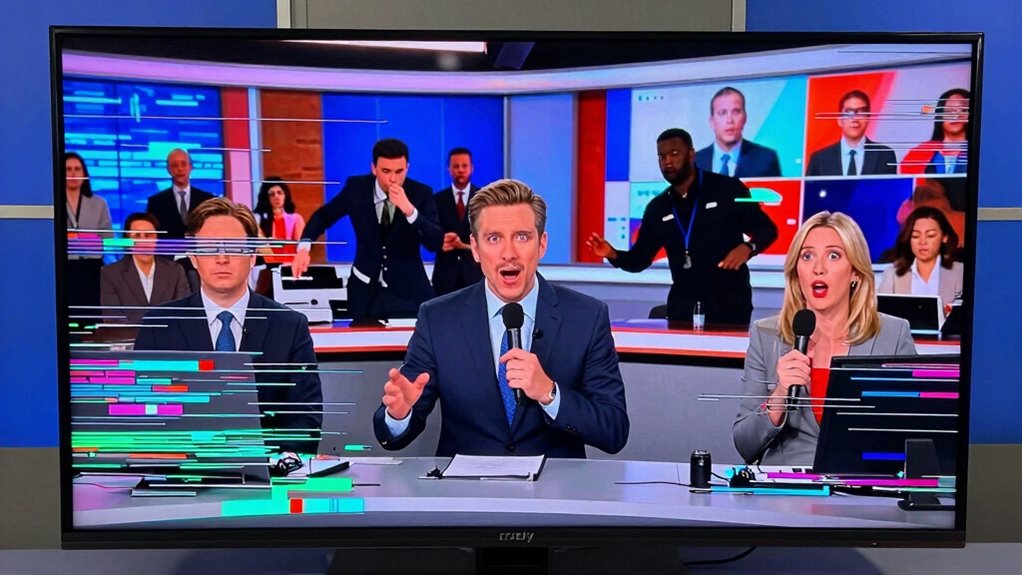

A breaking news hack is a shocking TV broadcast prank that hijacks signals to display unauthorized messages or disturbing images, catching viewers off guard. These incidents often expose weaknesses in broadcast security, using techniques like signal overpowering or exploiting alert systems. Famous examples include the Max Headroom incident and coordinated zombie alerts, which caused chaos and panic. If you keep exploring, you’ll discover how these hacks highlight vulnerabilities in broadcast systems and their lasting impacts.
Key Takeaways
- Breaking news hacks are unexpected broadcast interruptions that shock viewers and reveal vulnerabilities in broadcast systems.
- Notable incidents include the Max Headroom hijack and the 2013 zombie alert prank across multiple states.
- Hackers utilize signal overpowering, distortion, and exploitation of emergency alert systems to create startling disruptions.
- Investigations often trace hackers through technical fingerprints, leading to arrests and legal actions.
- These pranks expose broadcast security weaknesses and demonstrate how easily signals can be manipulated to cause chaos.
Breaking News Hack
In recent years, “Breaking News Hack” has become a term associated with shocking and sometimes alarming interruptions to television broadcasts, often revealing vulnerabilities in broadcast systems or showcasing creative pranks. You might have seen a seemingly normal program suddenly hijacked by a bizarre, distorted figure, or a warning message claiming a zombie outbreak, all designed to catch viewers off guard. These incidents often send shockwaves through the audience and expose weaknesses in how broadcasters protect their signals. Soviet Pirate Broadcasting, a common practice during the Cold War era, demonstrated how individuals could disrupt official channels, highlighting the ongoing risks of signal intrusion. One of the earliest and most famous examples is the Max Headroom incident. You’re watching your favorite program when suddenly, a masked figure appears on screen, swaying erratically with no clear audio. The technician team quickly regains control by changing the broadcast frequency, but the intrusion leaves a lasting impression. Later that night, another hijacking hits WTTW Channel 11 during a Doctor Who episode. The intruder talks randomly, his voice heavily distorted, ending with a bizarre scene of a flyswatter spanking. Despite investigations and threats of heavy fines, this hack remains unsolved, leaving many to wonder how such a breach could happen.
Another notorious case is the Captain Midnight HBO hack in 1986. You’re probably asleep when, suddenly, a message appears on your screen protesting HBO’s subscription fee. The hacker, John R. MacDougall, used a satellite transmitter with more power than HBO’s own signal to broadcast his message. The authorities traced the equipment fingerprint on a VHS recording, leading to his arrest. This unprecedented breach prompted new laws, including the 1986 Electronic Communications Privacy Act, to prevent similar incidents.
In 2013, multiple stations across New Mexico, Michigan, and Montana experienced a coordinated prank. Emergency alerts warned of a zombie outbreak, urging viewers to stay safe. The messages claimed bodies were rising from graves, creating chaos and panic. When the hacker’s identity was finally uncovered after the fourth intrusion, authorities arrested him, ending a nationwide scare that was entirely fabricated. These pranks exploited vulnerabilities in emergency alert systems, showing how easy it can be to manipulate broadcast signals.
Across history, broadcast hijacks have used different methods, from overpowering studio links to hijacking satellite signals, often leaving behind identifiable fingerprints in the technical data. Sometimes, pre-taped segments with distortion masked the intruders’ identities, making it challenging to catch them. The consequences for these hackers range from fines to jail time, with laws tightening to prevent future breaches. Despite the risks, these incidents highlight how fragile broadcast systems can be and how hackers continue to find ways to surprise and shock millions of viewers.
Frequently Asked Questions
How Did Hackers Access Emergency Alert Systems for the Zombie Prank?
You might have accessed the emergency alert systems for the zombie prank by exploiting vulnerabilities in their communication infrastructure. Hackers often gain entry through weak security protocols, such as unprotected networks or poorly secured servers. They use specialized equipment or software to override legitimate signals, sending false alerts. In some cases, they target vulnerable broadcast stations or emergency systems with known weaknesses, allowing them to broadcast the hoax message to multiple viewers simultaneously.
What Technical Equipment Was Used in the Max Headroom Incident?
Like a shadow lurking in the background, you’d need equipment like a signal generator and a transmitter to pull off the Max Headroom incident. Hackers used a personal video cassette recorder (VCR) to leave fingerprints, and they tapped into the station’s signal link (STL). This allowed them to overpower the broadcast with a pre-taped segment, masking their identity and taking control of the transmission.
Were Any of These Broadcast Hacks Politically Motivated?
No, these broadcast hacks weren’t politically motivated. Instead, they served different purposes: some aimed to shock or prank viewers, like the Max Headroom incident and zombie outbreak hoax, while others protested costs or used disruption for fame, like Captain Midnight. You see, most hackers sought attention or personal expression, not political change, though their actions still caused major legal and safety concerns.
How Have Broadcasters Improved Security After These Hijackings?
You’ve probably noticed broadcasters have stepped up security since those hijackings. They now implement encryption, stronger signal controls, and real-time monitoring to detect anomalies early. When the Max Headroom incident happened, it was a wake-up call that led to tighter controls. Similarly, broadcasters now regularly update their cybersecurity measures, train staff on security protocols, and collaborate with authorities, making it harder for hackers to hijack signals again.
What Legal Actions Were Taken Against the Perpetrators?
You should know that legal actions against perpetrators included hefty fines, jail time, and license suspensions. For instance, Captain Midnight’s hacker faced a $5,000 fine and a year’s probation, while the FCC could impose up to $100,000 in fines. Congress also passed laws like the 1986 Electronic Communications Privacy Act, making satellite signal hijacking a felony. Authorities actively pursued and arrested hackers, emphasizing strict enforcement.
Conclusion
So, next time you catch a sudden, shocking broadcast, remember it might just be a clever prank waiting to surprise you. Think of it as a magician’s trick—seemingly impossible, yet carefully planned. This hack proves that even the most serious news can turn into a playful illusion, reminding you to stay alert and question what you see. After all, in this world of tricks, not everything is as it seems—sometimes, it’s just a brilliant ruse.