
TL;DR
A paper posted to arXiv in September 2024 describes a method for malware on a compromised, air-gapped computer to encode data in radio signals generated by RAM activity. The authors report transmission rates of up to 1,000 bits per second under their evaluation; the paper is a security research report, not evidence of a known real-world incident.
Researchers describe a method for malware on a compromised air-gapped computer to send information through radio signals generated by activity in its memory buses, according to a paper posted to arXiv on September 3, 2024. The authors report a data rate of up to 1,000 bits per second in their evaluation, illustrating a potential way to bypass network isolation without a direct wired or wireless connection.

Get privacy and security gear delivered free with Prime
- Fast, free delivery on millions of items
- Prime Video, Amazon Music and more included
- Member-only deals all year
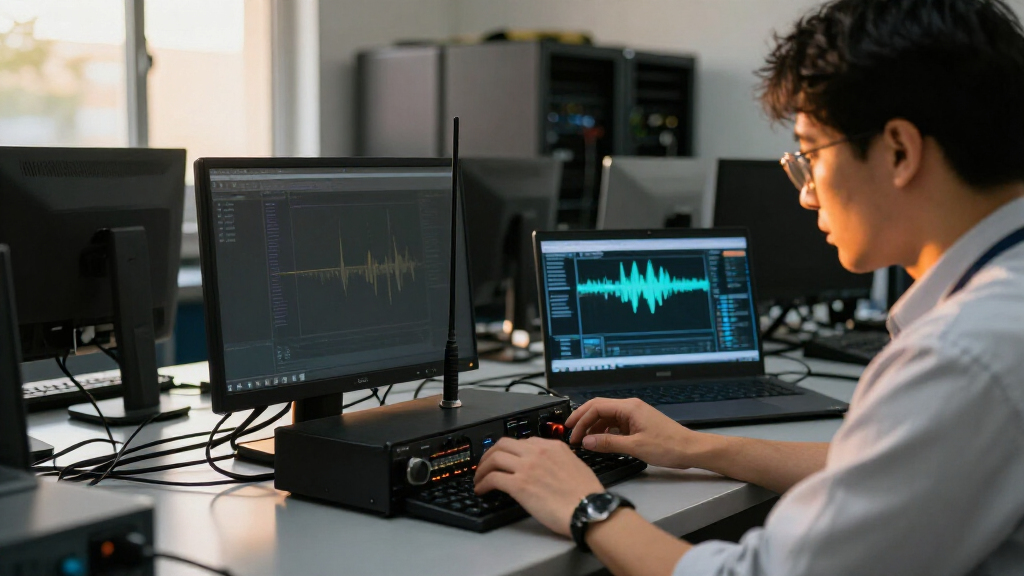
The paper says software on a compromised computer can manipulate RAM-related activity to generate radio signals that carry encoded information. The authors describe how an attacker with software-defined radio hardware and an ordinary antenna could receive the raw signals from a distance, then decode them into binary data. The proposed channel does not require the protected computer to connect to an external network.
The authors say the method could encode several types of sensitive information, including files, images, keystrokes, biometric information and encryption keys. Those examples describe the information the researchers say could be transmitted; they do not establish that data was stolen from a real air-gapped system.
The paper presents what it calls fast modification methods and gives a maximum reported rate of 1,000 bits per second. It also discusses implementation, related work, evaluation results and possible countermeasures. The listed version was submitted to arXiv in September 2024, and the paper’s comments say the work was accepted to the Nordic Conference on Secure IT Systems in 2023.
The Limits of Network Isolation
Air gaps are intended to reduce exposure by physically disconnecting computers from networks. The research highlights a different security concern: isolation from network traffic does not necessarily prevent every form of information from leaving a device. If malicious software is already present, hardware activity may provide an out-of-band communication channel that does not rely on the usual network interfaces.
That distinction matters for organizations handling sensitive information, including facilities that use air gaps as one layer of protection. The paper does not show that air gaps are ineffective or that this technique is being used in the wild. Instead, it describes a possible threat that defenders may need to weigh alongside physical access controls, malware prevention and monitoring for unusual emissions. The authors also propose countermeasures, though the supplied abstract does not specify their effectiveness or operational requirements.
Products Worth Considering

LG UltraGear 34-Inch Curved QHD Gaming Monitor, 160Hz, FreeSync Premium

Samsung Odyssey OLED G8 34-Inch Curved Ultra WQHD Gaming Monitor

EcoFlow DELTA 3 Portable Power Station, 1024Wh, 1800W
As an affiliate, we earn on qualifying purchases.
A 2023 Conference Paper
The paper is titled “Leaking Secrets from Air-Gap Computers by Spelling Radio Signals from RAM.” Its arXiv record identifies it as a cryptography and security paper and lists Mordechai Guri as the submitter. The first version was posted on September 3, 2024; the record’s comments state that the work was accepted to the Nordic Conference on Secure IT Systems in 2023.
Air-gapped systems are computers kept physically separate from external networks, including the internet. That separation is intended to prevent direct remote communication. The researchers’ approach concerns a different path: signals associated with the computer’s internal components. The paper’s central claim is that malware could shape those emissions to encode data and that receiving equipment could capture and decode them.
““malware on a compromised computer can generate radio signals from memory buses (RAM)””
— The paper’s authors, in the arXiv abstract
Practical Range and Risk
The supplied abstract does not give enough detail to determine the exact transmission distance, the conditions needed for the reported rate, or how performance changes across different hardware. It also does not provide a detailed account of the evaluation setup or the specific countermeasures and their measured results. Those questions require the full paper and its evaluation details.
The report describes a research method, not a documented incident. The available source does not establish that attackers have used it to extract information from operational air-gapped systems, nor does it quantify how often malware could gain the access needed to operate on such a computer. The practical risk depends on those factors as well as the receiving equipment and environment.
Reviewing Defenses and Conditions
The next step for readers assessing the claim is to consult the paper’s full implementation and evaluation results, including the conditions behind its reported data rate and the countermeasures it proposes. Security teams can use those details to judge whether the described emissions channel is relevant to their hardware and threat model, rather than treating the abstract’s maximum rate as a universal result.
The arXiv record identifies the work as accepted to a 2023 conference, but the supplied material does not describe a new deployment, incident or follow-up finding after the September 2024 posting. Any later claims about real-world use, wider hardware compatibility or defensive effectiveness would need separate evidence.
Key Questions
What does the paper say is being transmitted?
The researchers say malware can encode information in radio signals associated with RAM and memory-bus activity. They list files, images, keystrokes, biometric information and encryption keys as possible data.
Does this mean an air-gapped computer connects to the internet?
No. The described method is an out-of-band radio channel, not an internet or network connection. The paper says a receiver could capture emissions using software-defined radio equipment and an antenna.
Was data stolen from a real system?
The supplied source describes a research method and its evaluation. It does not report a real-world theft or establish that the technique has been used against an operational air-gapped computer.
How fast is the reported channel?
The authors report a rate of up to 1,000 bits per second. The abstract alone does not specify the full test conditions, range or how consistently that rate can be achieved across systems.
Source: arxiv.org