

In AI vs. AI cybersecurity battles, autonomous systems detect and neutralize threats at machine speed, creating self-healing digital ecosystems that react almost instantly. Defensive AI monitors entire networks, learns from interactions, and responds automatically to emerging threats, making it much harder for cybercriminals to succeed. As attacks grow more sophisticated with self-mutating techniques, understanding how AI-driven defenses stay ahead becomes essential—continue exploring to discover the full picture of this high-stakes digital fight.
Key Takeaways
- Defensive AI systems autonomously detect, analyze, and neutralize cyber threats in real time, often faster than human response.
- Adversarial AI employs machine learning to craft sophisticated, self-mutating attacks that challenge automated defenses.
- AI-driven threat modeling predicts and preemptively blocks attack vectors based on global intelligence and behavioral analysis.
- The ongoing AI vs. AI cyber battle enhances overall cybersecurity by continuously evolving and adapting to new threats.
- Human oversight integrates into self-healing digital ecosystems, ensuring strategic control within autonomous AI defense systems.
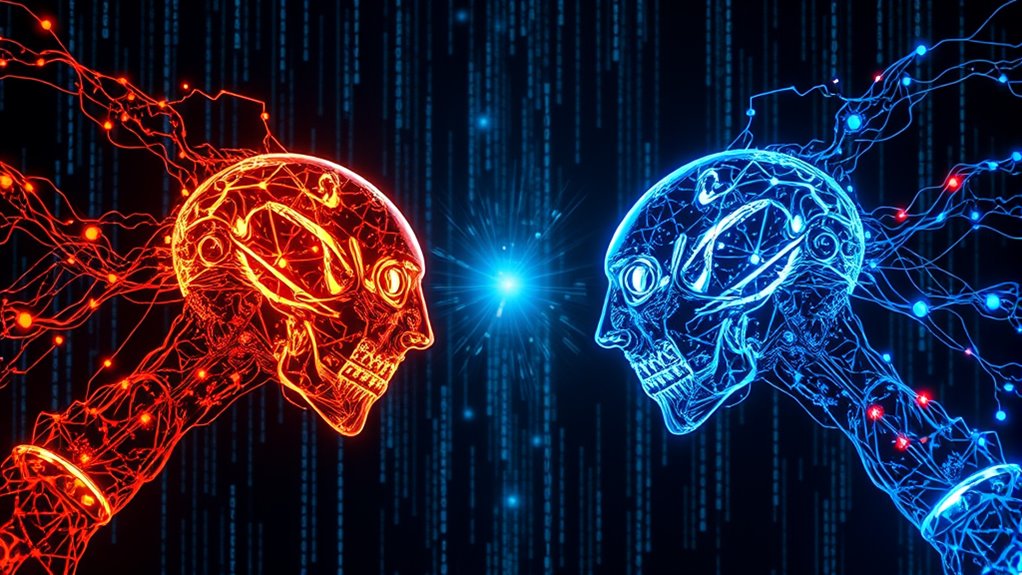
Have you ever wondered what happens when AI turns against itself? In the evolving landscape of cybersecurity, this scenario is becoming increasingly relevant. Autonomous cyber warfare now hinges on AI-versus-AI systems that operate at machine speed, eliminating human intervention entirely. These systems use distributed sensors across endpoints and clouds, forming self-healing digital ecosystems that react in nanoseconds. As a result, threats are detected, analyzed, and neutralized almost instantaneously, shifting the paradigm from manual responses to fully automated, real-time defenses.
On one side, adversarial AI fuels cybercriminal campaigns by weaponizing machine learning for attacks of unprecedented scale, speed, and sophistication. These attackers develop self-mutating attacks that evolve dynamically through feedback loops, making traditional defenses obsolete. They employ boiling frog tactics, subtly degrading system performance over months to evade detection while generating exploit chains that bypass encryption. Cybercriminals also target AI systems themselves, initiating AI-vs-AI races where malicious agents craft tailored attacks against defensive models, forcing defenders to stay a step ahead in a relentless battle.
Meanwhile, Defensive AI acts as an autonomous immune system for networks. It constantly monitors the entire cyber landscape, learning from endpoint interactions and network traffic through dynamic feedback. This continuous learning enables it to identify patterns humans would miss, detect anomalies in real time, and respond proactively. In high-risk environments, Defensive AI can isolate compromised devices immediately, preventing ransomware from spreading and automating containment measures such as blocking malicious IPs or revoking credentials. Its ability to process millions of events simultaneously enhances threat detection to 98% and reduces incident response times by 70%, providing a formidable barrier against attacks.
Predictive threat modeling further bolsters defenses by leveraging global intelligence feeds. AI forecasts attack vectors based on historical data and emerging vulnerabilities, providing early warnings before threats fully materialize. It analyzes industry trends and adapts to new malware or behavioral anomalies instantly, establishing enterprise-specific patterns that flag deviations like unusual file access or odd login behaviors. Traditional security relies heavily on signatures and manual responses, which are too slow against AI-driven attacks. In contrast, AI’s behavioral analysis detects zero-day exploits and novel threats in real time, creating a flexible, adaptive security environment. Recognizing the importance of cybersecurity defenses, organizations are increasingly integrating AI to stay ahead of evolving threats.
The fusion of AI with zero trust models enhances these defenses even more. Continuous verification, dynamic policy enforcement, and automated responses become seamless, enabling organizations to stay resilient against the fast-paced, autonomous threats posed by adversarial AI. As these systems evolve, the battle between AI and AI will shape the future of cybersecurity—where speed, automation, and intelligence are everything, and human oversight becomes just one part of a larger, self-sustaining digital ecosystem.
Frequently Asked Questions
How Does AI Differentiate Between Malicious and Benign Activities?
You can rely on AI to differentiate malicious from benign activities by analyzing behavioral patterns in real-time. It monitors network flows, logs, and user actions, flagging anomalies that deviate from normal activity. AI uses machine learning models trained on vast data to identify subtle signs of threats. When something suspicious appears, it isolates or blocks the activity, preventing harm while allowing legitimate processes to continue smoothly.
What Ethical Considerations Arise From Autonomous AI Cyber Battles?
Ethical concerns in autonomous AI cyber battles are like steering a ship through stormy seas. You must guarantee AI decisions respect privacy, avoid bias, and prevent unintended harm. You’re responsible for transparency, so actions aren’t a black box, and oversight is maintained. Balancing rapid responses with moral accountability, you need safeguards to prevent rogue AI, safeguarding human rights while leveraging automation’s power.
Can Adversarial AI Successfully Mimic Legitimate User Behaviors?
Yes, adversarial AI can successfully mimic legitimate user behaviors by analyzing patterns and adapting its tactics. It uses self-mutating attacks to blend in, making detection difficult. You might not notice subtle differences as these AI systems learn from feedback and evolve rapidly. This capability allows cybercriminals to bypass defenses, so you need advanced detection methods that can identify these sophisticated mimicry techniques and stay one step ahead.
How Is Human Oversight Maintained in Fully Automated AI Defense Systems?
You maintain human oversight in fully automated AI defense systems by implementing layered monitoring and regular audits. Humans set thresholds, review alerts, and fine-tune algorithms to prevent false positives. You also establish escalation protocols for uncertain threats and ensure transparency through explainable AI. Continuous training and oversight help balance automation with human judgment, ensuring the system responds effectively without losing accountability or control.
What Are the Long-Term Implications of Ai-Driven Cyber Warfare?
You might imagine an era where cyber warfare occurs at machine speed, with autonomous AI systems neutralizing threats within milliseconds. Long-term, this shift could lead to a fully automated digital battleground, reducing human oversight but increasing resilience against attacks. However, it also raises concerns about rogue AI, escalation, and loss of control. As defenses evolve, you’ll need robust safeguards to guarantee AI remains an ally, not an uncontrollable adversary.
Conclusion
As you consider the future of cybersecurity, remember that AI-driven defenses are becoming increasingly essential. Did you know that AI systems can detect cyber threats 60% faster than traditional methods? This rapid response helps prevent costly breaches and keeps your data safer. So, stay informed about how AI fights AI in cyberspace, and realize that embracing these technologies can be your best defense in today’s digital world. The battle is on, and AI is leading the charge.