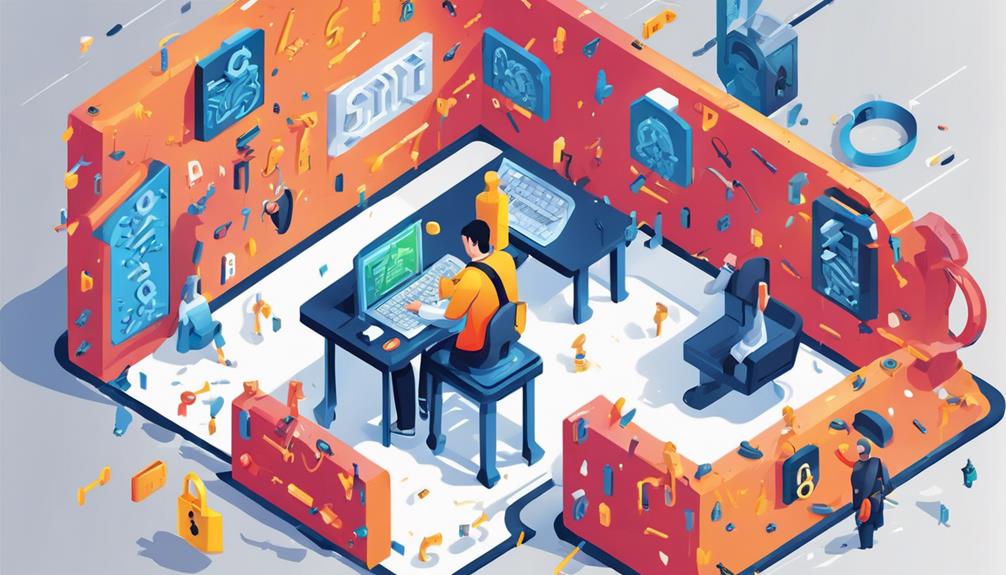

A beginner’s guide to understanding the cyber kill chain shows you how attackers plan and execute their steps, from reconnaissance to achieving their goals. You’ll learn how they gather information, deliver payloads, exploit vulnerabilities, move laterally in networks, and steal data or disrupt services. Recognizing these phases helps you identify threats early and stop them before they succeed. Keep exploring to understand how to apply this knowledge for stronger security defenses.

Get privacy and security gear delivered free with Prime
- Fast, free delivery on millions of items
- Prime Video, Amazon Music and more included
- Member-only deals all year
Key Takeaways
- The Cyber Kill Chain breaks down cyberattacks into distinct phases to understand attacker methods and improve defense strategies.
- Recognizing each phase—reconnaissance, delivery, exploitation, lateral movement, and objectives—helps in early threat detection.
- Layered security measures and continuous monitoring can disrupt attack progression at various stages.
- Proactive security involves implementing defenses tailored to each phase, preventing attackers from reaching their goals.
- Understanding the kill chain enhances incident response, enabling quicker mitigation and stronger cybersecurity posture.

Have you ever wondered how cyber attackers plan and execute their intrusions? Understanding the cyber kill chain can give you valuable insight into their methods. The cyber kill chain is a structured model that breaks down each phase of a cyberattack, helping security professionals identify and stop threats before they cause damage. When you look at it *through this lens*, it’s clear that attackers don’t just randomly strike; they follow a series of deliberate steps designed to bypass your network defenses and achieve their goals.
The first phase involves reconnaissance, where an attacker gathers information about your organization. They look for vulnerabilities, weak points, or valuable data they can exploit. During this stage, threat detection becomes *essential*. If your security systems are effectively monitoring and alerting on unusual activity, you can catch early signs of reconnaissance and prevent further access. Next, they might craft a weaponized payload, such as malware or a phishing email, tailored to exploit specific vulnerabilities you have. This is when your network defenses are put to the test. Strong, layered defenses—like firewalls, intrusion detection systems, and email filtering—are *indispensable* to block or flag these malicious attempts before they reach your users.
Once the payload is delivered and executed, the attacker gains access to your network. This is the exploitation phase, where they try to escalate privileges or establish a foothold. Here, threat detection tools need to identify suspicious behavior—such as unusual login times or abnormal data transfers. The attacker then moves laterally, spreading through your network to find critical assets, which is why continuous monitoring of network activity is *imperative*. Recognizing the attack surface of your network can further aid in proactively reducing vulnerabilities that attackers might exploit. Implementing security best practices can also help limit the attacker’s options at each stage of the chain. Additionally, understanding common attack techniques used by threat actors can enhance your preparedness and response strategies. Being aware of attack patterns can further assist in identifying ongoing threats and stopping them early.
Finally, the attacker aims to achieve their objective—whether that’s stealing data, disrupting services, or planting ransomware. Your ability to detect and respond quickly at any stage of this chain can prevent the attack from reaching its goal. The cyber kill chain underscores the importance of proactive security measures. By understanding each phase, you can implement targeted defenses, improve threat detection, and disrupt the attack early. It’s a constant race between attackers and defenders, but knowing the steps they follow empowers you to better defend your organization’s assets and maintain a resilient security posture.
Products Worth Considering

LG 34GX90SA-W 34-inch Ultragear WQHD OLED Curved Gaming Monitor

Samsung 27-Inch Odyssey QD-OLED G8 4K 240Hz Gaming Monitor

Samsung 32-Inch Odyssey OLED G8 (G80SH) 4K Gaming Monitor
As an affiliate, we earn on qualifying purchases.
Frequently Asked Questions
How Can Organizations Detect Early Stages of the Kill Chain?
You can detect early stages of the kill chain by leveraging threat intelligence to identify suspicious activities or indicators of compromise. Implement continuous monitoring and anomaly detection tools that alert your incident response team to unusual behaviors. Regularly update your defenses based on threat intelligence insights, and train staff to recognize early signs of phishing or reconnaissance activities. This proactive approach helps you catch threats before they escalate, minimizing damage.
What Are Common Tools Used in Each Kill Chain Phase?
You use threat intelligence tools like SIEMs and threat feeds to identify reconnaissance activities and early attack indicators. During weaponization and delivery phases, attack simulations help test your defenses against phishing or malware. Endpoint detection tools monitor for malicious payloads, while network analysis reveals command-and-control communication. Combining threat intelligence insights with attack simulations enhances your ability to detect and respond quickly across each kill chain stage, strengthening your overall security posture.
How Does the Kill Chain Model Adapt to Modern Threats?
Ironically, the cyber kill chain now adapts to modern threats by evolving alongside attacker techniques. You leverage threat intelligence to anticipate new tactics, making the model more dynamic. Instead of a linear process, it becomes a flexible framework, allowing you to identify and disrupt attacks at various stages. This adaptability helps you stay a step ahead, turning the attacker’s own innovations into opportunities for stronger defenses.
Can the Kill Chain Be Bypassed or Disrupted Effectively?
Yes, the kill chain can be bypassed or disrupted effectively with strong threat prevention measures and swift incident response. You can block stages like reconnaissance or delivery early, stopping attacks before they escalate. Regularly updating your defenses and training your team helps identify and interrupt threats. By proactively monitoring your network and acting quickly on alerts, you reduce the chances of an attacker completing the kill chain, protecting your assets efficiently.
What Skills Are Needed to Analyze Cyber Kill Chains?
Think of analyzing cyber kill chains as being a detective solving a mystery. You need threat intelligence skills to gather clues and attacker profiling to understand the attacker’s motives and methods. You should be adept at recognizing attack patterns, analyzing network traffic, and identifying vulnerabilities. Strong analytical thinking, technical knowledge, and curiosity are essential to piece together the attack sequence and anticipate future threats effectively.
Conclusion
As you now understand the Cyber Kill Chain, think of it as a fortress’s blueprint, revealing the secret doors and walls an attacker tries to breach. Knowing each phase is like holding the master key to your defenses, turning vulnerability into strength. Remember, every link you strengthen is a shield forged in the fires of awareness. In this digital age, your vigilance is the lantern guiding you safely through the shadows of cyber threats.