
AI has made phishing scams much smarter, helping scammers craft messages that look authentic and bypass filters easily. With AI, they can personalize attacks, mimic voices, and create convincing fake identities, increasing success rates. These advanced tactics make it harder to spot scams and put your organization at greater risk of financial loss and data theft. Stay alert—there’s a lot more to uncover about how AI is changing cyber threats and what you can do next.
Key Takeaways
- AI-generated content boosts phishing success rates by over 350%, making scams more convincing and harder to detect.
- Phishing attempts involving AI increased by 466%, with AI-driven campaigns dominating over 82% of efforts.
- AI enables scammers to craft personalized, authentic-looking messages that bypass traditional spam filters.
- Deepfake voices and synthetic identities enhance impersonation, increasing the effectiveness of vishing and spear-phishing attacks.
- The rapid automation of AI-powered campaigns every 20 seconds heightens the threat and scale of phishing attacks globally.
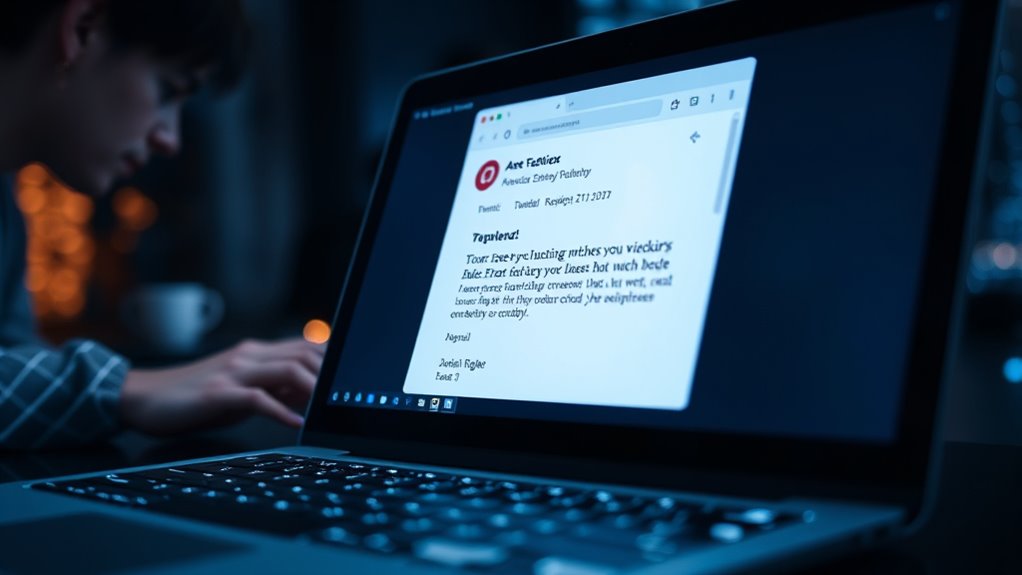
Have you noticed how AI is transforming the landscape of cybercrime, especially in phishing scams? Over the past year, phishing reports have surged by an astonishing 466%, with email volumes increasing over 1,265% since generative AI tools like ChatGPT launched. This rapid growth means you’re facing a smarter, more sophisticated threat landscape. AI-driven techniques allow scammers to craft highly convincing messages that evade traditional spam filters, making detection much more challenging. Nearly 9 out of 10 phishing attempts now involve AI-generated or AI-assisted content, and these campaigns account for over 82% of all phishing efforts. This shift means that the usual warning signs are less effective, as AI can mimic writing styles, hijack email threads, and produce convincing language that appears authentic.
AI is making phishing scams more convincing and widespread, with 82% of attacks now AI-driven.
AI doesn’t just make scams more convincing; it also boosts their effectiveness. AI agents trick users 24% more efficiently than human scammers, boasting click-through rates of around 54% versus just 12% for human-crafted emails. Spear-phishing campaigns powered by large language models achieve a 56% success rate, outperforming generic emails by over 350%. The ability to generate deepfake voices for vishing scams adds another layer of danger, enabling attackers to impersonate trusted figures convincingly across multiple channels. These advancements mean you’re more likely to fall victim if you’re not cautious, especially since AI automates personalized attacks by scraping data to mimic your writing style and preferences. Increased sophistication, driven by advances in cybercrime tactics, makes these attacks harder to detect and more likely to succeed.
Organizations are feeling the impact too, with 86% reporting at least one AI-related phishing incident. Many of these attacks involve social engineering, which AI enhances by making scams more believable and tailored to individual targets. Identity-based attacks now make up around 60% of phishing incidents, often driven by AI-powered impersonations that hijack email threads or create synthetic identities. The financial toll is significant—average breach costs are nearly $5 million, with Business Email Compromise (BEC) losses reaching $2.7 billion and phishing-related losses in the millions. Scammers are launching new sites every 20 seconds globally, and over half of all fraud now involves AI, including the creation of deepfakes and synthetic identities.
Detecting these AI-crafted scams is becoming increasingly difficult. Traditional filters often miss highly realistic messages, and only about 48% of employees understand how AI is used in phishing attacks. As AI continues to evolve, cybercriminals leverage tools like GPT-4 and WormGPT to produce authentic language that skirts past spam filters, making it critical for you to stay vigilant. The threat is growing so rapidly that AI-powered phishing is now recognized as a primary identity threat vector in 2025. Staying informed and cautious is your best defense against these smarter, more convincing scams that are now a dominant force in cybercrime.
Top picks for "phish scam smart"
Open Amazon search results for this keyword.
As an affiliate, we earn on qualifying purchases.
Frequently Asked Questions
How Can Organizations Detect Ai-Generated Phishing Emails Effectively?
You can detect AI-generated phishing emails by implementing advanced AI-based filtering tools that analyze language patterns, detect inconsistencies, and identify deepfake voice or images. Educate your staff on AI phishing tactics, encouraging vigilance and skepticism. Regularly update your security protocols, use multi-factor authentication, and monitor email activity for suspicious behavior. Combining technology and training helps you better identify and block these sophisticated scams before they cause harm.
What Are the Best Strategies to Prevent Ai-Assisted Social Engineering Attacks?
To prevent AI-assisted social engineering attacks, you should implement thorough employee training focused on recognizing sophisticated scams, including AI-driven tactics. Use advanced email filtering and AI detection tools that adapt to new threats. Encourage skepticism of unexpected requests, verify identities through separate channels, and promote a security-first culture. Regularly update security protocols and simulate attacks to test awareness, ensuring your team stays alert against evolving AI-enabled threats.
How Does AI Improve the Realism of Deepfake Voice Scams?
Imagine a voice so convincing it feels like your trusted colleague speaking. AI improves the realism of deepfake voice scams by mimicking tone, pitch, and speech patterns with astonishing accuracy. It crafts voices that imitate familiar voices, making deception seamless. This technology hijacks your trust, making it nearly impossible to distinguish between real and fake, putting you at greater risk of falling victim to scams that sound as genuine as the people you know.
Are Traditional Spam Filters Sufficient Against Ai-Crafted Phishing Messages?
No, traditional spam filters aren’t enough against AI-crafted phishing messages. AI enables these scams to bypass SPF, DKIM, and DMARC protections, making them harder to detect. You might find that many AI-generated emails slip through, evading filters entirely. That’s why you need advanced security solutions and constant awareness. Staying informed about AI tactics helps you recognize and avoid these sophisticated threats, reducing your risk of falling victim.
What Training Measures Help Employees Recognize Ai-Enabled Phishing Attempts?
You need to stay ahead of AI-enabled phishing attempts by training your employees to spot subtle signs of deception. Conduct interactive sessions that simulate real AI-crafted scams, emphasizing language inconsistencies, unusual request patterns, and deepfake voices. Regular updates on AI tactics keep awareness sharp. Empower your team with practical tools and confidence, so they can recognize and report suspicious emails before falling victim to these sophisticated, ever-evolving threats.
Conclusion
As you navigate the digital world, remember that AI-powered phishing scams are becoming more sophisticated. In fact, over 70% of cyberattacks now involve some form of AI, making scams harder to spot. Stay vigilant, verify sources, and never click suspicious links. The more you understand these tactics, the better you can protect yourself. Don’t let AI’s advancements catch you off guard—stay informed and cautious to keep your personal info safe.