
Yes, employee training can greatly stop cyber attacks by turning staff into your first line of defense. When you educate employees about threats like phishing and safe password practices, they become more alert and less likely to fall for scams. Reinforcing secure behaviors and providing tools like MFA also help. While training alone isn’t enough, it plays an essential role in creating a security-conscious culture. If you’re interested in how to strengthen this approach, there’s more to explore.
Key Takeaways
- Well-trained employees act as a vital human firewall, reducing the risk of breaches caused by human errors like phishing.
- Regular, engaging security awareness training improves staff vigilance and promotes secure behaviors.
- Role-specific training and practical tools help employees recognize threats and respond appropriately.
- Continuous reinforcement and monitoring encourage a security-conscious culture that supports attack prevention.
- Employee training complements technical controls, making organizations more resilient against cyber attacks.
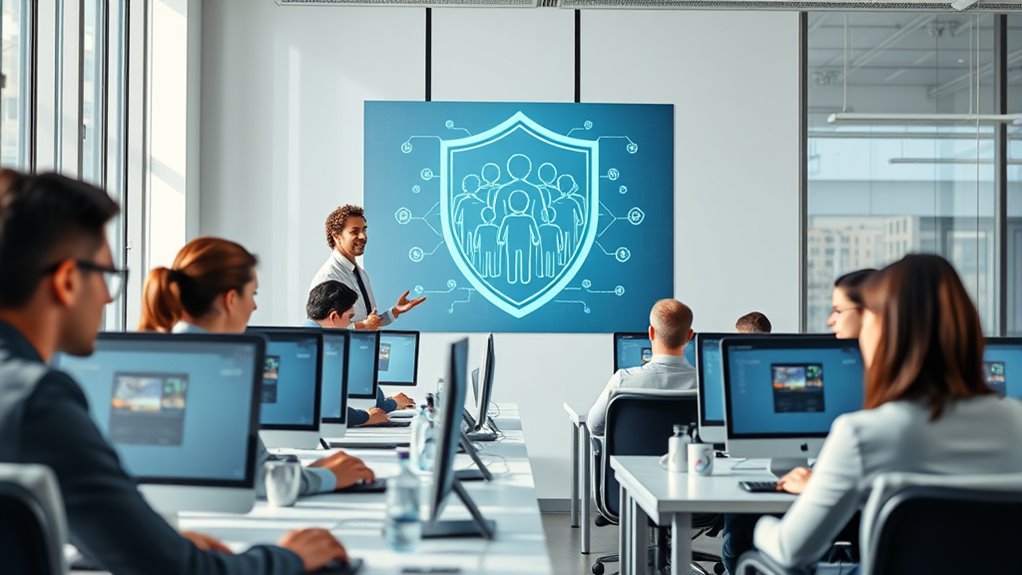
Have you ever wondered why your organization’s cybersecurity defenses often fall short despite advanced technology? The answer often lies in the human element. Employees, intentionally or not, act as the first line of defense — the human firewall. This collective awareness, knowledge, and behavior of staff are essential because most breaches involve human actions, such as falling for phishing scams, misconfigurations, or unsafe downloads. Technical controls alone won’t stop these threats; instead, you need a security-aware culture where staff recognize risks, follow best practices, and report suspicious activity promptly. Human behavior is a critical factor in cybersecurity outcomes. Building an effective human firewall starts with regular security awareness training. Cover essential topics like phishing recognition, password hygiene, device handling, and incident reporting. But training must be engaging and practical. Short microlearning modules delivered frequently improve retention and keep staff updated on evolving threats. Simulated phishing campaigns are equally important—they help measure behavior change and identify vulnerable groups within your organization. When employees see realistic scenarios, they become more cautious and less likely to click malicious links or open suspicious attachments. Incorporating behavioral insights into training programs can further enhance engagement and effectiveness. Clear policies and accessible reporting channels are indispensable components. When staff know exactly how to escalate suspicious activity, incidents get prioritized and dealt with faster, reducing potential damage. Reinforcement mechanisms like reminders, role-specific content, and microlearning prevent complacency and knowledge decay over time. Tracking metrics such as click rates and report rates helps you evaluate your program’s effectiveness and identify areas for improvement. For example, a declining phishing click rate indicates your training is working, while increased report rates show staff are alert and engaged. Your goal is to create a security-conscious environment where employees are motivated to act as defenders, not weak links. Providing role-specific training tailored to high-risk groups — such as finance or HR — enhances your organization’s resilience. Integrating awareness efforts with practical tools like password managers and multi-factor authentication (MFA) makes secure behavior easier to adopt. Recognizing and rewarding employees who actively report suspicious activity encourages ongoing vigilance and fosters a positive security culture. Ultimately, the human firewall isn’t just about training; it’s about continuous improvement. Monitoring key indicators like phishing click-through rates, suspicious email reports, and incident response times helps you gauge success and adapt your strategies. While training considerably reduces risk, it complements technical controls like email filtering and MFA. Remember, no matter how advanced your technical defenses are, without vigilant employees acting as your human firewall, attackers will find ways to exploit human vulnerabilities. Building this layer of defense is essential to stopping cyber attacks before they cause real damage.
Top picks for "human firewall employee"
Open Amazon search results for this keyword.
As an affiliate, we earn on qualifying purchases.
Frequently Asked Questions
How Often Should Security Training Be Refreshed for Maximum Effectiveness?
You should refresh security training at least every six months to maintain its effectiveness. Regular updates reinforce key concepts, address evolving threats like spear-phishing and deepfakes, and prevent behavioral decay. Incorporate ongoing simulated phishing exercises and real-world examples to keep employees engaged and aware. Continuous reinforcement guarantees that security awareness becomes part of your organizational culture, reducing susceptibility and strengthening your overall cyber defenses.
What Are the Best Ways to Measure Training Success Beyond Click Rates?
You can measure training success beyond click rates by tracking user reporting accuracy. For example, if employees correctly identify and report simulated phishing attempts, it shows increased awareness and engagement. Additionally, monitor time-to-report suspected incidents, which indicates how quickly staff respond to threats. Combining these metrics with assessments of behavioral changes over time gives a thorough view of training effectiveness and helps identify areas needing improvement.
How Can Organizations Address Persistent Sophisticated Attack Methods?
You can address persistent sophisticated attack methods by combining ongoing, role-specific training with advanced technical defenses. Regularly update training content to include new threats like deepfakes and spear-phishing, and use simulated attacks to test readiness. Encourage a security-minded culture, reinforce training through frequent microlearning, and integrate technical controls like multi-factor authentication and email filtering. This layered approach helps reduce risks even against evolving, complex threats.
What Role Do Technical Controls Play Alongside Employee Training?
Technical controls act as your first line of defense, blocking many threats before they reach your employees. While training reduces susceptibility and improves response, it can’t counter sophisticated attacks alone. Combining layered technical measures—like multi-factor authentication, email filtering, and intrusion detection—with ongoing employee education creates a resilient security posture. This synergy minimizes vulnerabilities, ensuring that even if one layer falters, others stand firm to protect your organization.
How Can Small Businesses Justify the Cost of Security Training Programs?
You can justify security training costs by recognizing its high ROI, often between 3× and 7×, and even higher in larger organizations. Training reduces breach costs, with some reports citing savings of over $200,000 per incident avoided. It also strengthens your security culture, lowers employee-caused incidents, and enhances detection and response times. When combined with technical controls, training becomes a cost-effective way to protect your business from costly cyber threats.
Conclusion
By now, you realize that employee training is your strongest defense against cyber attacks. Did you know that 95% of cybersecurity breaches are caused by human error? That’s a staggering number, but it highlights how essential your awareness and vigilance are. Keep educating yourself and your team regularly—your proactive efforts can turn employees into a powerful human firewall. Staying informed is your best weapon to protect your organization from evolving cyber threats.