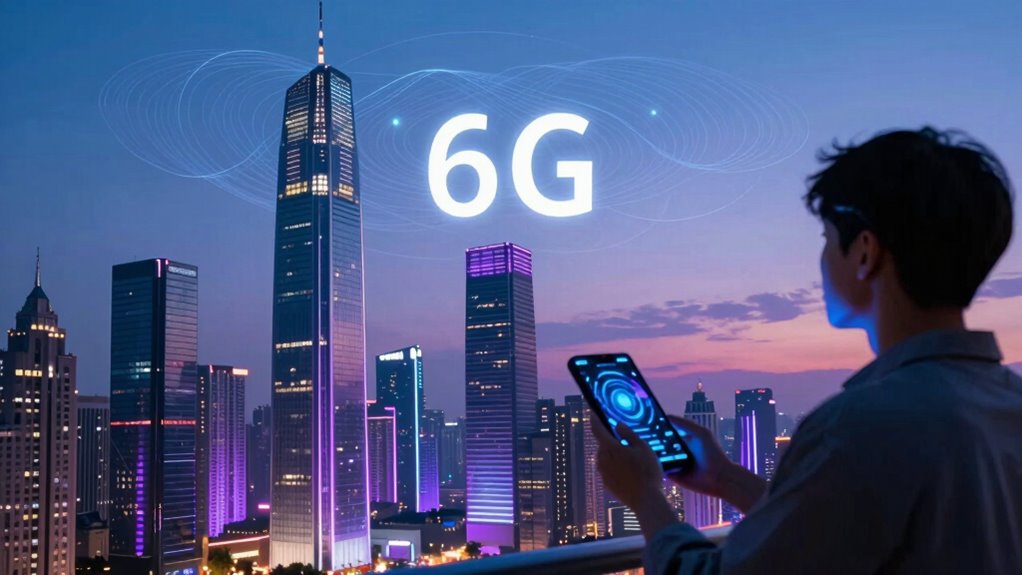

6G is coming, and it will drastically boost your wireless experience with speeds over 100 Gbps and near-zero latency, making downloads instant and communications seamless. Expect smarter devices, real-time holographic calls, and autonomous vehicles working more efficiently. This next-gen network will also support immersive AR, VR, and connected cities. As everything becomes more interconnected and intelligent, exploring these changes will reveal how your digital world is about to transform.
Key Takeaways
- 6G will deliver speeds over 100 Gbps, enabling rapid downloads and seamless 8K streaming.
- Latency will drop to microseconds, supporting real-time holography, AR/VR, and autonomous vehicle responses.
- New spectrum bands like sub-terahertz will increase network capacity and device connectivity.
- AI integration will enable smarter networks, enhanced security, and digital twins for better environment management.
- 6G will transform industries, cities, and healthcare with immersive, highly responsive wireless experiences.

Have you ever wondered how future wireless technology will transform your daily life? By the early 2030s, 6G is expected to become a reality, building on the foundation laid by 5G and its predecessors. This new generation promises to revolutionize connectivity, offering speeds and capabilities that seem almost science fiction today. Unlike 5G, which already provides impressive data rates, 6G aims to push speeds beyond 100 Gbps, reaching up to 1 Tb/sec in some tests. That’s a thousand times faster than current 5G networks, enabling you to download entire HD movies in seconds or stream live 8K drone footage seamlessly. With these speeds, real-time holographic communication and immersive AR/VR experiences will become commonplace, transforming everything from entertainment to work. 6G operates at microsecond speeds, enabling instant data transfer, making real-time interactions more seamless than ever before. Latency will drop to microseconds, making delays practically nonexistent. This ultra-low latency will support instant responses for autonomous vehicles, remote surgeries, and live digital twins of physical environments. Massive bandwidth will come from new spectrum bands like sub-terahertz and cm-wave frequencies, which will supplement existing 5G bands and allow for unprecedented network capacity. Spectrum sharing techniques will make efficient use of available frequencies, minimizing interference and boosting overall network reliability. You’ll experience a seamless, highly integrated wireless environment where digital and physical worlds converge through sensing, digital twinning, and intelligent ecosystems, all managed by advanced AI and machine learning. Frequency bands above 100 GHz will operate alongside existing spectrum, enabling faster data transfer and more connected devices without congestion. AI will play an essential role, supporting edge inference and network self-optimization, ensuring your devices and applications perform flawlessly. Distributed AI workloads will run across your device, local edge servers, and data centers, enabling smarter, more secure networks. Quantum communication will further enhance security, protecting your data from threats. Additionally, the integration of European cloud infrastructure will ensure data sovereignty and promote sustainable cloud solutions across regions. Applications will extend across many fields, transforming cities into smart, interconnected hubs, enabling industry 4.0, and creating new business opportunities. Imagine holographic telepresence that makes remote meetings feel face-to-face, or precision agriculture that maximizes crop yields. Autonomous vehicles will communicate with each other and infrastructure in real time, improving safety and efficiency. Healthcare will benefit from remote monitoring and telemedicine, while immersive XR experiences will become part of everyday life. As 6G unfolds, it will not only enhance your connectivity but also redefine how you interact with the world, making everything smarter, faster, and more integrated.
Top picks for "next wireles mean"
Open Amazon search results for this keyword.
As an affiliate, we earn on qualifying purchases.
Frequently Asked Questions
Will 6G Devices Be Compatible With Existing 5G Networks?
Yes, 6G devices will be compatible with existing 5G networks. You’ll be able to use 6G devices on current 5G infrastructure thanks to multi-RAT spectrum sharing, which allows different wireless standards to operate seamlessly together. This compatibility guarantees you won’t need new hardware immediately and can enjoy smoother shifts between networks. As 6G develops, it will complement and enhance 5G, providing faster speeds and more advanced features.
How Will 6G Impact Current Smartphone and Iot Device Designs?
Your smartphone and IoT device designs will evolve to handle the ultra-fast speeds and low latency of 6G, meaning more compact antennas and advanced processors. You’ll see increased integration of AI and digital twinning features, enabling smarter, more efficient devices. They’ll support higher bandwidth applications like holography and immersive AR/VR, requiring new materials and energy-efficient components to manage the demanding performance standards while maintaining portability and battery life.
What New Privacy Concerns Will Arise With 6g’s Advanced Sensing Features?
With 6G’s advanced sensing features, your privacy could face unprecedented threats—you might be watched more than ever. These sensors gather detailed data about your environment, habits, and even emotions, raising concerns about constant surveillance. You’ll need tighter controls and smarter privacy safeguards. As these capabilities grow, so does the risk of misuse, making it essential for you to stay informed and vigilant about how your data is collected and shared.
When Can Consumers Realistically Expect Widespread 6G Coverage?
You can expect widespread 6G coverage around 2030, but it’ll depend on your location and infrastructure investment. Initially, expect it in major cities and tech hubs as providers roll out pilot programs starting around 2025-2026. Over the next few years, coverage will expand gradually, reaching more rural and suburban areas by the late 2020s. Stay updated, as adoption rates will vary worldwide, shaping how soon you’ll experience true 6G connectivity.
How Will 6G Affect Energy Consumption and Environmental Sustainability?
You’ll notice 6G aims to improve energy efficiency substantially, with some estimates suggesting a 90% reduction in power consumption compared to 5G. This means your devices and networks will use less energy, helping cut down carbon emissions. Advanced AI and spectrum sharing will optimize resources, making the system smarter and greener. So, as 6G rolls out, expect more environmentally sustainable tech that’s better for the planet and your daily life.
Conclusion
As 6G approaches, you’ll experience lightning-fast speeds and seamless connectivity like never before. Experts predict that by 2030, 6G could deliver data rates up to 1,000 times faster than 5G, transforming how you work, play, and connect. Imagine streaming ultra-high-definition content instantly or experiencing augmented reality without lag. Staying ahead means embracing these advancements early, so you can enjoy a future where technology effortlessly fits into your daily life. The next generation is almost here—are you ready?