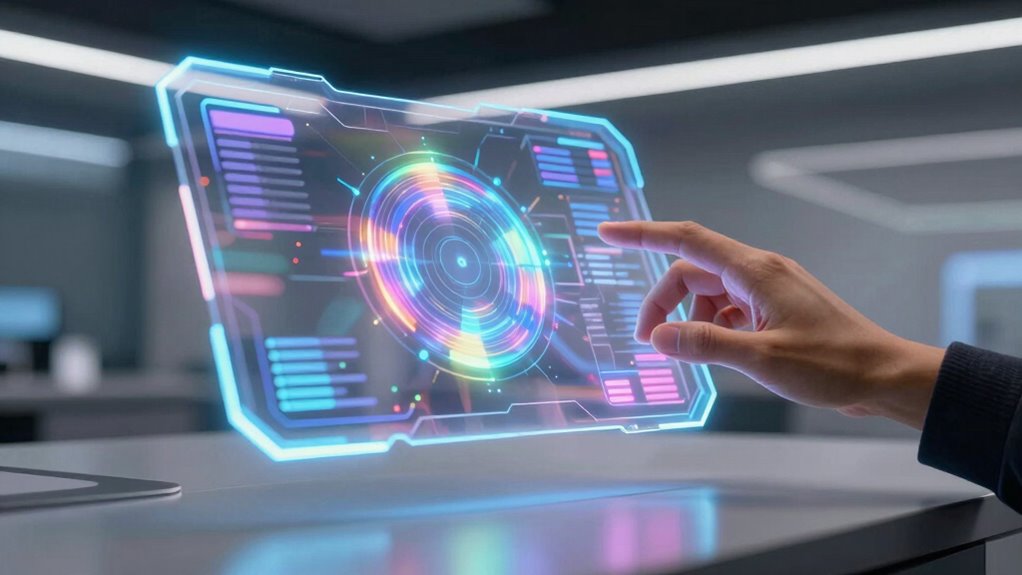

Holographic displays are rapidly evolving, offering immersive, lifelike visuals that could soon replace traditional screens. Advances in light-field technology, AI-driven 3D reconstructions, and compact, glasses-free devices make it possible to experience content in 3D without headsets. These innovations are expanding viewing angles and enabling real-time, realistic interactions. If you keep exploring, you’ll discover how this technology is transforming entertainment, communication, and everyday digital experiences, bringing the future closer to you.
Key Takeaways
- Advancements in holographic technology enable immersive, real-time 3D visuals that can replace traditional screens in various applications.
- Compact, glasses-free holographic displays are emerging, making holography more accessible and eliminating the need for physical screens.
- Industry growth and integration into consumer devices suggest a future where holograms could serve as primary visual interfaces.
- Holographic displays are expanding into entertainment, healthcare, and communication, reducing reliance on conventional screens.
- Ongoing innovations aim to make holograms lighter, smaller, and more responsive, supporting seamless replacement of traditional screens.
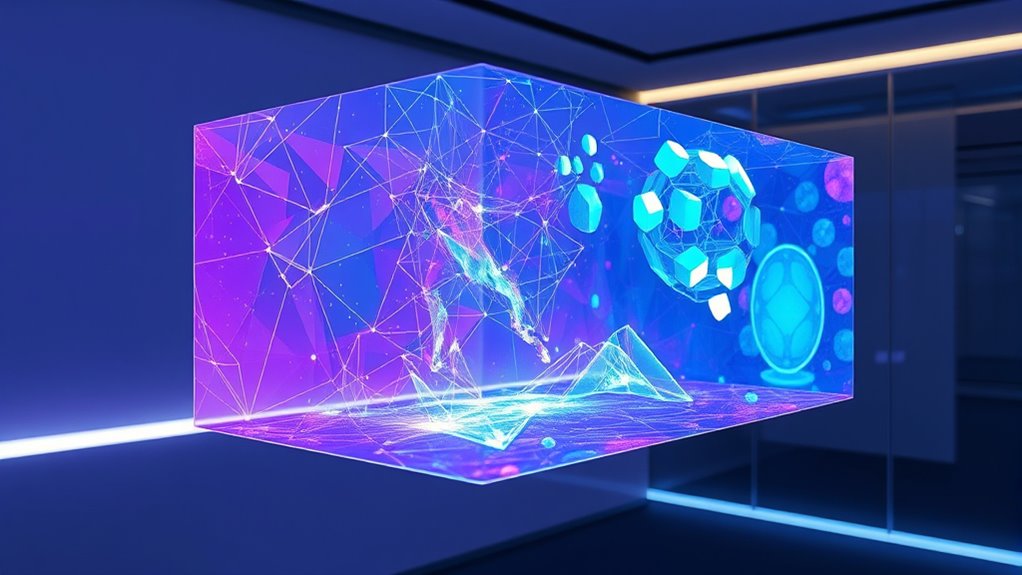
Have you ever wondered what the future of visual displays looks like? It’s shaping up to be incredibly immersive, thanks to groundbreaking holographic technology. AI plays a crucial role here, enabling faster 3D reconstructions, realistic animations, and dynamic volumetric scenes that create lifelike visuals right before your eyes. These advancements aren’t just about better images; they’re about transforming how you experience digital content, whether it’s in entertainment, healthcare, or industry. Thanks to AI, holograms are becoming sharper, more detailed, and more responsive, making the boundaries between virtual and real worlds blur like never before.
Holographic tech, enhanced by AI, is revolutionizing immersive visual experiences across entertainment, healthcare, and industry.
Imagine glasses-free displays that support wider viewing angles and higher resolutions, allowing multiple viewers to experience the same 3D scene without wearing cumbersome headsets. Light-field and lenticular systems are expanding the field of view and eyebox, creating what’s called reality-first user experiences that feel natural and immersive. These displays are turning what used to be niche prototypes into consumer-ready products, like holographic smartphones with floating UI prototypes or compact hologram projectors that fit into your pocket. VR headsets are shrinking to the size of eyeglasses, offering all-day comfort and high-fidelity visuals, thanks to tiny pixels under 300 nanometers and OLED metasurfaces that generate full holograms from a single pixel.
The market is booming, with the holographic display industry surpassing USD 3.4 billion in 2024 and projected to grow at over 25% annually through 2034. This growth is driven by rising demand in entertainment, healthcare, automotive, and education sectors, where immersive visuals enhance experiences and productivity. Investments are fueling AR and VR platforms, bringing advanced holographic projectors into cinemas, live events, and museums, enabling visitors to see 3D artifacts without special glasses. In industries like manufacturing and logistics, holographic telepresence and real-time 3D visualization are revolutionizing workflows and communication. The integration of cloud technology is also enabling more scalable and flexible holographic solutions, making high-quality visuals accessible to more users.
Key technologies such as computer-generated holograms, holographic metasurfaces, and holographic waveguides are making holography more practical and affordable. Low-cost CMOS chips in HXR platforms power spatial computing in smart glasses, bringing holographic interfaces closer to everyday use. Holographic display technology is also being integrated into consumer devices, making holograms more accessible in daily life. Future trends point toward holographic MR workspaces replacing monitors with floating dashboards, portable hologram projectors, and lightweight VR devices that blend realism and comfort. Challenges remain, like reducing size and weight, but progress in OLED and metasurface tech is closing the gap.
In short, holographic displays are poised to eliminate traditional screens, offering a new era of visual interaction that’s more immersive, intuitive, and accessible.
Top picks for "holographic display goodbye"
Open Amazon search results for this keyword.
As an affiliate, we earn on qualifying purchases.
Frequently Asked Questions
How Durable Are Holographic Display Devices Over Time?
Holographic display devices are becoming more durable as manufacturers improve materials and engineering. You’ll find that high-quality holograms withstand daily use and environmental factors better over time. However, cheaper models might degrade faster due to less robust components. To guarantee longevity, handle your device carefully, keep it clean, and follow manufacturer care instructions. With ongoing innovations, expect future holographic devices to last even longer and resist wear and tear more effectively.
What Are the Current Limitations of Holographic Display Resolution?
Like viewing a distant star through a telescope, holographic display resolution faces challenges. You’re limited by the tiny pixel sizes, often under 300 nanometers, which restrict detail and clarity. Despite AI advancements boosting image quality and realism, achieving ultra-high resolution remains difficult due to hardware constraints. As a result, holograms sometimes appear less sharp or detailed, especially in complex or large scenes, but ongoing innovations promise to push these boundaries further.
Are Holographic Displays Energy-Efficient Compared to Traditional Screens?
Holographic displays are generally less energy-efficient than traditional screens because they require more power to generate complex 3D images and maintain vivid visuals. You might notice higher energy consumption when using advanced holographic devices with AI enhancements or large-scale projections. However, ongoing innovations like metasurfaces and miniaturized components are working to improve efficiency, making future holographic displays potentially more sustainable and practical for everyday use.
How Accessible Are Holographic Display Technologies for Consumers?
You can expect holographic display tech to become more accessible soon, with the market valued at over USD 3.4 billion in 2024 and growing rapidly. Compact devices like holographic smartphones and portable projectors are already entering the consumer space. As prices drop and technology advances—like high-resolution, glasses-free systems—you’ll find it easier to experience immersive 3D content firsthand, making holography more practical and affordable for everyday use.
What Are the Safety Considerations for Prolonged Hologram Viewing?
You should be aware that prolonged hologram viewing can cause eye strain, fatigue, and potential discomfort due to intense focus and light exposure. To stay safe, take regular breaks, adjust brightness levels, and make certain of proper ambient lighting. It’s also wise to use devices with built-in eye comfort features, and avoid long sessions if you experience headaches or visual disturbances. Always follow manufacturer guidelines for safe use of holographic technology.
Conclusion
Imagine a world where screens vanish, replaced by vibrant, floating holograms that seem to defy reality. While traditional displays have shaped your daily life, holographic technology offers a future where visuals become immersive and seamless. As you step into this new era, remember that what once seemed impossible is now within reach. Say goodbye to screens, and embrace a world where digital and physical worlds blend effortlessly—your next interaction might just be holographic.