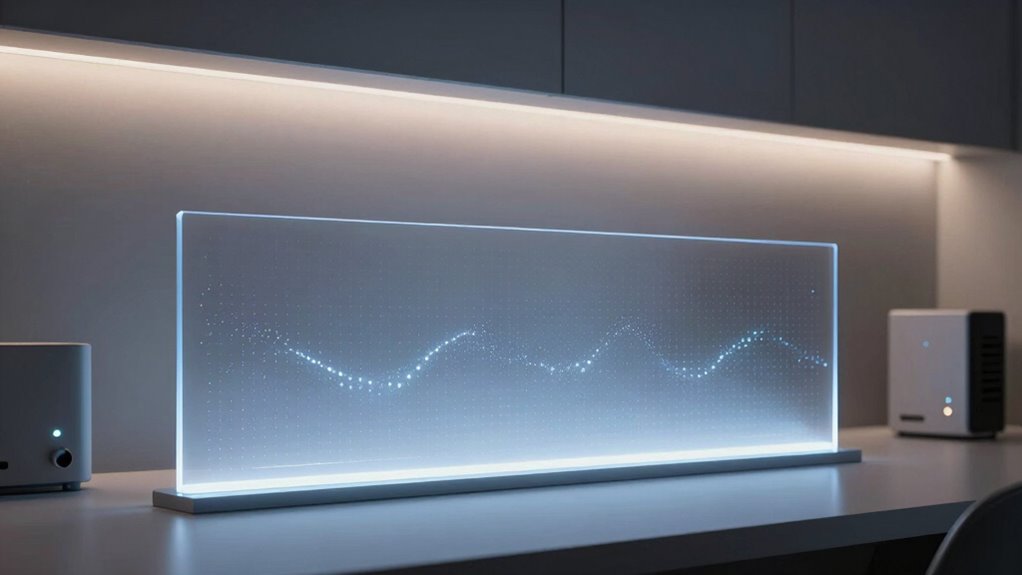

Li-Fi transmits data via rapid flickering LED lights, offering a faster and more secure alternative to Wi-Fi. It can reach speeds up to 224 Gbps, vastly surpassing traditional wireless connections. Because it uses light signals, Li-Fi doesn’t pass through walls, reducing hacking risks and interference. While its range is limited to about 10 meters, it’s ideal for confined spaces and high-density environments. Keep exploring to discover how this invisible tech might shape your connected world.
Key Takeaways
- Li-Fi transmits data via modulated LED light, providing ultra-fast speeds up to 224 Gbps, surpassing Wi-Fi’s capabilities.
- Light signals do not penetrate walls, confining data to illuminated zones and enhancing security against hacking.
- Limited to short-range (about 10 meters), Li-Fi is ideal for micro-zones like offices, hospitals, and smart homes.
- It offers interference-free, eco-friendly communication by avoiding RF emissions and electromagnetic interference.
- Li-Fi can complement Wi-Fi, especially in high-density or RF-sensitive environments, revolutionizing secure, high-speed connectivity.

As wireless connectivity demands continue to grow, Li-Fi is emerging as a promising alternative to traditional Wi-Fi. Unlike Wi-Fi, which transmits data via radio frequencies, Li-Fi uses modulated light from LED bulbs to send information. This technique allows for a much broader spectrum—spanning from 430,000 to 770,000 GHz—which is about 10,000 times larger than Wi-Fi’s radio spectrum. Using photodiodes as receivers, Li-Fi translates the light signals into data, enabling rapid and reliable communication. With speeds reaching up to 224 Gbps, Li-Fi surpasses Wi-Fi’s typical maximum of around 1 Gbps and even exceeds WiGig, the fastest Wi-Fi variant. This means you could download full HD movies in mere seconds, supporting demanding applications like streaming, gaming, and real-time data transfers with ease.
Li-Fi’s speed advantage is complemented by its security benefits. Since light signals do not pass through walls, the data remains confined to illuminated areas, drastically reducing hacking risks compared to Wi-Fi’s radio signals that penetrate barriers. This makes Li-Fi particularly attractive for sensitive environments like banks, government agencies, or healthcare facilities. Moreover, Li-Fi’s immunity to electromagnetic interference from devices like microwaves or other Wi-Fi networks ensures consistent, interference-free performance, especially in crowded places such as hospitals or airplanes. It’s reliable in RF-sensitive zones, including operating rooms, where electromagnetic disturbances can be problematic. Furthermore, the use of light for data transfer means it does not contribute to RF pollution, making it an environmentally friendly option. Additionally, as the demand for energy-efficient solutions increases, Li-Fi’s low power consumption makes it an even more attractive choice for sustainable technology initiatives.
However, Li-Fi’s range is limited to about 10 meters, requiring a direct line of sight to the LED light source. It creates micro-zones within rooms, making it suitable for confined spaces like offices, classrooms, or homes but less practical for broad-area coverage. In contrast, Wi-Fi can extend over 20 to 50 meters and penetrate walls, making it more suitable for larger environments. Despite this, Li-Fi’s integration with existing LED lighting infrastructure offers a significant efficiency boost. It’s energy-efficient, reducing the need for additional networking equipment such as routers and repeaters, and consumes less power overall.
Li-Fi’s future looks promising, especially in high-density settings where it can reduce network congestion by leveraging multiple LED sources. Its applications span from hospitals and data centers to underwater communication and smart homes. While it’s unlikely to completely replace Wi-Fi due to its limited range, Li-Fi is positioned to complement it, providing ultra-fast, secure connections where needed. As the technology advances and becomes more compatible, it could revolutionize how we connect, making the internet faster, safer, and more efficient—all through the silent, invisible waves of light.
Top picks for "silent internet could"
Open Amazon search results for this keyword.
As an affiliate, we earn on qualifying purchases.
Frequently Asked Questions
Can Li-Fi Work Outdoors or in Sunlight?
Li-Fi struggles to work outdoors or in bright sunlight because sunlight can overpower the light signals from LEDs, making data transmission unreliable. The system relies on a clear line-of-sight and controlled lighting conditions, so outdoor use is limited. However, with specialized filters and shielding, some improvements are possible. Still, for consistent outdoor connectivity, Wi-Fi remains the more practical choice due to its resistance to sunlight interference.
What Are the Challenges of Implementing Li-Fi in Existing Infrastructure?
You might think installing Li-Fi is as simple as swapping out bulbs, but existing infrastructure poses challenges. Upgrading requires integrating LED lighting systems capable of data transmission, which can be costly and complex. You’ll need line-of-sight for reliable signals, meaning redesigning spaces or installing additional equipment. Plus, compatible photodiodes and network management tools aren’t yet widespread, making seamless deployment a formidable task despite Li-Fi’s promising speed and security advantages.
How Does Li-Fi Handle Movement and Device Switching?
You’ll find that Li-Fi handles movement and device switching smoothly within its limited range. As you move, devices stay connected by switching between different LED light zones, creating seamless handovers. This process is quick, thanks to the micro-zone coverage, ensuring minimal latency. However, if you move out of the line-of-sight or into a shadowed area, the connection may drop, requiring you to reconnect or reposition.
Is Li-Fi Compatible With Current Wi-Fi-Enabled Devices?
You’ll find that most current Wi-Fi devices aren’t natively compatible with Li-Fi, since they’re designed to connect via radio signals. Imagine your smartphone or laptop trying to dance with a partner speaking a different language—without an adapter, they won’t sync smoothly. However, with specialized hardware or adapters, you can bridge the gap, allowing your devices to harness Li-Fi’s ultra-fast, secure light-based data transmission.
What Are the Cost Differences Between Li-Fi and Wi-Fi Deployment?
You’ll find that deploying Li-Fi can be more cost-effective in the long run since it uses existing LED lighting infrastructure, eliminating the need for additional routers or repeaters. However, initial setup costs may be higher due to specialized equipment like photodiodes and modulated LEDs. Overall, Li-Fi’s higher performance and security can offset costs, especially in environments like hospitals or data centers where reliability and security matter most.
Conclusion
As you explore the dazzling potential of Li-Fi, imagine a world where light leads the way, replacing wavering Wi-Fi signals with swift, silent streams. Picture pulses of pure, pristine photons powering your devices seamlessly, silencing static and stabilizing signals. With this luminous leap, you’ll step into a space where speed and security shine brighter than ever. Embrace the brilliance of the future, where light lingers long, leading us into a luminous, limitless internet landscape.