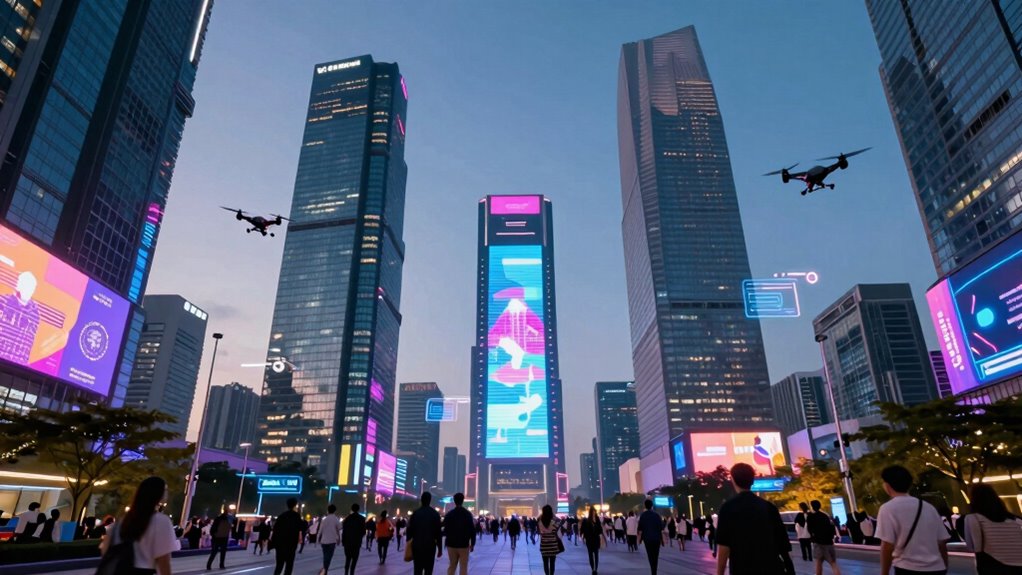

Technological advances like AI, biotech, and autonomous systems are turning sci-fi concepts into reality, creating a mix of utopian potential and dystopian risks. You might see smarter homes, medical breakthroughs, or new ways to connect, but also face issues like surveillance, privacy breaches, and job displacement. As power concentrates and ethical questions grow, the future could go either way. Keep exploring to discover how these shifts could shape a better or worse world.

Get privacy and security gear delivered free with Prime
- Fast, free delivery on millions of items
- Prime Video, Amazon Music and more included
- Member-only deals all year
Key Takeaways
- AI advancements improve healthcare, accessibility, and productivity but also raise privacy, bias, and ethical concerns.
- Surveillance and biometric tech enhance security but threaten privacy and civil liberties through increased social control.
- Autonomous systems transform transportation and logistics, yet pose safety, accountability, and escalation risks.
- Biotech innovations enable personalized medicine and human augmentation, sparking ethical debates and regulatory lag.
- Power concentration, misinformation, and job displacement challenge societal stability, blurring lines between sci-fi and reality.

Is technology steering us toward a utopia of effortless convenience, or are we unwittingly paving the way for a dystopia of surveillance and inequality? As AI becomes more embedded in everyday life, it’s clear that the line between benefits and risks is blurring. Large language models power conversational assistants with humanlike fluency, attracting hundreds of millions of users. Multimodal AI systems now enable interactions through images, audio, and video, automating content creation and making media more accessible. Edge and device AI reduce latency and protect privacy by running models locally on your phone or IoT devices, allowing offline personalization and real-time responses. These innovations boost productivity in customer service, hiring, and medical workflows but also raise concerns about bias and fairness. Developer toolkits and simulation platforms accelerate prototyping of autonomous systems, speeding up deployment in logistics and mobility, yet raising questions about safety and accountability.
Meanwhile, surveillance and biometric technologies expand rapidly. Urban camera networks and facial recognition are now used for policing, border control, and retail analytics, increasing location tracking and social control capabilities. Biometric authentication—covering face, fingerprints, voice, and behavior—improves security but centralizes sensitive data, creating risks of misuse. Predictive policing and risk-scoring algorithms are used to allocate resources, but they often produce disparities and contested outcomes. Commercial emotion and intent detection are applied in advertising and hiring, pushing privacy boundaries and raising consent issues. Governments and civil society push back with bans and regulation, but these efforts remain inconsistent and fragmented across nations. The democratization of AI tools—open-source models accessible to anyone—fosters widespread innovation and unpredictability.
Rapid expansion of surveillance and biometric tech raises privacy, misuse, and social control concerns amid inconsistent global regulation
Autonomous systems are transforming transportation, logistics, and defense. Limited urban autonomous vehicles are operating under regulatory sandboxes, improving safety incrementally. Warehouses now deploy coordinated robots that increase throughput, reshaping jobs and labor markets. Militaries adopt autonomous systems like surveillance drones and loitering munitions, shifting force dynamics and raising ethical debates on human oversight. Urban air mobility prototypes move toward certification, with partial commercialization expected within the next two decades. As capabilities spread, concerns grow about accountability, human control, and escalation risks.
Biotech breakthroughs, like synthetic blood and gene editing, are revolutionizing health care, enabling faster development of personalized treatments. Wearables and sensors continuously monitor health, offering early detection and remote management but generating vast health data. Brain-computer interfaces show promising control of external devices, sparking debates over cognition privacy and equity. Regulations lag behind innovation, leading to uneven access and ethical dilemmas. Quantum and communication tech advances hint at secure, high-speed data transfer, while space infrastructure investments expand Earth observation and connectivity. However, geopolitical competition and supply chain vulnerabilities threaten these developments.
All these innovations threaten to concentrate power in the hands of governments and corporations, increasing risks of authoritarian control, systemic instability, and systemic bias. Automated decision-making in markets amplifies winner-take-all dynamics, while pervasive surveillance erodes civil liberties. Job displacements, wealth concentration, and social divides deepen as AI replaces routine tasks, demanding new skills and policies. Misinformation and synthetic media undermine trust, fueling polarization. As capabilities grow, so do the risks of misuse—autonomous weapons, cyberattacks, and accidental failures—forcing us to confront whether this technological revolution leads us toward a brighter future or sets the stage for a darker one. [The global race among nations and corporations drives relentless AI development, risking stagnation or retreat if unchecked.
Frequently Asked Questions
How Will AI Regulation Balance Innovation and Safety?
You’ll see AI regulation balancing innovation and safety by creating clear frameworks that encourage responsible development while supporting technological progress. Governments and organizations will implement standards, audits, and transparency measures to prevent misuse and bias, fostering public trust. You’ll need to stay informed about evolving laws, advocate for ethical practices, and support policies that promote safe innovation, ensuring AI benefits society without compromising safety or privacy.
What Are the Privacy Implications of Widespread Biometric Surveillance?
Biometric surveillance is like having a thousand watchful eyes peering into your life, eroding your privacy with every scan. You risk your personal details becoming open books for governments and corporations, revealing your habits, preferences, and even emotions without consent. This constant tracking can lead to misuse, discrimination, or loss of control over your identity. It’s a silent invasion, turning your private moments into shared data on a digital stage.
Can Autonomous Systems Ensure Accountability in Critical Decisions?
Autonomous systems can guarantee accountability in critical decisions by incorporating transparent algorithms, regular audits, and human oversight. You should demand clear documentation of decision processes, enforce strict standards, and implement fail-safes to prevent errors. By continuously monitoring their actions and ensuring responsible design, you help hold these systems accountable. Ultimately, combining technological safeguards with effective regulation and oversight is key to ensuring these systems make ethical, reliable choices.
How Will Job Markets Adapt to Ai-Driven Automation?
You’ll find that job markets adapt by shifting focus toward skills AI can’t easily replicate, like creativity, emotional intelligence, and complex problem-solving. As automation handles routine tasks, you might see new roles emerge in tech, data analysis, and maintenance. Upskilling becomes essential, and industries will likely prioritize human oversight. This shift encourages continuous learning, ensuring you stay valuable in an evolving landscape while AI takes on more predictable work.
What Measures Prevent Misuse of Synthetic Media and Misinformation?
You can help prevent misuse of synthetic media and misinformation by supporting strong regulations, promoting transparency, and advocating for technological tools that verify content authenticity. Stay informed about new detection methods and encourage their adoption. Be cautious when sharing content from untrusted sources, and educate others on identifying deepfakes and manipulated media. Your vigilance and demand for ethical standards can shape a safer digital environment and reduce the spread of misinformation.
Conclusion
As you navigate this rapidly evolving tech landscape, remember it’s like walking a tightrope between a utopia and a dystopia. Your choices and awareness shape whether these innovations become a shining beacon or a shadowed alley. Just as a lighthouse guides ships safely, responsible development guarantees technology serves us all. Stay vigilant, informed, and proactive—because, in this digital age, your influence is the anchor that keeps progress steady and safe.
Columbus Day / Indigenous Peoples' Day Picks
long weekend sales
As an affiliate, we earn on qualifying purchases.