TL;DR
SpaceX Super Intelligence LLC denies liability in a UK High Court case brought by Labour MP Jess Asato over sexualised fake images of her generated with Grok. The dispute centers on whether responsibility rests with the users who made the requests, the platform that distributed the images or the company that built and operated the AI system. The court has not ruled on the claim.
SpaceX Super Intelligence LLC has denied liability in a UK High Court lawsuit brought by Labour MP Jess Asato over sexualised fake images of her generated with Grok, according to Reuters. The defence argues that viewers would recognise the images as fictitious and that the company did not determine users’ prompts. No court has ruled on the allegations or the company’s response.

Get privacy and security gear delivered free with Prime
- Fast, free delivery on millions of items
- Prime Video, Amazon Music and more included
- Member-only deals all year
Asato filed her claim on June 3, 2026, seeking damages, a declaration and an order requiring effective, permanent technical measures to stop Grok from making manipulated images of her, according to her lawyers at AWO. The claim alleges misuse of private information and breaches of data protection law. AWO says Grok was used to manipulate images of Asato in early January, including to generate a video. These are allegations, not findings by a court.
Reuters reports that the company’s written defence, dated October 29, says it removed images that breached its terms. It argues that reasonable viewers would understand the relevant content to be “AI-generated, fictitious and implausible” rather than realistic. The defence also says the company “did not determine the content of the relevant users’ prompts” and disputes Asato’s entitlement to the order she seeks.
Asato’s lawyers have challenged that account. In a statement quoted in the source material, she said: “SpaceX SI wants to have it both ways.” The central dispute is whether the system’s design and safeguards make its operator responsible for outputs requested by users, or whether responsibility lies elsewhere. The available account does not establish how the court will assess that question.
Who Bears Responsibility for AI Images
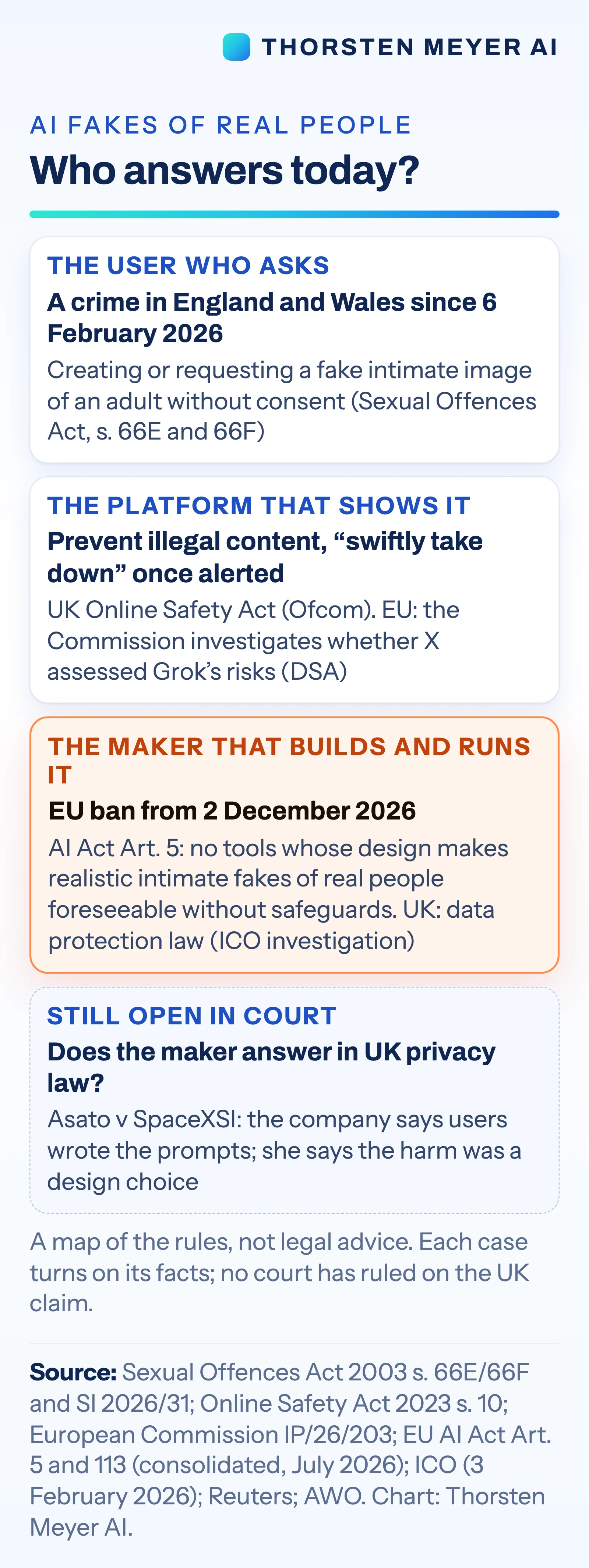
The case could test how existing privacy and data protection claims apply when an AI system produces sexualised images of an identifiable person. It puts model design and safeguards alongside user conduct and platform distribution as potential parts of the responsibility question. The case is among the early claims examining liability tied to an AI system’s design, according to Reuters and Asato’s lawyers; that description does not mean the court has decided the issue.
The timing also matters for people and businesses that offer or use image generators. In England and Wales, creating or requesting a fake intimate image of an adult without consent has been a crime since February 6, 2026, according to the source material. That rule gives users a legal risk to consider when making such requests. It does not, by itself, resolve the separate civil claims or establish what responsibility an AI provider has in Asato’s case.
For businesses, the case puts practical choices under scrutiny: what safeguards a system has, how its instructions constrain outputs and how reports of harmful content are handled. Those measures may be relevant evidence in disputes, but the source material does not establish what evidence will be presented or how the judge will weigh it. For people targeted by manipulated images, the case may clarify which routes are available to challenge the conduct and seek remedies.
Products Worth Considering

DJI Mini 3 Drone with DJI RC Controller

Bose Lifestyle Ultra Wireless Home Speaker, White Smoke

Jackery Fridge Guard 1024Wh Backup Power Station with Mount
As an affiliate, we earn on qualifying purchases.
How the Case Reached Court
According to AWO, Grok was used to manipulate images of Asato in early January. On January 7, the UK Information Commissioner’s Office (ICO) said it had contacted X and xAI to seek information about their safeguards under UK data protection law. In mid-January, xAI said it restricted image editing in Grok and blocked requests to generate images of people in revealing clothing “where it’s illegal,” Reuters reported.
The European Commission opened a Digital Services Act investigation of X over Grok on January 26, according to the timeline in the source material. The ICO opened formal investigations into X and X.AI LLC on February 3. On March 26, an Amsterdam court ordered limits on Grok and X concerning undressing images, with a stated penalty of €100,000 a day. These are separate regulatory and court developments; they do not determine Asato’s UK claim.
Asato filed in the High Court on June 3. The company’s defence followed on October 29 and was reported by Reuters on November 19. The source material says an EU AI Act ban on systems generating realistic intimate images of identifiable people without consent is due to apply from December 2, 2026, where that outcome is foreseeable from the system’s design and safeguards are missing.
““did not determine the content of the relevant users’ prompts””
— SpaceX Super Intelligence LLC, as reported by Reuters
Questions the Judge Must Resolve
The case remains undecided. The available source material does not provide a judgment, hearing schedule or account of the evidence the parties will present. It is not clear how the court will assess whether the images were recognisable as fictitious, what role the system’s design played, or whether the company’s actions meet its legal duties.
The scope of the claim and the eventual remedy also remain unsettled. Asato seeks damages and an order relating to images of her; the defence disputes her entitlement to that order. The source material does not say whether she will seek a broader ruling about Grok or what technical measures, if any, the court could require.
Regulatory investigations and the Amsterdam order are distinct from this lawsuit. Their outcomes and any further action by UK or EU authorities are not set out in the supplied material. The December 2 EU AI Act start date is approaching, but the source does not explain how the new provision would apply to this dispute or to any particular system.
The UK Claim and EU Rules
The next major step in the UK case is for the High Court to consider the parties’ pleadings and evidence. No hearing date or decision is identified in the available source material, so the timing of a ruling is unknown. Any judgment would address the claims before that court; its reach would depend on the issues the judge decides.
The EU AI Act provision described in the source material is scheduled to apply from December 2, 2026. The ICO and European Commission investigations are also listed as ongoing, with no outcome provided. Further statements, filings or regulatory decisions could add detail about the safeguards at issue and the responsibilities each party accepts or disputes.
Key Questions
What is Jess Asato’s lawsuit about?
Asato alleges misuse of private information and breaches of data protection law over sexualised fake images of her generated with Grok. She seeks damages, a declaration and an order for measures to prevent Grok from making manipulated images of her. The allegations have not been decided by a court.
What does SpaceXSI say in its defence?
According to Reuters, the company denies liability. It says it removed images that breached its terms, argues that viewers would recognise the relevant content as fictitious and says it did not determine users’ prompts.
Has a court decided who is responsible?
No. The High Court claim is ongoing, and the available source material reports no ruling on the allegations or the defence.
What other legal developments are mentioned?
The source says creating or requesting a fake intimate image of an adult without consent has been a crime in England and Wales since February 6, 2026. It also lists UK and EU investigations and an Amsterdam court order, which are separate from Asato’s claim.
Source: Thorsten Meyer AI