TL;DR

Get privacy and security gear delivered free with Prime
- Fast, free delivery on millions of items
- Prime Video, Amazon Music and more included
- Member-only deals all year
A report on Courk’s Blog describes using a custom laser fault-injection platform to bypass the RP2350’s Secure Boot protections and recover a challenge secret. The author says a single laser-induced fault was sufficient, but the supplied material does not include the full attack procedure, Raspberry Pi’s response, or independent confirmation of the result.
Security researcher Courk says a custom laser fault-injection platform bypassed Secure Boot on a Raspberry Pi Pico 2 built around the RP2350 microcontroller, allowing recovery of a secret stored in protected one-time-programmable memory. The report describes work submitted to Raspberry Pi after the researcher completed the RP2350 Hacking Challenge, but the supplied source material does not establish whether the company independently verified the result or changed the chip’s protections.
The challenge device was configured to store secret data in an OTP area, enable Secure Boot, disable the Serial Wire Debug interface and activate security measures including glitch detectors. It also ran signed firmware intended to restrict access to the area containing the secret. The challenge asked participants to recover that data, potentially by bypassing Secure Boot.
Courk’s report says the researcher chose laser fault injection rather than searching for a software flaw in the Boot ROM. The method directs a focused laser at exposed silicon; the report explains that light can cause temporary transistor malfunctions. Courk says a single laser-induced fault was enough to bypass Secure Boot, though the excerpt provided for this article does not include the complete experimental results or the steps used to produce the fault.
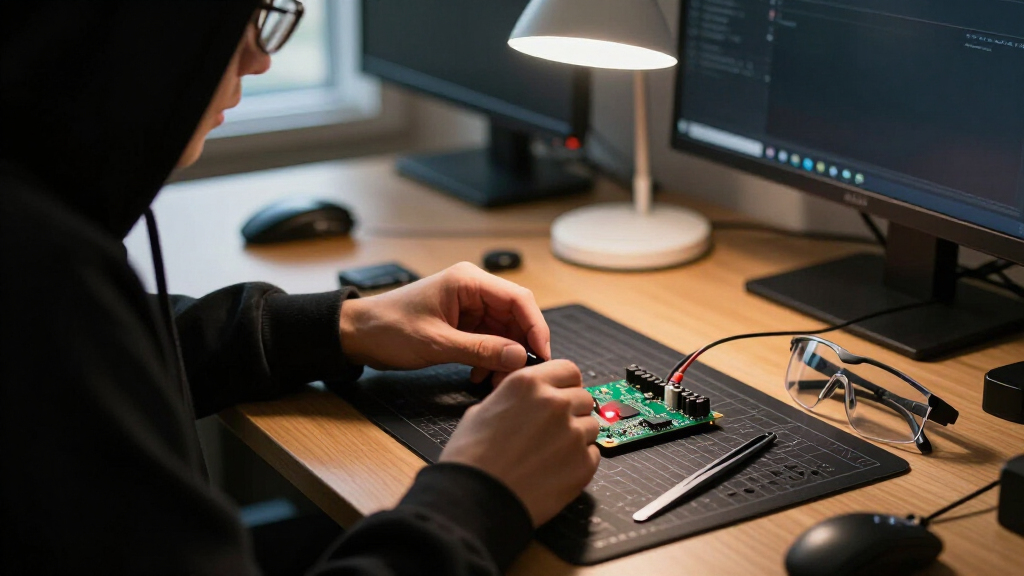
The researcher built a platform described as custom and low-cost and says manufacturing files were included in the original article for people interested in reproducing the work. The article also warns that the setup uses a high-power infrared laser, which can be hazardous. Its technical details should be treated as the author’s account, rather than as an independently validated security assessment.
What the Attack Says About RP2350 Defenses
The report matters because the RP2350’s security design is intended to resist physical fault attacks as well as software-level attempts to defeat its boot process. Its Boot ROM uses a Redundancy Co-Processor to support checks such as execution-order validation, protected boolean and integer values, stack canaries, and processor halts after detected panic conditions. The chip also includes configurable detectors intended to respond to voltage or electromagnetic glitches.
Courk’s account suggests that those defenses did not prevent the reported laser-based attack on the challenge configuration. That does not, by itself, show that all RP2350 devices or real-world products using the chip can be compromised in the same way. The result is specific to a prepared Pico 2 challenge device and a physical attack requiring access to the silicon die. For designers, the episode highlights that security protections against one class of fault injection may not cover other physical techniques.
The reported low cost of the setup is relevant to hardware security testing: specialized equipment is not necessarily the only route to laboratory fault-injection work. Still, the report’s description does not provide a verified price comparison or establish how repeatable the platform is across devices. The practical risk depends on an attacker’s physical access, equipment, target configuration and ability to reproduce the fault.
As an affiliate, we earn on qualifying purchases.
The DEF CON 2024 Challenge Setup
Raspberry Pi introduced the RP2350 in August 2024 as a successor to the RP2040 with additional capabilities, including Secure Boot. A few days after the announcement, an RP2350 hacking challenge was launched during DEF CON 2024. The challenge repository supplied instructions for setting up a Pico 2 with protected data, locked-down security settings and signed firmware.
The report says the Boot ROM had been audited before the challenge opened, which informed Courk’s decision to pursue a hardware attack rather than look for a logic error in the ROM. The author also points to existing attempts to make laser fault injection more accessible, including repurposing laser-engraving hardware and NetSPI’s RayV-Lite project. Courk notes that a presentation about RayV-Lite was available at Black Hat 2024; these examples are background, not evidence that the platforms use identical methods or produce comparable results.
Laser fault injection requires access to the chip’s die, so the package must be opened while keeping the device capable of operating. Courk’s report says the die was exposed from the backside of the chip. That physical preparation distinguishes the technique from attacks that can be attempted through ordinary software access or by manipulating a device’s external power supply.
“The redundancy coprocessor (RCP) is used in the RP2350 bootrom to provide hardware-assisted mitigation against fault injection and return-oriented programming attacks.”
— RP2350 datasheet, as quoted in Courk’s report
low-cost laser fault injection kit
As an affiliate, we earn on qualifying purchases.
As an affiliate, we earn on qualifying purchases.
Verification and Exposure Questions
The supplied source material is an excerpt and does not show the full experimental account. It does not provide enough detail to independently assess the reported fault, its repeatability, the precise conditions required, or the range of RP2350 devices affected. Although Courk says the findings were submitted to Raspberry Pi, the company’s assessment or response is not included.
It is also unclear from the material whether the challenge’s exact configuration is representative of products that use the RP2350, or whether a successful attack would be practical outside a controlled lab. The report’s description of the setup as low-cost is not accompanied here by a specific total price or a comparison baseline. No claim about a broader product vulnerability, patch, or mitigation can be confirmed from the supplied text.
As an affiliate, we earn on qualifying purchases.
Company Review and Replication
The next useful developments would be a response from Raspberry Pi and independent technical review of the complete report. Reproduction by other researchers could help establish how reliably the fault can be induced, which device configurations are affected and whether the challenge’s protections can be adjusted to resist this attack path.
Readers seeking the build details should consult Courk’s original report, while following its safety warning: the platform uses a high-power infrared laser. Until more verification or a manufacturer statement is available, the finding is best described as a researcher-reported bypass on a configured challenge device, not a confirmed compromise of every RP2350-based product.
hardware fault injection equipment
As an affiliate, we earn on qualifying purchases.
As an affiliate, we earn on qualifying purchases.
Key Questions
What did the researcher report?
Courk says a custom laser fault-injection setup bypassed Secure Boot on a configured RP2350 Pico 2 challenge device and recovered secret data stored in OTP memory.
What is laser fault injection?
It is a physical testing technique that directs a focused laser at exposed chip silicon. As Courk explains, light can trigger temporary faults in transistors, potentially disrupting security checks when precisely timed.
Does the report show that all RP2350 devices are vulnerable?
No. The reported result concerns a challenge device configured with particular security settings. The supplied material does not establish the attack’s applicability to every RP2350 product or configuration.
Has Raspberry Pi confirmed the finding?
Courk says the findings were submitted to Raspberry Pi, but the source material supplied here does not include a company statement or independent confirmation.
Can the setup be built safely at home?
The original report warns that the platform uses a high-power infrared laser, which can be hazardous. The source material does not provide enough information to assess an individual’s ability to build or operate it safely.
Source: hn
Halloween Picks
halloween
As an affiliate, we earn on qualifying purchases.