Portable VPN routers let you route several devices through a VPN connection while traveling, but speed, setup, and internet access vary widely. My best overall pick is the GL.iNet GL-A1300 Slate Plus, a practical balance of VPN-focused features and travel-friendly design. The GL.iNet GL-MT3000 Beryl AX is a strong alternative for buyers who want Wi-Fi 6, while the GL.iNet GL-E5800 MUDI 7 stands apart for cellular connectivity and eSIM support. Compact low-cost models can be easier to pack, but may offer less speed or flexibility; newer Wi-Fi standards do not help if the hotel connection is the bottleneck. Read on for the full comparison and advice on choosing a router that suits your trip.

Get privacy and security gear delivered free with Prime
- Fast, free delivery on millions of items
- Prime Video, Amazon Music and more included
- Member-only deals all year
Key Takeaways
- The Slate Plus is the balanced pick: It leads this lineup for buyers who want a travel router with VPN capability without moving to a larger cellular or premium Wi-Fi 7 model.
- The Beryl AX offers a different kind of value: Its Wi-Fi 6 positioning makes it a sensible step up from basic compact routers for travelers connecting several modern devices.
- Cellular models solve a separate problem: The MUDI 7 and MUDI 4G LTE can provide mobile internet options, while ordinary travel routers generally depend on an existing wired or wireless connection.
- Wi-Fi 7 is not an automatic reason to upgrade: The Slate 7, Beryl 7, Roam 7, and ASUS RT-BE58 Go make more sense when your devices and internet source can benefit from newer wireless capabilities.
- Smallest and most capable are not the same: The Mango prioritizes a compact, simple role, while larger or newer models trade packability and simplicity for more connectivity choices.
| GL.iNet GL-A1300 Slate Plus Portable Dual-Band VPN Travel Router |  | Best for Customization | Wi-Fi: Wi-Fi 5, dual-band 2.4 GHz and 5 GHz | Maximum wireless rate: 400 Mbps at 2.4 GHz + 867 Mbps at 5 GHz | VPN: OpenVPN up to 28 Mbps; WireGuard up to 170 Mbps | VIEW LATEST PRICE | See Our Full Breakdown |
| GL.iNet GL-SFT1200 Opal Travel Router | 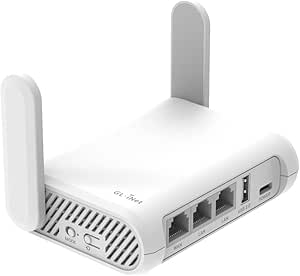 | Best Lightweight Pick | Wi-Fi: Wi-Fi 5, dual-band | Maximum wireless rate: 300 Mbps at 2.4 GHz + 867 Mbps at 5 GHz | VPN: OpenVPN and WireGuard | VIEW LATEST PRICE | See Our Full Breakdown |
| TP-Link Roam 7 BE3600 Wi-Fi 7 Portable Dual-Band Travel Router |  | Best for Large Device Groups | Wi-Fi: Wi-Fi 7, dual-band 2.4 GHz and 5 GHz | Maximum wireless rate: Up to 2882 Mbps at 5 GHz and 688 Mbps at 2.4 GHz | Device capacity: Up to 90 devices | VIEW LATEST PRICE | See Our Full Breakdown |
| GL.iNet GL-BE3600 Slate 7 Wi-Fi 7 Travel Router with Touchscreen |  | Best Premium Control | Wi-Fi: Wi-Fi 7, dual-band 2.4 GHz and 5 GHz | Maximum wireless rate: 688 Mbps at 2.4 GHz + 2882 Mbps at 5 GHz | VPN: OpenVPN up to 100 Mbps; WireGuard up to 540 Mbps; client and server | VIEW LATEST PRICE | See Our Full Breakdown |
| GL.iNet GL-MT300N-V2 Mango Portable Travel Wi-Fi Router |  | Best Ultra-Light Budget-Feature Pick | Wi-Fi: Wi-Fi 4 (802.11b/g/n), 2.4 GHz | Maximum wireless rate: Up to 300 Mbps | VPN: OpenVPN client pre-installed | VIEW LATEST PRICE | See Our Full Breakdown |
| GL.iNet GL-E5800 MUDI 7 5G Tri-Band Wi-Fi 7 Travel Router with eSIM |  | Best for Cellular Flexibility | Wi-Fi: Tri-band Wi-Fi 7: 688 Mbps (2.4 GHz), 2,882 Mbps (5 GHz), 5,765 Mbps (6 GHz) | Cellular: 5G and LTE; maximum listed 5G download speed 4.67 Gbps | SIM support: Built-in eSIM and two nano-SIM slots; dual standby | VIEW LATEST PRICE | See Our Full Breakdown |
| TP-Link Roam 6 AX1500 Portable Wi-Fi 6 Travel Router (TL-WR1502X) |  | Best for Straightforward Hotel Wi-Fi Sharing | Wi-Fi: Wi-Fi 6, dual-band; up to 1,500 Mbps total listed wireless speed | Band speeds: Up to 1,201 Mbps on 5 GHz and 300 Mbps on 2.4 GHz | Ethernet: Two 10/100/1000 Mbps Ethernet ports | VIEW LATEST PRICE | See Our Full Breakdown |
| GL.iNet GL-MT3600BE Beryl 7 Dual-Band Wi-Fi 7 Travel Router |  | Best for VPN Power and Customization | Wi-Fi: Dual-band Wi-Fi 7: 688 Mbps (2.4 GHz) and 2,882 Mbps (5 GHz) | Ethernet: Two 2.5G ports: one WAN and one LAN | VPN: WireGuard and OpenVPN client and server support | VIEW LATEST PRICE | See Our Full Breakdown |
| TP-Link Roam 6 AX3000 Dual-Band Wi-Fi 6 Travel Router (TL-WR3002X) |  | Best for App-Based VPN Sharing | Wi-Fi: Dual-band Wi-Fi 6: up to 2,402 Mbps on 5 GHz and 574 Mbps on 2.4 GHz | Ethernet: One 2.5 Gbps WAN/LAN port and one 1 Gbps LAN port | VPN: OpenVPN and WireGuard client and server; PPTP and L2TP | VIEW LATEST PRICE | See Our Full Breakdown |
| GL.iNet GL-E750V2 MUDI 4G LTE Portable Travel Router |  | Best for Budget-Conscious Cellular VPN Travel | Cellular: 4G LTE Cat 6 with SIM card slot | Wi-Fi: Dual-band Wi-Fi 5; up to 300 Mbps on 2.4 GHz and 433 Mbps on 5 GHz | VPN: OpenVPN and WireGuard | VIEW LATEST PRICE | See Our Full Breakdown |
| TP-Link Roam 6 AX1500 Portable Dual-Band Wi-Fi 6 Travel Router |  | Best for Easy Setup | Wi-Fi standard: Wi-Fi 6 (802.11ax) | Bands and maximum speeds: Dual-band; up to 1,201 Mbps on 5 GHz and 300 Mbps on 2.4 GHz | VPN protocols: OpenVPN and WireGuard | VIEW LATEST PRICE | See Our Full Breakdown |
| GL.iNet GL-MT3000 Beryl AX Wi-Fi 6 Travel Router | 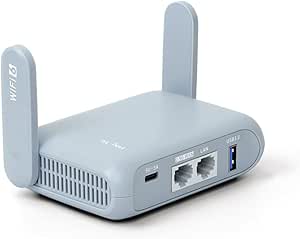 | Best for OpenWrt Flexibility | Wi-Fi generation: Wi-Fi 6 | Bands and wireless speeds: Dual-band; 574 Mbps on 2.4 GHz and 2,402 Mbps on 5 GHz | Operating system: OpenWrt 21.02 | VIEW LATEST PRICE | See Our Full Breakdown |
| ASUS RT-BE58 Go WiFi 7 Dual-Band Travel Router |  | Best Premium Connectivity | Wi-Fi generation: Wi-Fi 7 (802.11be) | Bands and maximum speeds: Dual-band; up to 688 Mbps on 2.4 GHz and 2,882 Mbps on 5 GHz | Maximum combined Wi-Fi speed: Up to 3.6 Gbps | VIEW LATEST PRICE | See Our Full Breakdown |
| GL.iNet GL-AXT1800 Slate AX Wi-Fi 6 Travel Router with VPN |  | Best for High-Capacity VPN Sharing | Wi-Fi generation: Wi-Fi 6 (802.11ax) | Bands and maximum speeds: Dual-band; up to 600 Mbps on 2.4 GHz and 1,200 Mbps on 5 GHz | Maximum connected devices: Up to 120 | VIEW LATEST PRICE | See Our Full Breakdown |
| portable VPN router | Wi-Fi | VPN | Operating system | Ethernet |
|---|---|---|---|---|
| GL.iNet GL-A1300 Slate Plus Po | Wi-Fi 5, dual-band 2.4 GHz and 5 GHz | OpenVPN up to 28 Mbps; WireGuard up to 170 Mbps | OpenWrt 21.02 | — |
| GL.iNet GL-SFT1200 Opal Travel | Wi-Fi 5, dual-band | OpenVPN and WireGuard | OpenWrt | — |
| TP-Link Roam 7 BE3600 Wi-Fi 7 | Wi-Fi 7, dual-band 2.4 GHz and 5 GHz | — | — | — |
| GL.iNet GL-BE3600 Slate 7 Wi-F | Wi-Fi 7, dual-band 2.4 GHz and 5 GHz | OpenVPN up to 100 Mbps; WireGuard up to 540 Mbps; client and server | OpenWrt 23.05, Kernel 5.4.213 | 2 × 2.5G ports: 1 WAN and 1 LAN |
| GL.iNet GL-MT300N-V2 Mango Por | Wi-Fi 4 (802.11b/g/n), 2.4 GHz | OpenVPN client pre-installed | OpenWrt | 2 ports; 100 Mbps LAN bandwidth |
| GL.iNet GL-E5800 MUDI 7 5G Tri | Tri-band Wi-Fi 7: 688 Mbps (2.4 GHz), 2,882 Mbps (5 GHz), 5,765 Mbps (6 GHz) | OpenVPN-DCO up to 700 Mbps; WireGuard up to 600 Mbps | — | One 2.5 Gbps WAN/LAN port |
| TP-Link Roam 6 AX1500 Portable | Wi-Fi 6, dual-band; up to 1,500 Mbps total listed wireless speed | — | — | Two 10/100/1000 Mbps Ethernet ports |
| GL.iNet GL-MT3600BE Beryl 7 Du | Dual-band Wi-Fi 7: 688 Mbps (2.4 GHz) and 2,882 Mbps (5 GHz) | WireGuard and OpenVPN client and server support | OpenWrt 21.02, Kernel 5.4.281 | Two 2.5G ports: one WAN and one LAN |
| TP-Link Roam 6 AX3000 Dual-Ban | Dual-band Wi-Fi 6: up to 2,402 Mbps on 5 GHz and 574 Mbps on 2.4 GHz | OpenVPN and WireGuard client and server; PPTP and L2TP | — | One 2.5 Gbps WAN/LAN port and one 1 Gbps LAN port |
| GL.iNet GL-E750V2 MUDI 4G LTE | Dual-band Wi-Fi 5; up to 300 Mbps on 2.4 GHz and 433 Mbps on 5 GHz | OpenVPN and WireGuard | OpenWrt | — |
| TP-Link Roam 6 AX1500 Portable | — | — | — | One 1 Gbps WAN/LAN port and one 1 Gbps LAN port |
| GL.iNet GL-MT3000 Beryl AX Wi- | — | — | OpenWrt 21.02 | — |
| ASUS RT-BE58 Go WiFi 7 Dual-Ba | — | — | — | — |
| GL.iNet GL-AXT1800 Slate AX Wi | — | — | OpenWrt 21.02 | — |
More Details on Our Top Picks
GL.iNet GL-A1300 Slate Plus Portable Dual-Band VPN Travel Router
The Slate Plus is a strong fit for travelers who want more control than a basic hotspot router provides. Its OpenWrt base supports customization, while OpenVPN and WireGuard, VPN routing policies, and a kill switch give you ways to direct and protect connected devices. Compared with the lighter GL.iNet Opal, it weighs more but adds USB-based network storage and more room for advanced network setups. Dual-band Wi-Fi and gigabit LAN also make it a more capable hub for a hotel room or temporary workspace. The tradeoff is VPN throughput: its stated maximum is 170 Mbps with WireGuard and 28 Mbps with OpenVPN, so it may not suit users who need high VPN speeds. The configurable physical switch also takes setup before it does anything useful.
Pros:- OpenWrt supports advanced configuration and application installation
- OpenVPN, WireGuard, VPN routing policies, and a kill switch support flexible traffic protection
- USB storage can be shared through SAMBA and WebDAV
- Dual-band Wi-Fi, Ethernet, and tethering offer several ways to connect
Cons:- Maximum VPN speeds are limited to 170 Mbps with WireGuard and 28 Mbps with OpenVPN
- The physical switch must be configured before it can control a feature
- At 429 g, it is heavier than the 145 g GL.iNet Opal
Best for: Travelers who want OpenWrt customization, VPN routing controls, and USB-drive network storage in a compact dual-band router
Not ideal for: VPN users who need high OpenVPN throughput or buyers who want a physical VPN switch that works without configuration
- Wi-Fi:Wi-Fi 5, dual-band 2.4 GHz and 5 GHz
- Maximum wireless rate:400 Mbps at 2.4 GHz + 867 Mbps at 5 GHz
- VPN:OpenVPN up to 28 Mbps; WireGuard up to 170 Mbps
- Processor:IPQ4018 at 717 MHz
- Memory:256 MB RAM
- Ports:3 ports; gigabit LAN
- Operating system:OpenWrt 21.02
- Dimensions and weight:118 × 84 × 33 mm; 429 g
Our verdict“Choose the Slate Plus if customization and network-storage options matter more than the lightest carry or faster VPN throughput.”
GL.iNet GL-SFT1200 Opal Travel Router
At 145 g, the Opal is the easy carry choice in this group for travelers who want VPN support without bringing a larger router. It turns a wired connection or public Wi-Fi into a private dual-band network, and its OpenVPN and WireGuard support covers common VPN setups. Compared with the more customizable GL.iNet Slate Plus, the Opal is lighter and has retractable antennas, but it gives up Slate Plus features such as USB-drive network storage and tethering support. Its gigabit WAN and LAN ports are useful when a wired connection is available, while the antennas can be repositioned to help reception. The compromises are practical: public Wi-Fi may need manual reconnection after a hotspot session expires, and the VPN switch needs configuration before it works. It is less suited to travelers who depend on tethering.
Pros:- Light 145 g design is easy to pack
- OpenVPN and WireGuard are pre-installed, with compatibility for more than 30 VPN providers
- Gigabit WAN and LAN ports support wired connections
- Retractable antennas provide room to adjust reception
Cons:- Does not support easy tethering
- The VPN toggle requires manual setup before use
- Public Wi-Fi repeater mode may need manual reconnection when hotspot access expires
Best for: Light-pack travelers who want a compact dual-band VPN router for hotel Ethernet or public Wi-Fi
Not ideal for: Travelers who need easy phone tethering, automatic recovery from hotspot time limits, or extensive USB storage features
- Wi-Fi:Wi-Fi 5, dual-band
- Maximum wireless rate:300 Mbps at 2.4 GHz + 867 Mbps at 5 GHz
- VPN:OpenVPN and WireGuard
- Ports:2 gigabit LAN ports and 1 gigabit WAN port
- Operating system:OpenWrt
- Antennas:2 retractable antennas
- RAM:128 MB
- Weight:145 g
Our verdict“Pick the Opal for a lightweight, dual-band travel router when wired or public Wi-Fi is your main internet source.”
TP-Link Roam 7 BE3600 Wi-Fi 7 Portable Dual-Band Travel Router
The Roam 7 suits trips where several people or devices need to share one connection: it supports up to 90 devices and can create a private network from public Wi-Fi, Ethernet, or USB tethering. Its Wi-Fi 7 speeds and 2.5 Gbps WAN port give it more modern wireless and wired capacity than the Wi-Fi 5 GL.iNet Opal. Multiple operating modes also let it serve as a router, access point, range extender, or client, making it adaptable beyond hotel use. VPN support includes OpenVPN and WireGuard, among other protocols. This is not a self-contained mobile internet device, though: it needs an external connection and has no SIM or eSIM support. Buyers who value open-source firmware should also note that it does not support OpenWrt, and its dual-band design lacks 6 GHz Wi-Fi.
Pros:- Supports up to 90 connected devices
- Wi-Fi 7 and a 2.5 Gbps WAN port provide stronger connection capacity than Wi-Fi 5 travel routers
- Works with public Wi-Fi, Ethernet, or USB tethering
- Router, hotspot, access point, range-extender, and client modes offer flexible use
Cons:- Requires an external internet source and has no SIM or eSIM support
- Does not support OpenWrt
- Dual-band hardware does not include a 6 GHz band
Best for: Families, work teams, and travelers sharing an external internet connection across many devices
Not ideal for: People who need built-in cellular data, 6 GHz Wi-Fi, or OpenWrt-based customization
- Wi-Fi:Wi-Fi 7, dual-band 2.4 GHz and 5 GHz
- Maximum wireless rate:Up to 2882 Mbps at 5 GHz and 688 Mbps at 2.4 GHz
- Device capacity:Up to 90 devices
- Ports:1 × 2.5 Gbps WAN, 1 × 1 Gbps LAN, USB 3.0, USB-C power
- VPN protocols:OpenVPN, WireGuard, PPTP, and L2TP
- Operating modes:Router, hotspot, access point, range extender, and client
- Power:USB-C; included adapter or 5 V PD power source
- Cellular support:No SIM or eSIM support
Our verdict“Choose the Roam 7 for a shared, high-capacity travel network, but skip it if you need cellular service built into the router.”
GL.iNet GL-BE3600 Slate 7 Wi-Fi 7 Travel Router with Touchscreen
The Slate 7 is the most control-oriented pick here: a built-in touchscreen lets you check network status and manage features without relying on a separate app or browser session. It pairs that convenience with OpenWrt 23.05, Wi-Fi 7, two 2.5G Ethernet ports, and both VPN client and server support. Against the TP-Link Roam 7, it offers OpenWrt for deeper customization and a screen for on-device management; the Roam 7 instead lists support for up to 90 devices and a wider range of operating modes. The Slate 7’s stated VPN ceilings—540 Mbps with WireGuard and 100 Mbps with OpenVPN—are distinct from its faster Wi-Fi figures, so VPN traffic will not run at the headline wireless rate. Its advanced controls also demand more setup than a simple travel hotspot, and VPN service requires a compatible subscription.
Pros:- Touchscreen supports on-device network monitoring and VPN control
- OpenWrt 23.05 allows extensive customization and plugin installation
- Two 2.5G Ethernet ports support fast wired links
- WireGuard and OpenVPN work in client and server modes
Cons:- VPN service requires a compatible VPN subscription
- Maximum stated VPN speeds are lower than the maximum wireless rate
- The physical button needs configuration before it can toggle features
Best for: Technically confident travelers who want on-device controls, OpenWrt customization, and fast wired connections
Not ideal for: Buyers seeking the simplest plug-and-play option, or those expecting VPN speeds to match the router’s maximum Wi-Fi rate
- Wi-Fi:Wi-Fi 7, dual-band 2.4 GHz and 5 GHz
- Maximum wireless rate:688 Mbps at 2.4 GHz + 2882 Mbps at 5 GHz
- VPN:OpenVPN up to 100 Mbps; WireGuard up to 540 Mbps; client and server
- Ethernet:2 × 2.5G ports: 1 WAN and 1 LAN
- USB:1 × USB 3.0
- Memory and storage:2 GB RAM; 512 MB storage
- Operating system:OpenWrt 23.05, Kernel 5.4.213
- Control and power:Touchscreen and app; 12 V DC
Our verdict“Choose the Slate 7 if you want touchscreen convenience and OpenWrt-level control in a fast Wi-Fi 7 travel router.”
GL.iNet GL-MT300N-V2 Mango Portable Travel Wi-Fi Router
The Mango weighs just 39 g, making it the most compact choice in this group for travelers who want basic VPN routing with minimal baggage. Its OpenWrt software and pre-installed OpenVPN client let it turn wired or public Wi-Fi into a private network, and USB power means a laptop or power bank can supply electricity. Compared with the dual-band GL.iNet Opal, the Mango is dramatically lighter but gives up 5 GHz Wi-Fi, gigabit ports, and WireGuard support. That makes it a better match for modest browsing and simple travel setups than busy work sessions or demanding connections. Its 2.4 GHz Wi-Fi tops out at 300 Mbps, while its Ethernet ports are limited to 100 Mbps. Buyers also need to provide their own power adapter if they want a wall-powered setup.
Pros:- Very light at 39 g and compact enough for a small travel kit
- OpenWrt and a pre-installed OpenVPN client support VPN routing
- Can be powered from a laptop USB port or power bank
- Converts wired or public Wi-Fi into a private network
Cons:- Single-band 2.4 GHz Wi-Fi is less flexible than the dual-band GL.iNet Opal
- Ethernet ports are limited to 100 Mbps
- Power adapter is not included
Best for: Minimalist travelers who need a tiny USB-powered router for basic OpenVPN use and light connectivity
Not ideal for: People who need dual-band Wi-Fi, WireGuard, gigabit Ethernet, or higher-capacity VPN performance
- Wi-Fi:Wi-Fi 4 (802.11b/g/n), 2.4 GHz
- Maximum wireless rate:Up to 300 Mbps
- VPN:OpenVPN client pre-installed
- Ethernet:2 ports; 100 Mbps LAN bandwidth
- USB:USB 2.0
- Operating system:OpenWrt
- Memory and storage:128 MB RAM; 16 MB flash
- Weight and power:39 g; 5 V input
Our verdict“Pick the Mango when low weight and USB power matter more than dual-band performance, WireGuard, or fast wired networking.”
GL.iNet GL-E5800 MUDI 7 5G Tri-Band Wi-Fi 7 Travel Router with eSIM
The MUDI 7 is the most self-contained VPN option here: its built-in eSIM and two nano-SIM slots let you connect without relying on hotel Wi-Fi or a phone hotspot. That sets it apart from the TP-Link Roam 6 AX3000, which needs an external internet source, and its tri-band Wi-Fi 7 and support for up to 64 devices suit a group sharing one connection. OpenVPN-DCO and WireGuard are built in, while the touchscreen makes SIM selection and VPN controls more accessible than a typical travel router interface. The tradeoff is that this cellular flexibility adds complexity, and the eSIM activation uses one of the SIM positions. Its 5,150 mAh battery is rated for up to 13.5 hours, but actual runtime and cellular or VPN speeds vary with conditions. I’d choose it for mobile independence, not simplicity.
Pros:- Built-in eSIM plus two nano-SIM slots provide several ways to connect on the road.
- OpenVPN-DCO and WireGuard support with listed speeds up to 700 Mbps and 600 Mbps, respectively.
- Multi-WAN failover can switch among Ethernet, Wi-Fi repeater, USB tethering, and 5G.
- Touchscreen provides access to VPN controls, SIM switching, and data-usage monitoring.
Cons:- The eSIM activation uses one of the available SIM positions.
- Cellular data plans and VPN service may require separate arrangements.
- Advertised battery life and connection speeds vary with use and network conditions.
Best for: Travelers who want built-in 5G and flexible eSIM or physical-SIM options for several devices without depending on hotel Wi-Fi.
Not ideal for: Light packers who usually have dependable Wi-Fi or phone tethering and do not need cellular hardware, a touchscreen, or multiple WAN options.
- Wi-Fi:Tri-band Wi-Fi 7: 688 Mbps (2.4 GHz), 2,882 Mbps (5 GHz), 5,765 Mbps (6 GHz)
- Cellular:5G and LTE; maximum listed 5G download speed 4.67 Gbps
- SIM support:Built-in eSIM and two nano-SIM slots; dual standby
- VPN:OpenVPN-DCO up to 700 Mbps; WireGuard up to 600 Mbps
- Ethernet:One 2.5 Gbps WAN/LAN port
- USB-C:10 Gbps; supports tethering, OTG storage, and NAS sync
- Battery:5,150 mAh; rated for up to 13.5 hours
- Display and capacity:2.8-inch color touchscreen; supports up to 64 connected devices
Our verdict“Choose the MUDI 7 if built-in 5G and flexible SIM options matter more than keeping your travel router simple.”
TP-Link Roam 6 AX1500 Portable Wi-Fi 6 Travel Router (TL-WR1502X)
The Roam 6 AX1500 keeps the job simple: take an existing connection from public Wi-Fi, Ethernet, or USB phone tethering and share it through a private network. Its router, hotspot, access point, repeater, and client modes make it more adaptable than a basic Wi-Fi repeater, and USB-C power makes a compatible power bank an option. Compared with the Roam 6 AX3000, this model has lower listed wireless speeds and fewer advanced storage and VPN features; its appeal is a compact, uncomplicated connection-sharing setup. It does not include a modem, SIM or eSIM support, or OpenWrt, so there’s no independent cellular connection and less room for software customization. I’d shortlist it for travelers who need a basic gateway for hotel or phone-supplied internet, rather than a router that can get online by itself.
Pros:- Accepts internet from public Wi-Fi, Ethernet, or USB phone tethering.
- Multiple operating modes allow it to share, extend, or connect to existing networks.
- Two gigabit Ethernet ports support wired devices and network connections.
- Compact body and USB-C power support travel-friendly placement and compatible power-bank use.
Cons:- Requires an external internet connection and has no SIM or eSIM support.
- Does not support OpenWrt, limiting software customization.
- USB port is USB 2.0, and its listed wireless capacity is below the Roam 6 AX3000.
Best for: Travelers who mainly want to share hotel Wi-Fi, wired internet, or a tethered phone connection across their devices.
Not ideal for: People who need cellular service built into the router, OpenWrt customization, or advanced VPN client features.
- Wi-Fi:Wi-Fi 6, dual-band; up to 1,500 Mbps total listed wireless speed
- Band speeds:Up to 1,201 Mbps on 5 GHz and 300 Mbps on 2.4 GHz
- Ethernet:Two 10/100/1000 Mbps Ethernet ports
- USB:One USB 2.0 port
- Operating modes:Router, Hotspot, Access Point, Repeater, and Client
- Security:WPA-PSK, WPA2-Enterprise, and WPA3
- Power:USB-C; 5 V/3 A power source
- Dimensions:4.09 × 3.54 × 1.10 inches
Our verdict“Pick this model for compact, basic sharing of an internet connection you already have, not for standalone mobile data or advanced VPN configuration.”
GL.iNet GL-MT3600BE Beryl 7 Dual-Band Wi-Fi 7 Travel Router
The Beryl 7 is a strong fit for travelers who want a configurable VPN router with fast wired connections, rather than a built-in cellular modem. Its two 2.5G Ethernet ports give it more wired flexibility than the TP-Link Roam 6 AX1500, and the listed WireGuard VPN speed of up to 1,100 Mbps makes it better suited to high-throughput VPN use than the older MUDI 4G. OpenWrt, VPN client and server support, DNS over HTTPS/TLS, and a configurable physical switch offer meaningful control over how traffic is handled. Wi-Fi 7 operates on two bands here, not three, and the router needs an external internet source. The switch also needs configuration in the admin panel before it can control the chosen function. I’d favor it for users who will make use of those settings, not anyone seeking plug-and-play cellular access.
Pros:- Supports WireGuard and OpenVPN client and server use.
- Listed VPN throughput reaches up to 1,100 Mbps for WireGuard and 1,000 Mbps for OpenVPN-DCO.
- Two 2.5G Ethernet ports provide multi-gigabit wired connectivity.
- OpenWrt, DNS over HTTPS/TLS, and a configurable physical switch support network customization.
Cons:- Requires an external internet source; it has no listed cellular modem or SIM support.
- The physical switch must be configured in the admin panel before it controls a function.
- Wi-Fi is dual-band rather than tri-band, and actual throughput varies with network conditions.
Best for: VPN-conscious travelers who want OpenWrt controls, high listed VPN throughput, and multi-gigabit Ethernet in a portable router.
Not ideal for: Buyers who want built-in SIM connectivity, tri-band Wi-Fi, or the least hands-on setup.
- Wi-Fi:Dual-band Wi-Fi 7: 688 Mbps (2.4 GHz) and 2,882 Mbps (5 GHz)
- Ethernet:Two 2.5G ports: one WAN and one LAN
- VPN:WireGuard and OpenVPN client and server support
- Listed VPN speeds:Up to 1,100 Mbps for WireGuard and 1,000 Mbps for OpenVPN-DCO
- Operating system:OpenWrt 21.02, Kernel 5.4.281
- USB:One USB 3.0 port
- Device capacity:Up to 120 devices
- Memory:512 MB RAM
Our verdict“Choose the Beryl 7 if you want a customizable, high-throughput VPN router and can provide its internet connection separately.”
TP-Link Roam 6 AX3000 Dual-Band Wi-Fi 6 Travel Router (TL-WR3002X)
The Roam 6 AX3000 pairs a relatively approachable setup through the Tether app or web interface with VPN client and server support. It can turn public Wi-Fi, Ethernet, or USB tethering into a private network, then share files from USB storage or a microSD card. Compared with the simpler Roam 6 AX1500, it offers higher listed Wi-Fi speeds, a 2.5 Gbps WAN/LAN port, USB 3.0, and a wider set of VPN functions. It still needs an internet source outside the router: there’s no SIM support, and TP-Link does not support OpenWrt on this model. The 2.5 Gbps port is useful for compatible wired connections, but it does not make a weak hotel connection faster. I’d pick it for convenient VPN sharing and file access, not cellular independence or deep firmware customization.
Pros:- Supports OpenVPN and WireGuard clients and servers, plus PPTP and L2TP.
- Accepts public Wi-Fi, Ethernet, or USB tethering as its internet source.
- A 2.5 Gbps WAN/LAN port and USB 3.0 add wired and storage flexibility.
- Supports USB and microSD sharing, with microSD cards up to 512 GB.
Cons:- Requires an external internet connection and does not accept a SIM card.
- Does not support OpenWrt, limiting firmware customization.
- Actual wireless speed depends on the source connection, distance, and surroundings.
Best for: Travelers who want app-managed VPN sharing, fast wired connectivity, and portable storage access from existing internet connections.
Not ideal for: Users who need built-in cellular data or want to install OpenWrt packages and customize router firmware.
- Wi-Fi:Dual-band Wi-Fi 6: up to 2,402 Mbps on 5 GHz and 574 Mbps on 2.4 GHz
- Ethernet:One 2.5 Gbps WAN/LAN port and one 1 Gbps LAN port
- VPN:OpenVPN and WireGuard client and server; PPTP and L2TP
- Storage:USB 3.0 and microSD support up to 512 GB
- Processor:MTK dual-core 1.3 GHz
- Setup:TP-Link Tether app or web interface
- Power:USB-C; included adapter or 5 V PD power source
- Dimensions:4.1 × 3.5 × 1.1 inches
Our verdict“Choose the Roam 6 AX3000 for app-managed VPN sharing and storage access when you already have a connection to share.”
GL.iNet GL-E750V2 MUDI 4G LTE Portable Travel Router
The MUDI 4G combines a SIM-based LTE connection, battery power, and OpenVPN or WireGuard in one portable unit. That makes it more independent from hotel networks than the TP-Link Roam 6 AX3000, which must borrow internet from Wi-Fi, Ethernet, or a tethered phone. It also includes a 7,000 mAh battery and supports MicroSD cards up to 1 TB for local storage. The tradeoff is its older Wi-Fi 5 hardware and modest listed VPN speeds: up to 50 Mbps with WireGuard and 10 Mbps with OpenVPN. The newer MUDI 7 offers 5G, Wi-Fi 7, and much higher listed VPN throughput, while this model prioritizes a simpler LTE-and-battery package. Its separate physical eSIM card costs extra, and cellular service is restricted in listed regions. I’d choose it for basic mobile VPN access, not speed-heavy work.
Pros:- Built-in 4G LTE modem and SIM slot allow internet access without relying on local Wi-Fi.
- Supports both WireGuard and OpenVPN.
- The 7,000 mAh battery is rated for up to eight hours of use.
- MicroSD support accommodates cards up to 1 TB.
Cons:- Listed VPN speeds are limited to up to 50 Mbps for WireGuard and 10 Mbps for OpenVPN.
- The physical eSIM card is sold separately.
- Cellular functionality is unavailable in several listed regions.
Best for: Travelers who want a battery-powered LTE router with VPN support and MicroSD storage, and whose needs fit its modest VPN speeds.
Not ideal for: People who need fast VPN transfers, 5G, or cellular service in one of the listed restricted regions.
- Cellular:4G LTE Cat 6 with SIM card slot
- Wi-Fi:Dual-band Wi-Fi 5; up to 300 Mbps on 2.4 GHz and 433 Mbps on 5 GHz
- VPN:OpenVPN and WireGuard
- Listed VPN speeds:Up to 50 Mbps for WireGuard and 10 Mbps for OpenVPN
- Battery:7,000 mAh; rated for up to eight hours
- MicroSD:Supports cards up to 1 TB
- Operating system:OpenWrt
- Dimensions and weight:5.7 × 3.1 × 0.9 inches; 285 g
Our verdict“Choose the MUDI 4G for battery-powered LTE and basic VPN use if its listed throughput is enough for your travel needs.”
TP-Link Roam 6 AX1500 Portable Dual-Band Wi-Fi 6 Travel Router
I’d pick the Roam 6 AX1500 for travelers who want VPN support without taking on a more configurable OpenWrt router. It can turn hotel or public Wi-Fi, an Ethernet connection, or USB-tethered internet into a private network, and its Tether app or web interface keeps setup approachable. OpenVPN and WireGuard cover common VPN choices; two Gigabit Ethernet ports also give wired devices a place to connect. Compared with the GL.iNet GL-MT3000 Beryl AX, this model offers a simpler setup path and support for up to 60 devices, but it lacks OpenWrt’s software flexibility and the Beryl AX’s 2.5G WAN port. Its main limit for mobile travelers is clear: it needs an external internet source, since it has no SIM or eSIM support.
Pros:- Supports OpenVPN and WireGuard.
- Creates a private network from public Wi-Fi, Ethernet, or USB-tethered internet.
- Two Gigabit Ethernet ports and USB 3.0 provide useful wired and USB connectivity.
- USB-C power makes it compatible with a suitable power bank.
Cons:- Does not support SIM or eSIM, so internet access depends on another source.
- No OpenWrt support for users who want deeper software customization.
- Advertised wireless rates can fall with distance, obstacles, and available bandwidth.
Best for: Travelers who want an app- or browser-managed VPN router for hotel Wi-Fi, Ethernet, or phone-tethered internet, with room for several devices.
Not ideal for: Travelers who need built-in cellular service, OpenWrt customization, or a router that can get online without a separate connection source.
- Wi-Fi standard:Wi-Fi 6 (802.11ax)
- Bands and maximum speeds:Dual-band; up to 1,201 Mbps on 5 GHz and 300 Mbps on 2.4 GHz
- VPN protocols:OpenVPN and WireGuard
- Maximum connected devices:Up to 60
- Ethernet:One 1 Gbps WAN/LAN port and one 1 Gbps LAN port
- USB:USB 3.0
- Power:USB-C; 5 V/3 A power source
- Dimensions:4.6 × 3.5 × 1.3 inches
Our verdict“Choose the Roam 6 AX1500 if you want straightforward app-based setup and common VPN protocols, but skip it if you need cellular service or OpenWrt control.”
GL.iNet GL-MT3000 Beryl AX Wi-Fi 6 Travel Router
The GL-MT3000 Beryl AX suits travelers who want more control over VPN and network settings than a basic travel router provides. Running OpenWrt 21.02, it supports OpenVPN and WireGuard in both client and server roles, while a configurable physical toggle can put a selected function within easy reach after setup. Its 2.5G WAN port is a useful distinction from the TP-Link Roam 6 AX1500, whose Ethernet ports top out at 1 Gbps; the Beryl AX also offers fast Wi-Fi 6 rates on 5 GHz. The tradeoff is that wireless capability and VPN throughput are different measures: listed VPN speeds are up to 150 Mbps for OpenVPN and 300 Mbps for WireGuard. The toggle also needs configuration first, and a VPN service may require its own subscription.
Pros:- OpenWrt 21.02 supports a more configurable network setup.
- Offers OpenVPN and WireGuard client and server functions.
- 2.5G WAN, 1 Gbps LAN, and USB 3.0 provide flexible connectivity.
- WPA3 and a configurable physical toggle add security and control options.
Cons:- Maximum stated VPN speeds are lower than the headline Wi-Fi data rate.
- The physical toggle must be assigned a function in the admin panel before it works.
- Using a commercial VPN service may require a separate subscription.
Best for: Frequent travelers and technically confident users who want OpenWrt options, VPN client or server functions, and a multi-gigabit WAN connection.
Not ideal for: Buyers who want a simple, preconfigured appliance or expect VPN traffic to match the router’s headline wireless speed.
- Wi-Fi generation:Wi-Fi 6
- Bands and wireless speeds:Dual-band; 574 Mbps on 2.4 GHz and 2,402 Mbps on 5 GHz
- Operating system:OpenWrt 21.02
- VPN protocols:OpenVPN and WireGuard
- Maximum stated VPN speeds:150 Mbps OpenVPN; 300 Mbps WireGuard
- WAN and LAN:2.5G WAN and 1 Gbps LAN
- USB:USB 3.0
- Security:WPA2-PSK and WPA3
Our verdict“Choose the Beryl AX for OpenWrt flexibility and a 2.5G WAN port, but pick a simpler router if you do not plan to configure its advanced controls.”
ASUS RT-BE58 Go WiFi 7 Dual-Band Travel Router
For buyers who want a newer wireless standard and flexible ways to bring a connection on the road, the ASUS RT-BE58 Go is the premium-leaning pick here. It can create a private hotspot from public Wi-Fi or share internet through 4G or 5G tethering, while USB-C Power Delivery supports portable power. Its Wi-Fi 7 hardware and AiMesh support also give it a role beyond travel: it can join a compatible home network as an AiMesh node. Compared with the Wi-Fi 6 GL.iNet GL-AXT1800 Slate AX, the ASUS offers Wi-Fi 7 and broader mesh integration, but the Slate AX lists specific OpenVPN and WireGuard speeds and OpenWrt software. The RT-BE58 Go’s combined 3.6 Gbps figure is not a single-band speed, and cellular access still depends on a tethered phone or mobile dongle.
Pros:- Wi-Fi 7 support with a stated combined wireless rate up to 3.6 Gbps.
- Can create a private hotspot from public Wi-Fi or share 4G and 5G tethered internet.
- USB-C Power Delivery supports portable power setups.
- AiMesh support allows use with a compatible ASUS mesh network.
Cons:- Mobile internet depends on a tethered phone or mobile dongle rather than built-in SIM or eSIM.
- The 3.6 Gbps figure combines both bands; the listed 5 GHz maximum is 2,882 Mbps.
- The supplied product data does not specify VPN protocols or VPN throughput.
Best for: Travelers who want Wi-Fi 7, phone or dongle tethering, and the option to reuse the router as part of a compatible ASUS AiMesh home network.
Not ideal for: Buyers who need built-in SIM or eSIM connectivity, a stated VPN throughput figure, or OpenWrt-level configuration.
- Wi-Fi generation:Wi-Fi 7 (802.11be)
- Bands and maximum speeds:Dual-band; up to 688 Mbps on 2.4 GHz and 2,882 Mbps on 5 GHz
- Maximum combined Wi-Fi speed:Up to 3.6 Gbps
- Connection sharing:Public Wi-Fi, 4G tethering, and 5G tethering
- Operating modes:Wireless router, AiMesh node, range extender, access point, media bridge, repeater, and public Wi-Fi mode
- Security:VPN features, WPA2, WPA3, and advanced firewall
- Power:USB-C Power Delivery, 18 W
- LAN:1,000 Mbps
Our verdict“Choose the RT-BE58 Go if Wi-Fi 7, tethering, and ASUS AiMesh compatibility matter more than built-in cellular or clearly specified VPN performance.”
GL.iNet GL-AXT1800 Slate AX Wi-Fi 6 Travel Router with VPN
The GL-AXT1800 Slate AX is the strongest fit in this group for travelers sharing a VPN connection across a larger set of devices. It supports up to 120 connected devices and lists VPN speeds of up to 500 Mbps for OpenVPN and 550 Mbps for WireGuard—useful detail when comparing VPN-focused hardware, not a promise of real-world performance. Like the GL-MT3000 Beryl AX, it runs OpenWrt 21.02 and offers customizable controls; unlike that model, its listed VPN throughput is higher, and it adds USB storage sharing through SAMBA and WebDAV. In return, the Slate AX is Wi-Fi 6 rather than the Beryl AX’s Wi-Fi 6 design with a 2.5G WAN port, and its physical switch needs configuration before it can be used. Public Wi-Fi with timed sessions may also call for reconnecting.
Pros:- Supports up to 120 connected devices.
- OpenVPN and WireGuard support with stated maximum VPN speeds of 500 Mbps and 550 Mbps.
- OpenWrt 21.02 provides customizable software options.
- USB storage can be shared over the network using SAMBA or WebDAV.
Cons:- The physical feature switch must be assigned a function in the admin panel.
- Time-limited public Wi-Fi sessions may require reconnecting the router.
- It does not list built-in SIM or eSIM connectivity.
Best for: Traveling groups or remote workers with many devices who want OpenWrt customization, VPN support, and USB-connected file sharing.
Not ideal for: Buyers seeking built-in cellular service, a 2.5G WAN port, or a router that requires little setup for its hardware controls.
- Wi-Fi generation:Wi-Fi 6 (802.11ax)
- Bands and maximum speeds:Dual-band; up to 600 Mbps on 2.4 GHz and 1,200 Mbps on 5 GHz
- Maximum connected devices:Up to 120
- VPN protocols and stated speeds:OpenVPN up to 500 Mbps; WireGuard up to 550 Mbps
- Operating system:OpenWrt 21.02
- LAN bandwidth:1,000 Mbps
- File-sharing protocols:SAMBA and WebDAV
- Additional wireless features:MU-MIMO, OFDMA, BSS coloring, guest mode, QoS, and repeater mode
Our verdict“Choose the Slate AX for a large device group, stronger stated VPN throughput, and file sharing, but consider the Beryl AX if its 2.5G WAN port matters more.”

How We Picked
I ranked these portable VPN routers by how well they suit travel first, then compared their VPN role, wireless generation, connection options, portability, and likely setup burden. A router that can share an existing hotel connection is useful for keeping several devices on one network; a model with cellular support serves a different need by providing another path to internet access. I also weighed whether the product’s features solve a real travel problem rather than treating newer Wi-Fi standards as a benefit on their own.
The order reflects balance and range of use, not a claim that one device will be fastest in every room or network. The Slate Plus ranks first as a broadly useful VPN travel router, while compact entry models rank lower for buyers who need more headroom. Wi-Fi 7 and cellular models earn attention for distinct use cases, but their extra capabilities matter most when a traveler has compatible devices, suitable service, or a clear need for them. Every pick has a tradeoff, so the best choice depends on what connection you expect to use on the road.
| portable VPN router | Operating system |
|---|---|
| GL.iNet GL-A1300 Slate Plus Po | OpenWrt 21.02 |
| GL.iNet GL-SFT1200 Opal Travel | OpenWrt |
| TP-Link Roam 7 BE3600 Wi-Fi 7 | — |
| GL.iNet GL-BE3600 Slate 7 Wi-F | OpenWrt 23.05, Kernel 5.4.213 |
| GL.iNet GL-MT300N-V2 Mango Por | OpenWrt |
| GL.iNet GL-E5800 MUDI 7 5G Tri | — |
| TP-Link Roam 6 AX1500 Portable | — |
| GL.iNet GL-MT3600BE Beryl 7 Du | OpenWrt 21.02, Kernel 5.4.281 |
| TP-Link Roam 6 AX3000 Dual-Ban | — |
| GL.iNet GL-E750V2 MUDI 4G LTE | OpenWrt |
| TP-Link Roam 6 AX1500 Portable | — |
| GL.iNet GL-MT3000 Beryl AX Wi- | OpenWrt 21.02 |
| ASUS RT-BE58 Go WiFi 7 Dual-Ba | — |
| GL.iNet GL-AXT1800 Slate AX Wi | OpenWrt 21.02 |
Factors to Consider When Choosing Portable VPN Routers
Before choosing among these portable VPN routers, decide what job you need the device to do. A router that shares hotel Wi-Fi, one that connects to a wired room port, and one with cellular service can look similar in a product list but solve different travel problems.
Choose the Internet Source Before the Wi-Fi Standard
Start by identifying how the router will get online: hotel Wi-Fi, Ethernet, a phone hotspot, or mobile service built into the router. Many travel routers share an existing connection rather than creating internet access by themselves, a distinction that can prevent a frustrating purchase. Check whether the places you visit offer captive-portal Wi-Fi, since signing in through a router can be less straightforward than connecting a phone directly. Cellular options add independence, but their usefulness depends on coverage, compatible service, and any data plan requirements. Do not pay for a mobile-radio feature if you expect to use hotel or wired connections almost exclusively. Match the router’s input options to your actual travel routine before comparing wireless speed claims.
Treat VPN Performance as a Separate Question From Wi-Fi Speed
A router’s advertised wireless class does not tell you how quickly it can process encrypted VPN traffic. VPN speed depends on the router hardware, VPN protocol, server distance, and the internet connection feeding the router. If you mainly need secure browsing and access to work services, consistent performance may matter more than chasing the highest theoretical Wi-Fi rate. Travelers who stream or transfer large files through a VPN should check independent performance details for the exact protocol they plan to use. Also confirm that your chosen VPN service supports router-level setup or works with the router’s available client options. A newer wireless generation cannot remove a slowdown caused by encryption or a crowded hotel network.
Plan for Setup, Captive Portals, and Troubleshooting
Convenience on a trip often depends on the first five minutes of setup, not the number of advanced settings in the interface. A router may need to join a hotel network, pass a sign-in page, then share that connection with your devices; test this workflow at home before relying on it abroad. Some accommodations limit connected devices or require repeated sign-ins, so learn how your router handles those cases. If you travel for work, check whether you can keep a separate network name and password for your devices rather than rejoining each one to every new hotspot. More configuration choices can be helpful for technically confident users, but they can also add setup work. Pick an interface and feature set you are willing to manage when you are tired or short on time.
Size Your Network for Real Devices, Not a Spec Sheet
Count the devices you expect to connect and think about what they will do at the same time. A phone, laptop, and e-reader place a different burden on a travel router than several video streams, video calls, or large downloads. The router’s Wi-Fi generation matters most when your connected devices support it and your surroundings let them use it; older devices will not gain the full benefit. Small models can be easier to carry and set up, but their compactness may come with fewer connectivity options or less headroom. For occasional travel, avoid buying capacity you will rarely use. For a family or work group, prioritize stable multi-device use over the smallest possible case.
Account for Power, Heat, and Long Travel Days
A portable router still needs a practical power plan, especially when it will run for hours in a hotel room or shared workspace. Check how the device is powered and whether its intended setup fits the chargers, outlets, and battery packs you already carry. Cellular and higher-performance use can place different demands on power than light browsing, so the smallest router is not automatically the easiest one to live with. Avoid hiding a running router under clothes or inside tightly packed luggage, where heat can build up. If you move between rooms or vehicles often, fewer cables and a quick restart process may matter more than advanced network controls. Think about where the router will sit during use, not just how it fits in your bag.
Compare Total Ownership Needs, Not Just the Router
Some travel-router setups rely on a separate VPN subscription, a mobile data plan, or additional cables and adapters. Those recurring or accessory needs can change which model makes sense even when the router itself seems suitable. Read the current documentation for supported VPN services and firmware features, since software support can affect setup and future maintenance. Travelers who want a low-effort device should favor a simple role and a clear support path over a long feature list. Advanced users may value customization, but should be ready to maintain settings and troubleshoot compatibility. Choose a setup you can keep working and secure across the whole trip, not just one that looks capable on paper.
Frequently Asked Questions
Can a portable VPN router give me internet access without hotel Wi-Fi?
Usually, a travel router shares an internet connection; it does not create one by itself. Models with cellular connectivity can provide another route to the internet, but you still need compatible service, coverage, and any required data plan. A router without built-in mobile service typically needs Ethernet, an existing Wi-Fi network, or another supported upstream connection. If you need reliable access away from hotels, compare cellular options with the cost and coverage of using your phone as a hotspot. Check the exact model’s connection methods before buying.
Will a router-level VPN protect every device I connect?
When configured as a VPN client, a travel router can route connected devices through the VPN, which can be easier than setting up the service on each device. Coverage depends on the router’s configuration: some devices or traffic may be excluded, and a VPN connection can fail or disconnect. Confirm that the router supports your VPN provider’s setup method and learn how it signals a lost tunnel. A router VPN does not replace device updates, strong passwords, or careful handling of sensitive information. For work, check your employer’s rules before sending company traffic through a personal VPN setup.
Should I choose Wi-Fi 7 for a travel router if my current devices are Wi-Fi 6?
Not necessarily. A Wi-Fi 7 router can still connect older devices, but those devices will not receive Wi-Fi 7-specific benefits. The quality and speed of the hotel or mobile connection may limit performance long before the router’s wireless generation does. Consider Wi-Fi 7 if you expect to keep the router for several years, own compatible devices, or have a fast connection that can make use of it. If those conditions do not apply, a capable Wi-Fi 6 model may be a more sensible fit for travel.
What should I check before using a travel router on hotel Wi-Fi?
Check whether the hotel uses a sign-in page, limits the number of connected devices, or requires a new login after a period of time. The router must first join the hotel network, and the sign-in process can vary between properties and devices. Read the router’s instructions for captive portals and practice the setup before your trip. Keep the hotel’s network details and the router’s admin information available in case you need to reconnect. If the property restricts personal routers, follow its rules rather than trying to bypass them.
When is a cellular travel router a better choice than a compact Wi-Fi model?
A cellular model is a better fit when you need internet access beyond places that offer usable Wi-Fi or Ethernet, such as during transit or at a work site. Its value depends on local coverage, compatible cellular bands, service availability, and data limits, so check those details for your destination before relying on it. A compact Wi-Fi-only router is usually a simpler choice when you mainly want to share hotel or wired internet with several devices. Cellular capability also adds another service and setup decision. Choose it for a clear need for mobile connectivity, not just because it is an extra feature.
Conclusion
For most travelers seeking a capable, VPN-focused option, I recommend the GL.iNet GL-A1300 Slate Plus as the best overall because it balances travel use and VPN functionality without making cellular service or the newest Wi-Fi generation mandatory. The GL.iNet GL-SFT1200 Opal is my value-minded pick for buyers who want a simpler travel-router role and do not need premium wireless features. Beginners should start by comparing the TP-Link Roam 6 AX1500 models and the Opal around the connection method and setup they find easiest; check the exact model’s VPN support before deciding. For a best premium choice, look at the GL.iNet GL-BE3600 Slate 7 or ASUS RT-BE58 Go if Wi-Fi 7 fits your devices and travel needs. If mobile internet is the main requirement, the GL.iNet GL-E5800 MUDI 7 is the standout cellular pick, while the compact GL.iNet GL-MT300N-V2 Mango suits travelers who prize a small, basic device. Choose by the connection you need first, then by speed and extras.
Evergreen bestsellers Picks

Sony BRAVIA 6 77-Inch OLED 4K HDR Smart Google TV with Gemini (K-77A60)

De'Longhi Magnifica Evo Automatic Espresso Machine with Milk Frother, Silver

LG 77-Inch OLED evo C5 Series Smart TV (2025)
As an affiliate, we earn on qualifying purchases.