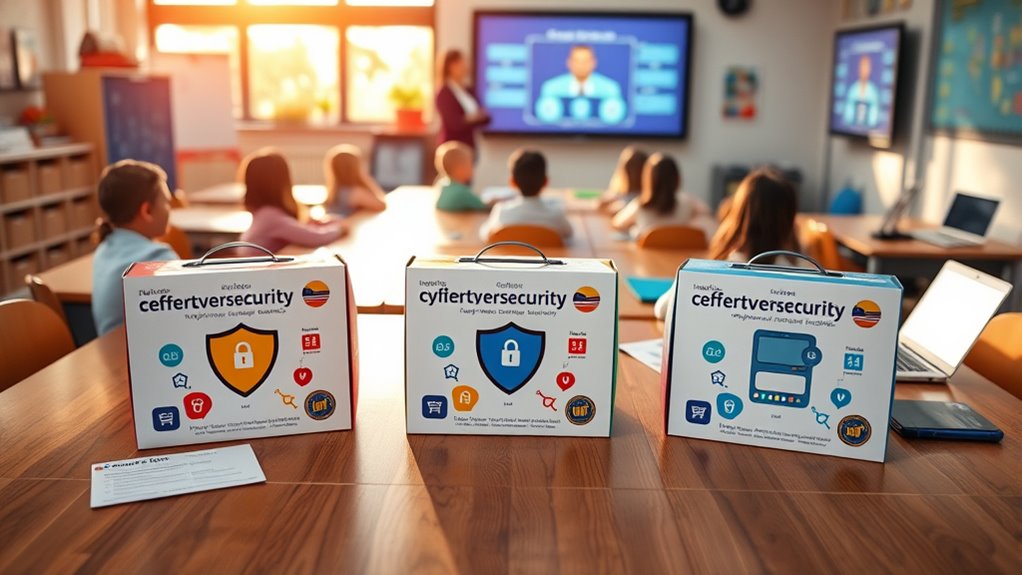

Choosing classroom cybersecurity materials depends on whether you want students to practice digital safety, explore coding logic, prepare for a certification exam, or carry a reminder home. I’d start with Cyber Elementary 5th Grade Skills Workbook for lessons that fit a defined classroom routine, or ThinkFun Hacker for hands-on logic challenges aimed at older children. The CompTIA Security+ Study Guide serves a different audience: learners working toward an advanced exam rather than a general school activity. The bulk awareness favors can support an event, but they offer less instruction than any of the learning-focused picks.

Get privacy and security gear delivered free with Prime
- Fast, free delivery on millions of items
- Prime Video, Amazon Music and more included
- Member-only deals all year
These options are not interchangeable kits. I rank them by how directly they support a classroom learning goal, how clearly their audience is defined, and what a teacher gets beyond a cybersecurity label. The tradeoff is practical: structured worksheets are easy to assign but print-based; a coding game invites active problem-solving but has a minimum age and finite challenges; exam prep may be too advanced for most school classes; and giveaways spread a message without teaching much by themselves.
Key Takeaways
- The Cyber Elementary workbook is the clearest fit for grade 5 instruction, with 36 worksheets, quizzes, and a teacher answer key.
- ThinkFun Hacker is the strongest choice for hands-on problem-solving, with 120 challenges for ages 10 and up, though students may need help at the starting age.
- The CompTIA Security+ guide targets SY0-701 exam preparation, so I’d reserve it for older students or adult learners rather than elementary classes.
- The awareness favor set includes 50 each of bags, pencils, bookmarks, and wristbands; it supports an event but is not a lesson plan.
- For a fuller classroom program, pair a teaching resource with discussion and practice; none of these four options alone covers every cybersecurity learning need.
| Cyber Elementary 5th Grade Skills Workbook & Lesson Quizzes: 36 Cyber Security, Online Safety & AI Safety Practice Worksheets with Teacher Answer Key |  | Best Overall for Grade 5 Lessons | Grade level: 5th Grade | Worksheets: 36 | Subjects: Cyber Security, Online Safety, AI Safety | VIEW ON AMAZON | See Our Full Breakdown |
| ThinkFun Hacker Cybersecurity Coding Game and STEM Toy for Ages 10 and Up |  | Best Hands-On Logic Game | Age range: 10 years and up | Brand: ThinkFun | Challenges: 120 | VIEW ON AMAZON | See Our Full Breakdown |
| CompTIA Security+ Study Guide: Master the SY0-701 Exam with 3-in-1 Method, Exercises, and Practice Questions |  | Best for Advanced Exam Preparation | Exam: CompTIA Security+ SY0-701 | Approach: 3-in-1 method | Learning materials: Exercises and practice questions | VIEW ON AMAZON | See Our Full Breakdown |
| 200 pcs Cybersecurity Awareness Month Favors – Online Safety Items Bulk |  | Best for Awareness Events and Take-Home Reminders | Total pieces: 200 | Package contents: 50 plastic bags, 50 wood pencils, 50 bookmarks, 50 rubber wristbands | Bag dimensions: Approx. 7.9 × 11.8 in | VIEW ON AMAZON | See Our Full Breakdown |
More Details on Our Top Picks
Cyber Elementary 5th Grade Skills Workbook & Lesson Quizzes: 36 Cyber Security, Online Safety & AI Safety Practice Worksheets with Teacher Answer Key
For a teacher who wants a ready-to-assign classroom resource, this workbook has the strongest fit in the group. Its 36 worksheets cover cybersecurity, online safety, and AI safety, while lesson quizzes and a teacher answer key give the material a clear instructional shape. That makes it easier to use across more than one class meeting than the awareness favors, which are reminders rather than teaching materials.
Its grade 5 focus is also a useful boundary: the language and exercises are described as age-appropriate, so the workbook is more targeted than the broad Security+ exam guide. Unlike ThinkFun Hacker, it does not make coding logic or game play the main learning method. That’s a strength for teachers planning direct practice, but a limitation for classrooms that want students moving pieces, experimenting, and solving puzzles together.
The main compromise is format. This is a print-based workbook, with no described digital activities or interactive platform. It also focuses on cyber and safety topics rather than wider STEM learning. I’d choose it as the most straightforward lesson resource here, while adding discussion, demonstrations, or other activities if students need more variety.
Pros:- Provides 36 practice worksheets for planned classroom use.
- Includes quizzes and a teacher answer key.
- Covers cybersecurity, online safety, and AI safety.
- Designed for fifth-grade learners with age-appropriate exercises.
Cons:- Print-only format does not provide interactive digital learning.
- Focuses on cyber and safety topics rather than broader STEM subjects.
Best for: Grade 5 teachers seeking printable cyber, online safety, and AI safety practice with a teacher answer key.
Not ideal for: Teachers looking for a digital platform, a hands-on coding game, or a broad STEM workbook.
- Grade level:5th Grade
- Worksheets:36
- Subjects:Cyber Security, Online Safety, AI Safety
- Teacher answer key:Yes
- Format:Print workbook
- Learning elements:Practice worksheets and lesson quizzes
Our verdict“I’d pick this workbook for the clearest grade 5 teaching structure, especially when quizzes and a teacher key matter more than game-based activity.”
ThinkFun Hacker Cybersecurity Coding Game and STEM Toy for Ages 10 and Up
ThinkFun Hacker takes a more active route than the workbook: students work through a grid of tokens and tiles to solve coding-themed challenges. With 120 challenges that progress from beginner to expert, it can give a class a sequence of puzzles instead of a stack of worksheets. Its emphasis on logic, spatial reasoning, and planning makes it the strongest pick here for learners who engage better by manipulating pieces and testing solutions.
That difference also defines its limits. The workbook addresses named safety topics and includes quizzes plus a teacher key; Hacker is described as a cybersecurity-themed coding game that teaches core programming principles. A teacher seeking direct lessons on online safety or AI safety should not treat it as an equivalent substitute. Compared with the Security+ guide, it is far more approachable as a group activity for younger learners, though the supplied details do not describe a facilitator guide or classroom lesson plan.
The age 10 and up recommendation deserves attention: the game may challenge children just at the minimum age, and students who need more support could find the puzzles difficult. The challenge booklet also has a finite set, so replay can fade once students have solved them. I’d use it as an enrichment activity or station, particularly when the goal is problem-solving rather than a complete digital citizenship unit.
Pros:- Includes 120 challenges with a stated progression from beginner to expert.
- Encourages logical, spatial, and planning skills through play.
- Game grid, tokens, tiles, and instructions support hands-on use.
- Offers a more active format than the print-only workbook.
Cons:- May be too complex for some children at the minimum recommended age.
- Replay interest may decrease after students complete the challenge set.
- Its coding focus does not cover the workbook’s stated range of safety topics.
Best for: Teachers of students around age 10 and older who want a tactile, puzzle-based introduction to coding logic.
Not ideal for: Classes needing explicit online safety lessons, a teacher answer key, or activities suitable for younger elementary students.
- Age range:10 years and up
- Brand:ThinkFun
- Challenges:120
- Included components:Game grid, tokens, challenge booklet, solution booklet, control panel, movement and specialty tiles
- Item type:Cybersecurity coding game and STEM toy
- Model year:2018
- Warranty:No Warranty
Our verdict“I’d choose Hacker for tactile logic practice and small-group engagement, while pairing it with a separate resource for explicit online safety instruction.”
CompTIA Security+ Study Guide: Master the SY0-701 Exam with 3-in-1 Method, Exercises, and Practice Questions
This guide is the outlier in the roundup because it is aimed at preparing for the CompTIA Security+ SY0-701 exam, rather than delivering general cybersecurity activities for a school class. Its described 3-in-1 approach combines exercises, practice questions, and step-by-step learning strategies. For a high school pathway, adult education group, or teacher-led certification club, that exam orientation may be more relevant than the grade 5 workbook or ThinkFun’s coding puzzles.
The focus is also the reason I rank it below those classroom-ready choices. The workbook names a grade level, number of worksheets, and teacher key; the game states an age range and challenge count. This listing supplies no specific content breakdown, so a teacher cannot tell from the provided information which exam areas the exercises cover or how the guide handles classroom pacing. It also may need additional resources for full preparation, which makes it a less self-contained choice.
I would consider it for motivated learners who already have an advanced cybersecurity goal and can work through exam material independently. For elementary learners, casual clubs, or a lesson on safe online habits, the vocabulary and exam target are likely to be a poor match. It has a clearer certification purpose than the favor set, but neither its purpose nor its contents make it a general classroom kit.
Pros:- Targets a specific certification exam, SY0-701.
- Describes a three-part approach with exercises and practice questions.
- Includes step-by-step learning strategies.
- Could support independent or instructor-guided exam preparation.
Cons:- The supplied description does not list specific content areas or materials.
- May require additional resources for full exam preparation.
- Its certification focus is less suitable for general school cybersecurity lessons.
Best for: Older students or adult learners in a certification-focused course preparing for the SY0-701 exam.
Not ideal for: Elementary classes, general online safety lessons, or teachers who need a clearly itemized classroom activity pack.
- Exam:CompTIA Security+ SY0-701
- Approach:3-in-1 method
- Learning materials:Exercises and practice questions
- Guidance:Step-by-step learning strategies
- Audience:Exam candidates
- Additional resources:May be needed for full preparation
Our verdict“I’d reserve this guide for an advanced certification track, since its exam focus is more specialized and less classroom-general than the workbook or game.”
200 pcs Cybersecurity Awareness Month Favors – Online Safety Items Bulk
This bulk set is built for reach and visibility: it includes 200 assorted items, split evenly among goody bags, pencils, bookmarks, and wristbands. A school running an awareness assembly or community event could use the different formats to send a simple online safety reminder home. Compared with the workbook, it takes almost no lesson planning to distribute; compared with ThinkFun Hacker, it does not ask students to solve or practice anything.
The product’s lock-and-shield graphics and social media reminder provide a message, but the description does not list instructional content, discussion prompts, or activities. I would treat the set as an event supplement rather than a cybersecurity curriculum. It ranks fourth because its classroom contribution is mostly promotional, while the other picks offer worksheets, guided challenges, or exam practice.
Quantity is its central tradeoff. A full set may be useful for a large assembly, several classes, or a community outreach session, but could leave a small classroom with more supplies than needed. The specified materials and approximate dimensions help with event planning, though color variety is limited. Choose it when distribution is the goal; skip it if your priority is measurable student practice or detailed teaching support.
Pros:- Includes 200 items in four giveaway formats.
- Provides an easy-to-distribute reminder about online safety.
- The mix of pencils, bookmarks, bags, and wristbands suits event handouts.
- Dimensions and materials are stated for basic planning.
Cons:- Does not include lessons, quizzes, or described learning activities.
- The bulk quantity may exceed what a small class needs.
- Limited color variety may not fit every school’s event materials.
Best for: Schools and organizers who need simple online safety giveaways for assemblies, awareness events, or outreach.
Not ideal for: Teachers seeking lesson plans, structured student practice, or a small quantity for one classroom.
- Total pieces:200
- Package contents:50 plastic bags, 50 wood pencils, 50 bookmarks, 50 rubber wristbands
- Bag dimensions:Approx. 7.9 × 11.8 in
- Pencil length:Approx. 7.4 in
- Bookmark dimensions:Approx. 5.91 × 2.36 in
- Wristband dimensions:Approx. 7.9 × 0.5 in
- Materials:Plastic, wood and graphite, rubber, assorted printed material
Our verdict“I’d use this set to extend an awareness event’s message, but pair it with instruction because the giveaways alone provide little structured learning.”

How We Picked
I compared the four products against the promise of classroom cybersecurity kits: useful materials that can help a teacher introduce, practice, or reinforce cyber-related concepts with learners. I gave the most weight to the clarity of the audience, the amount of instruction or guided activity included, and how readily the resource could fit a classroom session. A defined grade level, challenge sequence, answer key, or clear activity format makes it easier to plan around than a general claim of awareness.
That approach puts the Cyber Elementary workbook first because its grade 5 scope, 36 worksheets, quizzes, and teacher key make its classroom use easiest to understand. ThinkFun Hacker follows closely for a more active approach, but its coding and spatial reasoning emphasis means it is not a direct substitute for a digital citizenship workbook. The Security+ guide ranks third because its exam focus can be valuable for advanced learners but has a narrower classroom audience. The favor set ranks fourth: it can extend an event’s message, yet the supplied description does not include lessons, activities, or teaching guidance.
I used the supplied product descriptions and specifications to make these distinctions. Where product information is missing, I avoid assuming what a teacher will find inside. These are recommendations based on stated contents and intended use, not claims that any item independently meets a school curriculum or security standard.
Factors to Consider When Choosing Classroom Cybersecurity Kits
I’d choose a classroom cybersecurity resource by starting with the learning outcome, then checking whether the format, age range, and teacher support match the class.Match the material to the lesson goal
If the goal is to teach and check understanding of online safety topics, the Cyber Elementary workbook is the most direct option in this group: it names its subjects and includes quizzes and an answer key. For logical problem-solving with a coding theme, ThinkFun Hacker offers a different kind of practice. The Security+ guide suits exam preparation, while the favor set suits awareness events. A giveaway can reinforce a message, but it cannot replace a lesson or a chance for students to apply what they learned.
Check age and prior knowledge
Age fit matters even when a product has a stated audience. The workbook is specified for fifth grade; Hacker is recommended for ages 10 and up and may challenge some children at the minimum age. The Security+ guide is centered on a certification exam, so I’d expect it to fit older or more advanced learners better than a general elementary class. The favors do not describe a learning level because they are handouts. Match the material to students’ reading comfort and prior knowledge, and plan support where the product’s format may be demanding.
Decide how much teacher structure you need
A teacher answer key and lesson quizzes make the workbook easier to use for guided practice and review. Hacker includes instructions and a solution booklet, but the supplied details do not describe a full lesson plan. The Security+ guide promises strategies and practice questions, though its specific contents are not itemized. The favor set has no stated teaching support. If a resource needs to fit a particular class period, check the complete materials and plan a short introduction or debrief instead of assuming the package supplies one.
Balance interaction with coverage
Worksheets can cover several named safety themes in a consistent format, while a physical coding game makes students reason through a problem by moving pieces. Those formats serve different needs. The workbook explicitly includes cyber, online, and AI safety; Hacker focuses on coding principles and logic. Neither description establishes that one covers all the material the other does. I’d use a game to add active practice, then use a discussion or separate lesson to connect problem-solving to students’ online choices.
Treat exam guides and giveaways as specialized tools
The CompTIA guide can support a certification pathway, but the exam target narrows its fit. It may require additional resources, and the supplied description does not spell out its specific topics. The 200-piece favor set solves a different logistics problem: distributing reminders across an event or several groups. I’d choose either only when that specialized purpose is clear. For a class looking for a core teaching resource, the workbook and game offer more direct student activity.
Frequently Asked Questions
Which option is the best starting point for a typical classroom lesson?
I’d start with the Cyber Elementary workbook if the class is fifth grade and the lesson concerns cybersecurity, online safety, or AI safety. Its worksheets, quizzes, and teacher answer key provide a clearer structure for instruction than the game or giveaways. For other grades, check the material’s fit before using it as a core resource.
Is ThinkFun Hacker a complete cybersecurity curriculum?
The supplied description presents Hacker as a coding game with 120 challenges that teach core programming principles and build logic, spatial reasoning, and planning. It does not describe a full curriculum or lessons on the workbook’s stated online and AI safety topics. I’d treat it as a hands-on activity within a broader teaching plan.
Would the CompTIA Security+ guide work for younger students?
The guide is aimed at preparing for the SY0-701 Security+ exam, and its description does not state a school grade or age range. That specialized exam goal makes it a better match for advanced learners or certification-focused groups than an elementary class. The listing also says additional resources may be needed for full preparation.
Can the 200-piece favor set teach online safety by itself?
The set provides pencils, bookmarks, bags, and wristbands with an awareness message, but the description does not include lessons, quizzes, or activities. I’d use it to reinforce an event or class discussion, not as the main teaching material. Students still need instruction and opportunities to practice safe choices.
What should I pair with a classroom cybersecurity resource?
Pair the resource with a short discussion and an activity tied to the lesson goal. After a workbook exercise, students could explain their reasoning; after a Hacker puzzle, they could connect planning and problem-solving to safe digital habits. If using favors, give them out alongside a clear explanation of the message so they serve as reminders rather than stand-alone instruction.
Conclusion
For grade 5 teachers who want structured practice, I’d choose the Cyber Elementary workbook. For classes seeking hands-on logic challenges for students around age 10 and older, ThinkFun Hacker is the better fit, with separate safety instruction added as needed. I’d save the CompTIA Security+ guide for advanced learners pursuing its exam, and choose the bulk favor set when an assembly or outreach event calls for take-home reminders. The right pick depends on whether your classroom needs lessons, puzzles, exam preparation, or event materials.