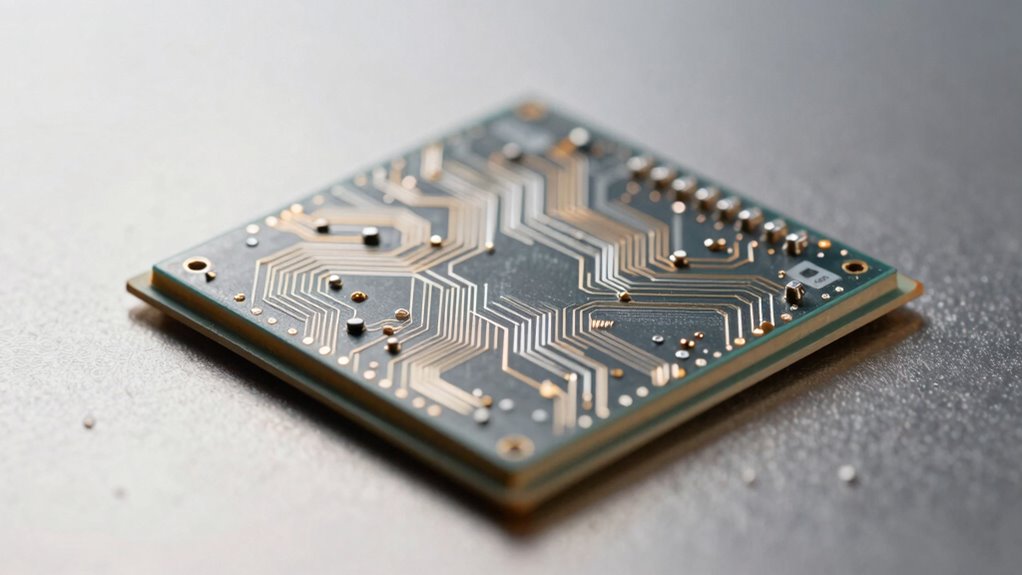

The latest nanotech computers are incredibly tiny, fitting on a fingertip thanks to cutting-edge nanofabrication techniques. These mini devices include quantum chips and powerful AI processors like NVIDIA Jetson Nano, all packed into tiny packages that could revolutionize portable and embedded tech. Innovations in nanolithography and molecular self-assembly enable more efficient, smaller electronics. If you want to explore just how compact and advanced these tiny marvels are becoming, there’s plenty more to discover.
Key Takeaways
- Quantum chips like IBM’s Quantum Loon are manufactured on 300mm wafers, enabling extremely compact and scalable designs.
- Microsoft’s Majorana 1 is a palm-sized quantum processor addressing stability for real-world applications.
- Miniature AI devices, such as NVIDIA Jetson Orin Nano, pack significant power into tiny, portable units.
- Cutting-edge nanofabrication techniques allow the creation of ultra-small, efficient components for advanced quantum and nanoelectronic devices.
- The nanotech market is rapidly growing, powering smaller sensors, nanorobots, and microprocessors for unprecedented miniaturization.
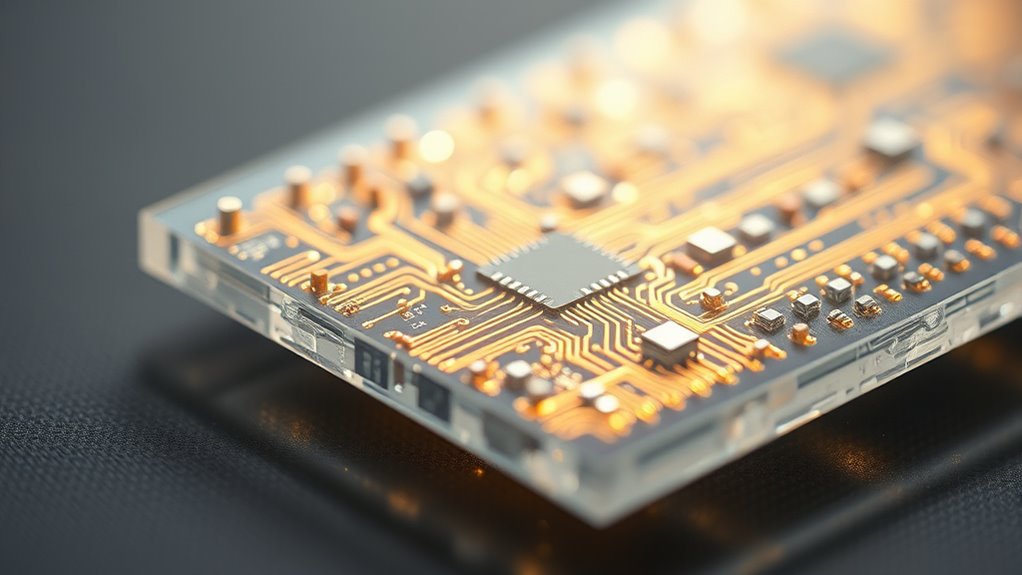
Have you ever wondered how tiny nanotech computers are transforming technology? These minuscule marvels are pushing the boundaries of what’s possible, fitting into devices so small they can be embedded seamlessly into everyday objects. Take the NVIDIA Jetson Orin Nano Super, for example. It’s palm-sized, yet packs an incredible punch with 67 INT8 TOPS, delivering 1.7 times the generative AI inference gain over its predecessor. It features an 8GB Jetson Orin Nano System on Module with an Ampere GPU and a 6-core ARM CPU, all running on Linux with NVIDIA’s all-encompassing software stack. Its high memory bandwidth of 102GB/s and support for up to four cameras make it ideal for edge AI applications, blending power with compactness. This remarkable miniaturization(main factual point) is opening new doors for portable and embedded AI solutions. Moreover, advancements in nanofabrication techniques are enabling even smaller and more efficient quantum and nanoelectronic components, further accelerating the miniaturization trend.
Tiny yet powerful: NVIDIA Jetson Orin Nano Super delivers 67 INT8 TOPS with high memory bandwidth for edge AI applications.
On the quantum front, IBM’s quantum chips are also astonishingly small. Manufactured using 300mm semiconductor wafers at Albany NanoTech, these chips like the Quantum Loon and Nighthawk are designed for rapid iteration, operating 24/7 to cut down development cycles. The wafers are cored to 200mm for custom processes before final assembly, enabling a wider variety of chip designs in less time. This advanced fabrication supports the future of quantum computing, aiming to access unprecedented processing capabilities in a tiny package.
Microsoft’s Majorana 1 quantum chip is another example. It’s palm-sized and features a revolutionary design that addresses quantum stability challenges beyond what Google and IBM have achieved. Recognized in Nature journal, it targets real-world applications in pollution control and medicine development, employing a new architecture that enhances reliability. Despite its small size, it promises to transform complex fields by bringing quantum computing closer to practical use.
Nanotechnology is revolutionizing electronics, with the nanotechnology services market projected to grow from $209.89 billion in 2025 to over $311 billion by 2029. Nanosensors, which are key components of this trend, are expected to grow at an 11.2% CAGR through 2034. These tiny devices leverage nanolithography and molecular self-assembly, enabling ultra-dense memory and compact microprocessors. They also power nanorobots used in DNA analysis and disease detection, making devices even smaller and more efficient.
All of this points to a future where computers are not only powerful but also astonishingly tiny. From edge AI devices to quantum chips, the trend is clear: technology is shrinking while capabilities expand. These tiny computers are set to revolutionize industries, making devices smarter, faster, and more integrated into our daily lives.
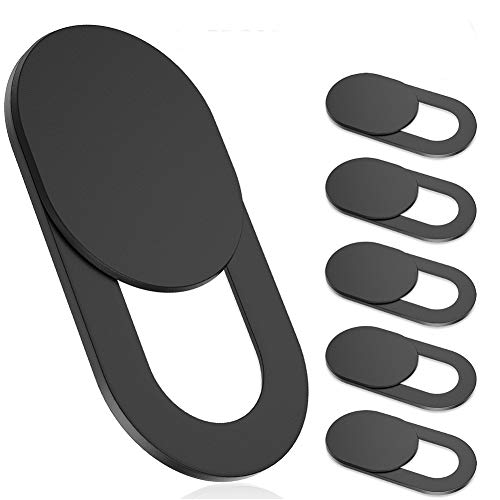
Laptop Camera Cover Slide, 6 Pack Ultra-Thin 0.022in Webcam Cover Blocker
- Privacy Protection: Easily block camera to prevent hacking
- Ultra-Thin Design: Only 0.022 inches thick, flexible and durable
- Easy Installation: Strong adhesive for secure attachment
As an affiliate, we earn on qualifying purchases.
Frequently Asked Questions
How Long Do Nanotech Devices Typically Last in Real-World Applications?
Nanotech devices usually last several years in real-world applications, but their lifespan depends on usage, environment, and materials. You’ll find that high-quality nanosensors and nanodevices can operate effectively for 3 to 10 years with proper maintenance. Advances in nanolithography and materials improve durability, yet extreme conditions may shorten their lifespan. Regular calibration and careful handling help maximize their longevity, ensuring they perform reliably over time.
What Are the Main Challenges in Mass-Producing Nanotech Computers?
You face several challenges in mass-producing nanotech computers. Scaling up manufacturing while maintaining precision is difficult, as tiny defects can cause failures. The high cost of advanced fabrication tools and techniques adds to the complexity. Ensuring device stability and reliability over time is tough due to nanoscale physics and material limits. Additionally, integrating nanodevices with existing systems demands innovative solutions to overcome compatibility and performance issues.
Are There Any Health Risks Associated With Nanotechnology in Electronics?
You might worry about nanotech in electronics causing health risks, like tiny particles infiltrating your body. While some concerns exist about inhaling or ingesting nanoparticles, rigorous safety standards aim to minimize exposure during manufacturing and disposal. Advances in nano-coated materials also reduce potential toxicity. Overall, with proper handling and regulation, nanotechnology can be safely integrated into electronics, transforming devices without jeopardizing your health or the environment.
How Secure Are Nanotech-Based Data Storage Systems?
Nanotech-based data storage systems are generally secure, but they face unique challenges. You need to be aware of potential vulnerabilities like physical tampering and quantum hacking, which could compromise stored data. Implementing robust encryption and physical security measures helps protect your information. As nanotech advances, staying updated on security protocols is vital to guarantee your data remains safe from emerging threats.
Can Nanotech Computers Operate in Extreme Environmental Conditions?
Yes, nanotech computers can operate in extreme environments. You’ll find them designed with advanced materials that resist high temperatures, radiation, and corrosion, making them suitable for space, deep-sea, or industrial settings. Engineers incorporate protective coatings and cooling systems to guarantee stability. Their miniaturized size allows for better heat dissipation and durability, so you can rely on them even in harsh conditions without sacrificing performance or reliability.

Haulonda Cute Webcam Cover Slide Ultra Thin 0.027in Web Camera Lens Shutter for Laptop/iPhone/iPad/Smartphone- Protection Against Surveillance(3Pack)
- Privacy Protection: Covers webcam to prevent spying
- Ultra Thin Design: Only 0.027 inches thick
- Durable & Reusable: Strong adhesive, removable and reusable
As an affiliate, we earn on qualifying purchases.
Conclusion
Now that you’ve seen how tiny these nanotech computers are, it’s like holding a universe in the palm of your hand. Just imagine the endless possibilities they reveal, transforming everything from medicine to technology. As they continue to shrink, the future feels brighter and more exciting than ever. These miniature marvels are proof that sometimes, the smallest things can make the biggest impact—like a whisper that can change the world.

6 Pack Laptop Camera Cover Slide, Computer Camera Cover Slide, Webcam Privacy Protector for Laptop, Computer, Tablet, Smartphone, Pc
- Privacy Protection: Physically blocks webcam for security
- Dust and Scratch Prevention: Protects lens from dust and scratches
- Ultra Thin Design: Only 0.7mm thick for seamless fit
As an affiliate, we earn on qualifying purchases.
![ProCase [6 Pack] Webcam Cover Slide for Laptop Phone, Ultra Thin Flexible Slide Camera Blocker Privacy Security Cover for MacBook Air Pro iMac iPad iPhone Echo PS4 Tablet PC Computer –Black](https://m.media-amazon.com/images/I/41YHLNbvTbL._SL500_.jpg)
ProCase [6 Pack] Webcam Cover Slide for Laptop Phone, Ultra Thin Flexible Slide Camera Blocker Privacy Security Cover for MacBook Air Pro iMac iPad iPhone Echo PS4 Tablet PC Computer –Black
- Ultra Thin Design: Only 0.04 inches thick
- Universal Compatibility: Fits Mac, iPad, iPhone, PS4, Echo
- Strong 3M Adhesive: Secure and residue-free attachment
As an affiliate, we earn on qualifying purchases.