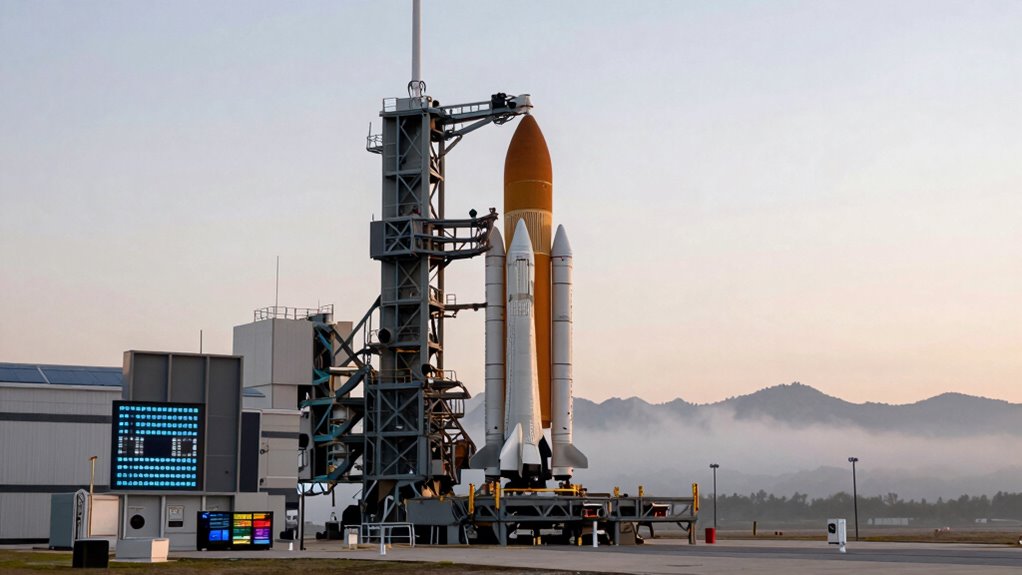

Tech giants like SpaceX, Blue Origin, Rocket Lab, and Lockheed Martin are revolutionizing the journey to Mars by developing reusable heavy-lift rockets, affordable communication satellites, and advanced landing and sampling systems. These innovations markedly lower costs and boost capabilities for future missions. Private investment fuels new technologies for habitats, life support, and surface mobility, making human settlement more feasible. Keep exploring to uncover how these advancements are shaping humanity’s leap toward Mars.
Open a free Amazon Business account
Business pricing, bulk buying and tax-exempt orders.
As an affiliate, we earn on qualifying purchases.
Key Takeaways
- Major companies like SpaceX and Blue Origin are developing reusable heavy-lift rockets to drastically lower Mars mission costs.
- Private firms are building advanced Mars communication networks to ensure reliable surface data and relay services.
- Multiple industry players are securing funding for Mars sample-return and landing technologies, fostering a competitive, innovative environment.
- Commercial initiatives are deploying small, rapid-response science payloads and imaging missions to expand Mars exploration.
- Private investment in habitats, life-support, and mobility tech is accelerating human exploration readiness and reducing mission risks.
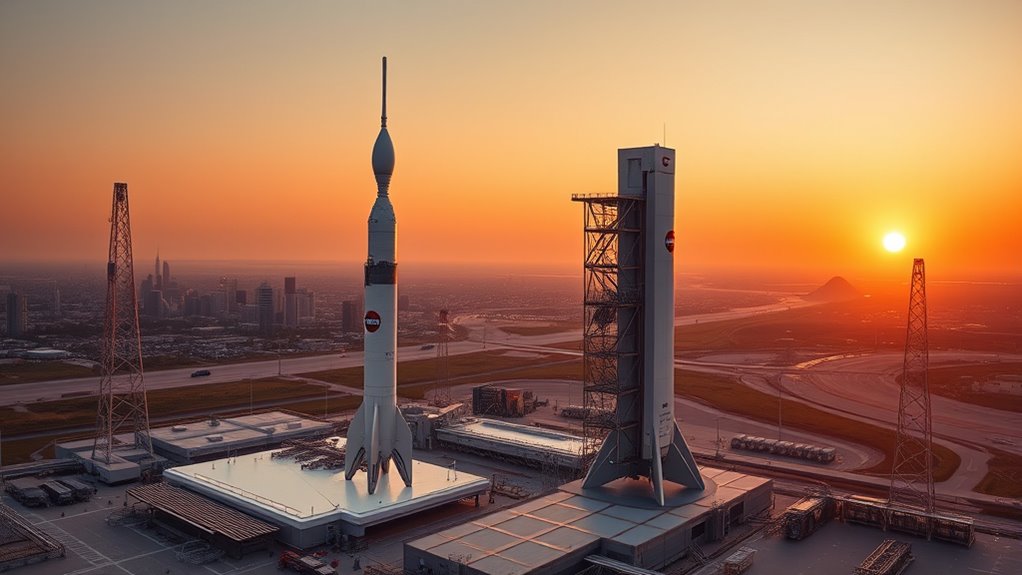
Are we on the brink of a new era in space exploration? The race to Mars is intensifying, driven by both government agencies and private companies. You’re witnessing a fundamental shift as tech giants like SpaceX, Blue Origin, Rocket Lab, and Lockheed Martin ramp up their efforts to establish a human presence on the Red Planet. Central to this push is the rapid development of commercial launch capabilities. Private firms are accelerating the creation of full-scale reusable heavy-lift rockets. SpaceX’s Starship, with its upcoming flights targeting mid-2020s, aims to revolutionize Mars logistics by offering a cost-effective, reusable architecture. Meanwhile, new entrants like Blue Origin’s New Glenn and larger Rocket Lab vehicles are increasing launch cadence, creating more competition and opening opportunities for deep-space payloads. As these reusable systems mature, the cost per kilogram to trans-Mars missions is expected to drop markedly, with SpaceX’s pricing models and Lockheed’s proposals promising multi-billion dollar savings compared to traditional missions.
The race to Mars accelerates with reusable rockets, lowering costs and boosting private sector participation in humanity’s next giant leap.
You’ll also see a surge in commercial infrastructure for Mars, particularly communication networks. Several companies, including SpaceX, Blue Origin, Rocket Lab, and Lockheed, are exploring Mars telecommunication orbiters. These relay satellites aim to provide higher-bandwidth surface links, support sample-return operations, and reduce dependence on aging NASA orbiters like MRO and MAVEN. Blue Origin’s Blue Ring concept proposes a deep-space platform capable of deploying small satellites around Mars, while SpaceX adapts Earth-orbit satellite tech for Mars relay services. These advancements will enable more robust surface communications, support distributed surface assets, and facilitate crewed missions, all while generating new revenue streams from imagery, navigation, and data services. This expansion of communication infrastructure is crucial for enabling long-term human missions and scientific research on Mars. Additionally, advancements in satellite technology and space-based networks are expected to further enhance data transfer capabilities and operational efficiency on Mars.
On the surface, commercial companies are also advancing Mars landing and sample-return technologies. Lockheed Martin, Rocket Lab, Blue Origin, SpaceX, and others have secured funding for developing surface imaging, cargo delivery, and sample-return systems. Lockheed’s proposed Mars Sample Return (MSR) mission emphasizes lower costs through proven designs and mass reduction, with multiple firms participating in MSR planning, indicating broad industry interest. Smaller, lower-mass landers and ascent vehicles are being prioritized to reduce complexity and costs, enabling iterative demonstrations for robotic and human logistics. Private cargo firms are working to establish regular supply routes, fueling the vision of sustained robotic and crewed presence on Mars.
Robotics and science payloads are also transforming Mars exploration. Commercial studies are adapting lunar and Earth-orbit spacecraft for surface imaging and science delivery. Small, targeted missions by private providers, including ride-alongs as secondary payloads, increase science frequency and responsiveness. These efforts, combined with the sale of high-resolution imaging and environmental telemetry, lower costs and expand access to Mars data. Industry and government collaborations are fostering hybrid funding models, accelerating technological advances.
Finally, private-sector investment is essential for human exploration. Firms are developing life-support systems, habitats, in-situ resource utilization, and surface mobility technologies. These innovations serve as testbeds for critical systems like entry vehicles, ascent modules, and surface rendezvous techniques, reducing risks for future crewed missions. Industry-led proposals focus on mass reduction, simplified architectures, and fixed-price contracts to minimize costs and schedule risks. As the race heats up, government agencies like NASA are increasingly relying on commercial procurement, creating a dynamic landscape where technological breakthroughs and strategic partnerships are shaping humanity’s next giant leap.
Frequently Asked Questions
How Will International Regulations Impact Commercial Mars Missions?
International regulations will shape your commercial Mars missions by setting rules on export controls, spectrum allocation, and planetary protection. You’ll need to navigate these policies carefully to avoid legal issues and delays. Regulations may restrict technology sharing, limit certain activities, or require compliance with environmental standards. Staying informed and working with regulatory bodies guarantees your missions align with international agreements, helping you avoid conflicts and facilitate smooth collaboration across borders.
What Are the Environmental Risks of Mars Surface Operations?
You might think it’s smooth sailing, but Mars surface operations come with environmental risks you should watch out for. Contamination from Earth microbes could threaten native ecosystems or future scientific discoveries. Chemical spills, habitat waste, and resource extraction might also disrupt the planet’s environment. To avoid making a mess of things, strict protocols and sustainable practices are essential, ensuring your mission respects Mars’ unique environment and keeps the red planet pristine for future explorers.
How Will Data Privacy Be Managed in Mars Telecommunication Networks?
You’ll need clear policies to manage data privacy in Mars telecommunication networks. Private companies and government agencies will establish protocols to protect sensitive information, ensuring secure encryption and access controls. As you transmit data between Earth and Mars, expect regulations to evolve, emphasizing cybersecurity measures and user privacy rights. Regular audits and international cooperation will be essential, so you can trust that your data stays confidential amid the expanding commercial Mars infrastructure.
What Is the Timeline for Private Companies to Establish a Human Presence on Mars?
Like pioneers forging a new frontier, you can expect private companies to establish a human presence on Mars around the late 2020s to early 2030s. Rapid advancements in reusable launch systems, surface habitat tech, and in-situ resource utilization accelerate timelines. With industry and government collaboration, your generation might see crews living and working on Mars within this decade or the next, transforming science fiction into reality faster than many anticipate.
How Will Cost Reductions Affect the Safety and Reliability of Mars Missions?
Cost reductions will improve Mars mission safety and reliability by allowing companies to invest in proven, flight-ready technologies and develop simpler systems. With lower expenses, you can expect more frequent testing, iterative improvements, and robust backup options, reducing risks. Additionally, affordable modular components enable better redundancy and maintenance, ensuring missions can adapt to challenges. Ultimately, reduced costs help create safer, more dependable Mars missions without sacrificing performance or mission success.
Conclusion
As tech giants push the boundaries of space exploration, you might wonder—are we truly ready for humans to set foot on Mars? Their innovations could revolutionize life on Earth and beyond, but the race raises questions about ethics, safety, and sustainability. Will their relentless pursuit of the Red Planet lead to a new era of discovery or unforeseen challenges? One thing’s certain: the future of space travel is faster and more exciting than ever.
Back to school Picks
back to school
As an affiliate, we earn on qualifying purchases.