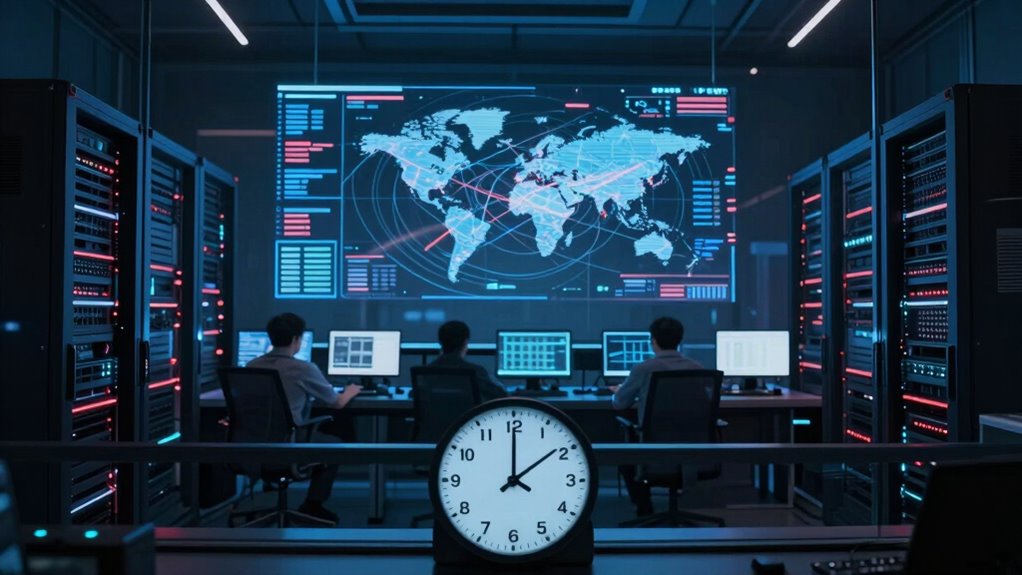

Nations are increasingly unprepared for the digital battles of 2025. Cyber threats have grown more sophisticated, with AI-driven attacks, supply chain breaches, and complex attribution challenges hampering defenses. Many states lack clear rules of engagement and fast response capabilities. Critical infrastructure remains vulnerable due to outdated systems and limited resources. If you want to understand how these vulnerabilities shape future conflicts and what’s being done to counter them, keep exploring this evolving landscape.
Open a free Amazon Business account
Business pricing, bulk buying and tax-exempt orders.
As an affiliate, we earn on qualifying purchases.
Key Takeaways
- Many nations have updated cyber strategies emphasizing deterrence, but attribution challenges hinder decisive responses.
- Critical infrastructure remains vulnerable due to outdated systems, insufficient incident response, and increasing attack sophistication.
- State-sponsored actors and cybercriminal groups are rapidly expanding offensive tools, including AI-driven social engineering and supply chain attacks.
- Defensive capabilities lag behind emerging threats, with personnel shortages and limited international cooperation complicating resilience.
- The growing use of AI, IoT, and cloud dependencies broadens attack surfaces, raising concerns about preparedness for large-scale cyber conflicts by 2025.

Cyberwarfare 2025
Is your organization prepared for the evolving landscape of cyberwarfare in 2025? As cyber threats become more sophisticated, your defenses must evolve rapidly. Governments worldwide have updated their national cyber strategies since 2022, emphasizing deterrence, attribution, and offensive capabilities. Yet, gaps remain. Less than half of medium-to-large states have publicly documented rules of engagement for cyber conflict, leaving many uncertainties about how conflicts are managed. Military integration of cyber units has increased, with armed forces establishing dedicated cyber commands and participating in joint exercises, but the credibility of deterrence efforts faces hurdles. Rapid, reliable attribution remains technically complex and politically sensitive, limiting your ability to respond decisively to sophisticated intrusions. Emerging attack techniques, such as AI-enhanced social engineering and deepfake impersonations, are reshaping the threat landscape. Capabilities are expanding at a breakneck pace. Open-source reports highlight a surge in offensive tools, especially targeting supply chains and cloud infrastructure. Meanwhile, defensive measures lag behind, with critical sectors suffering from shortages of skilled cybersecurity personnel and outdated architectures. The adoption of Zero Trust and cloud-native protections has accelerated across governments and industries, but regional and sectoral disparities persist. Both attackers and defenders are leveraging AI and machine learning—attack automation for phishing and payloads, defense for anomaly detection—fueling an arms race that challenges your organization’s agility and resourcefulness. Reliance on private cybersecurity firms further complicates resilience, creating dependencies that may hinder swift responses during crises. Additionally, the growing cybersecurity skills gap hampers efforts to build resilient defenses in many organizations. The threat landscape continues to intensify. Ransomware and extortion dominate, with breaches involving ransomware in up to 73% of incidents, and phishing campaigns driven by generative AI skyrocketing in volume and sophistication. Nation-states, especially China and Iran, have ramped up attacks—targeting telecoms, critical infrastructure, and government agencies—often blending cyber espionage with influence operations to achieve strategic objectives below the kinetic threshold. The proliferation of criminal-to-state actors, including ransomware-as-a-service and DDoS-for-hire, lowers barriers to entry, allowing disruptive campaigns to escalate rapidly. Critical infrastructure faces mounting risks, with energy, transportation, healthcare, and telecoms experiencing increased incidents. Operational technology vulnerabilities grow as IT and OT networks converge, many industrial control systems remain unpatched or poorly segmented. Your organization’s incident response capacity is often insufficient to contain large-scale, multi-vector attacks within 24 to 72 hours, exposing systemic resilience gaps. Cyber insurance policies tighten, yet many enterprises remain underinsured or face exclusions when nation-state threats are involved. As geopolitical tensions escalate, the risk of cyber conflict spilling into the physical domain intensifies, demanding heightened vigilance.
Technological trends like generative AI, cloud dependency, and IoT expansion accelerate the attack surface. Attackers exploit vulnerabilities in cloud providers and legacy devices, while quantum-resistant cryptography remains in its infancy. Automation tools benefit defenders but are outpaced by adversaries’ rapid deployment of automated, AI-powered attacks. International efforts to establish norms and share intelligence grow, but trust issues and conflicting interests hamper progress. Overall, your organization must navigate a complex, unpredictable cyberwarfare environment—preparedness and adaptability are no longer optional but essential for survival in 2025.
Frequently Asked Questions
How Effective Are Current International Cyber Norms in Deterring State-Sponsored Attacks?
Current international cyber norms are only somewhat effective in deterring state-sponsored attacks. You’ll find that while increased dialogue, sanctions, and incident-sharing are making some impact, enforcement remains inconsistent. Attribution challenges, fragmented legal frameworks, and differing national interests limit their effectiveness. Despite multilateral efforts, many nations still view cyber operations as plausible deniability tools, making it difficult to establish a strong, universally accepted deterrence framework that prevents aggressive cyber activities.
What Role Do Private Cyber Firms Play in National Cyber Defense Strategies?
Private cyber firms play a vital role in your national defense strategies by providing both offensive and defensive capabilities. They fill gaps where government resources are limited, offering specialized skills and tools for threat detection, incident response, and cyberattack mitigation. You rely on these firms for rapid threat intelligence sharing, conducting covert operations, and bolstering resilience, but dependence on their services also introduces risks related to mission transparency and public-private trust.
How Imminent Is the Threat of Quantum Computing Breaking Existing Cryptography?
The threat of quantum computing breaking existing cryptography is becoming increasingly imminent. You should understand that most national systems and critical vendors have only begun planning for post-quantum security, meaning current encryption methods could be vulnerable within the next decade. As quantum technology advances, attackers could potentially decrypt sensitive data, compromising communications, infrastructure, and national security. Staying ahead requires urgent investment in quantum-resistant cryptography and proactive security measures.
Are Current Cyber Doctrines Sufficient to Address Hybrid Cyber-Influence Operations?
Your current cyber doctrines are often insufficient for addressing hybrid operations because they lack clear rules for combined cyber, influence, and economic coercion tactics. Many nations haven’t fully integrated strategies for these complex, multi-domain threats, leaving gaps in response and attribution. To improve, you need all-encompassing, adaptable frameworks that include norms for influence campaigns, better intelligence sharing, and coordinated responses across military, intelligence, and civilian sectors.
What Measures Are Most Effective in Improving Critical Infrastructure Resilience Against Cyber Threats?
You can boost critical infrastructure resilience by adopting thorough cybersecurity frameworks that prioritize proactive measures. Implement modernized, segmented OT and IT networks, and deploy AI-driven detection tools to identify threats early. Regularly conduct cyber drills, update patching protocols, and strengthen supply chain security. Collaborate across sectors and nations for information sharing. These steps create layered defenses, making it harder for adversaries to disrupt essential services.
Conclusion
By 2025, over 60% of nations will face sophisticated cyber threats, making cyberwarfare a top security priority. You need to stay vigilant and invest in advanced defenses, as attackers become more agile and organized. The rise of automated cyberattacks means you’re more vulnerable than ever if you’re unprepared. If you ignore these risks, you could face devastating data breaches or disruptions that threaten your nation’s stability. Stay alert—cyberwarfare is no longer a distant threat but a present danger.
NFL season / tailgating Picks
team gear
As an affiliate, we earn on qualifying purchases.