
TL;DR

Get privacy and security gear delivered free with Prime
- Fast, free delivery on millions of items
- Prime Video, Amazon Music and more included
- Member-only deals all year
IdeaClyst is a local-first platform that acts as a war room for your ideas. It uses AI councils to pressure-test concepts, finds new opportunities, and keeps everything securely stored on your machine. It’s designed to help founders avoid costly mistakes and build confidence fast.
Imagine staring at three tabs open on your browser, each holding a different startup idea. Your stomach knots up. Which one deserves your next six months? Picking blindly is a gamble. That’s where IdeaClyst steps in. It’s not just a tool—it’s your digital war room, a strategic hub that turns uncertainty into confidence.
In 2026, the cost of building the wrong product skyrockets — over $150,000 for larger teams, often wasted on ideas nobody needs. Traditional validation takes months and costs thousands. But what if you could cut that down to hours—without losing sight of what really matters? IdeaClyst uses AI to bring the research and debate into your own machine, giving you a clear, evidence-backed picture of your idea’s potential.
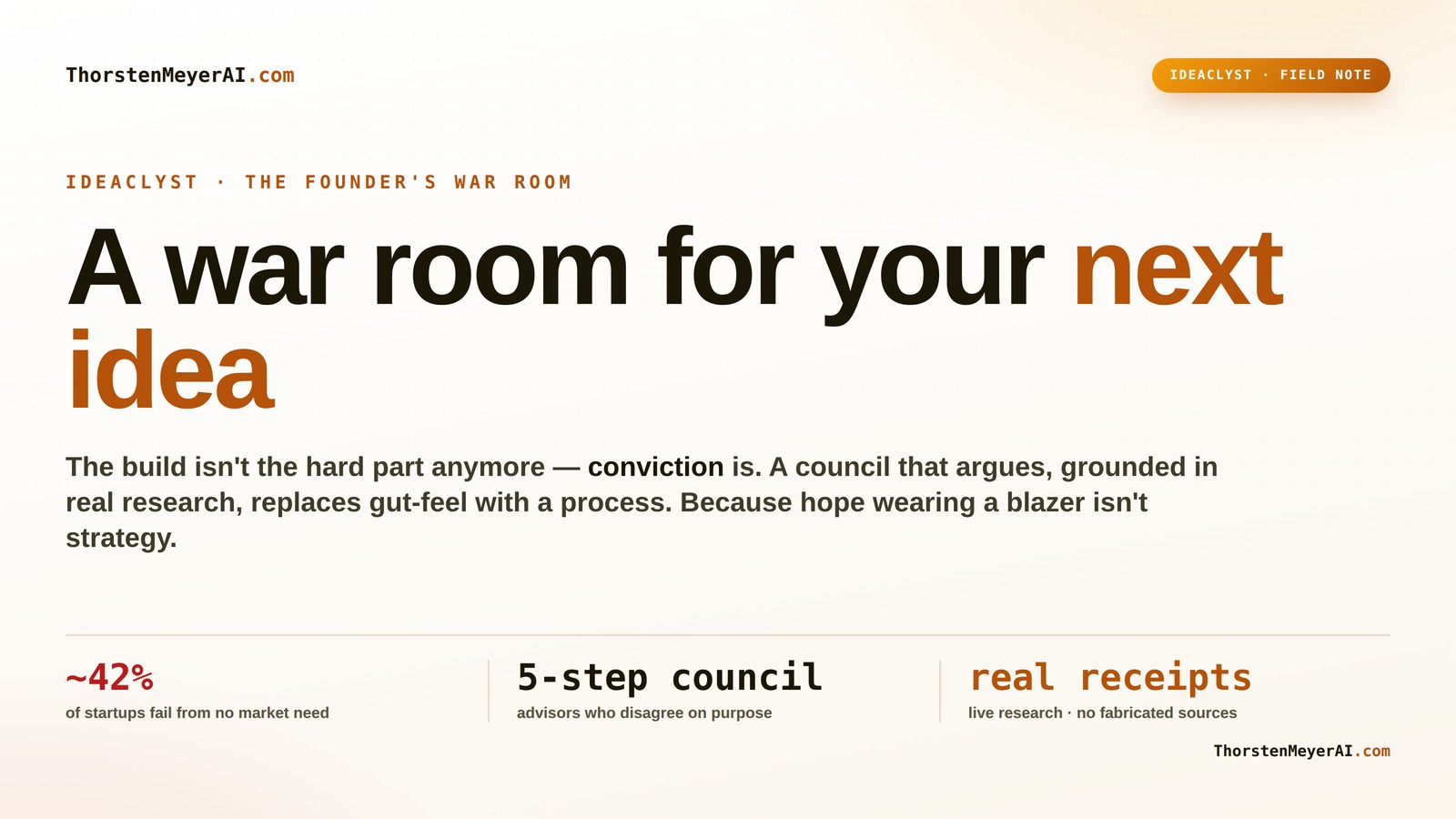
A war room for your next idea
The build isn’t the hard part anymore — conviction is. Knowing which idea deserves the next six months, and being able to defend it. Most founders answer with gut feel and optimistic math. That’s hope wearing a blazer. IdeaClyst replaces it with a process.
The most expensive decision is what to build
The single most valuable thing a tool can do is talk you out of the wrong six months. The numbers make the case better than any pitch.
Three tools in one — on your own machine
Strip away the framing and IdeaClyst is three things at once, all running locally with nothing leaving your laptop.
An AI council
Pressure-tests an idea you bring it — advisors who argue on purpose.
A discovery engine
Finds ideas you didn’t know to look for by hunting real demand signals.
A founder’s workspace
Carries winners from “interesting” all the way to “ready to build.”
Advisors who disagree on purpose
Not one confident, agreeable answer — a structured five-step deliberation where models play different roles and turn on their own work. The disagreement is the feature.
The five-step deliberation
A council that leads with the bad news surfaces the objections you’d otherwise find the expensive way, on month five.
Product strategy
Who’s it for, what’s the wedge, why now, what’s the business model.
Technical architecture
What would it actually take to build — and where’s the risk.
Critique pass
The council turns on its own work. Where’s the hand-waving? What kills this?
Second, independent critique
A different voice, a different angle — so blind spots don’t survive.
Final synthesis
Everything into one coherent founder packet: strategy, architecture, validation, plan.
When IdeaClyst cites a source, it actually fetched it
The hard departure from “ask an AI what it thinks of my startup.” It runs in a strict, real-data-only mode — if it can’t gather genuine evidence, it says so plainly rather than inventing a plausible paragraph.
Confidence with receipts
No fabricated statistics, no imaginary competitors, no made-up citations. The packet survives a skeptical co-founder or a sharp investor because the reasoning has receipts.
Market research first
Scouts the landscape before the council reasons about anything.
Competitor read
Real positioning, pricing signals, feature claims — differentiation vs. reality.
Validation with links
Not “talk to customers” — concrete signals & sources you can click.
From the blank page to build-ready
Evaluation is half the problem; the blank page is the other half. And a plan is worthless if it dies in a tab you never reopen.
Bring a space, not an idea
“AI for accountants,” “tools for indie game studios” — plus your goal and real capacity. It hunts demand signals across HN, Reddit, Product Hunt, GitHub, pricing pages.
- An honest market read — leads with the bad news when a space is hard
- An opportunity map — high pain, thin competition
- Ranked candidates — wedge, who pays, effort, risk, confidence
- each with KILL CRITERIA — when to walk away
A home and a forward path
Every promising idea gets carried forward, with every artifact in plain files on your disk.
- Validation tooling — sprint board, interview list, evidence browser
- Founder profile — a personal-fit lens; same discovery, different advice
- Build workspaces — funnel, personas, landing draft, version history
- “Build this idea” → a PRD + task queue, ready for a coding agent
Key Takeaways
- IdeaClyst acts as a local-first, secure war room for testing and developing ideas, keeping everything on your own device.
- Its structured AI council stages debate, critique, and synthesis, exposing flaws early and building confidence.
- Grounding ideas in real-time web research prevents false positives and ensures your plans are evidence-backed.
- You can start using IdeaClyst quickly—download, input ideas, debate, refine, and build with a clear plan.
- This tool saves thousands by reducing costly market missteps, especially for startups and innovation teams.
portable whiteboard for brainstorming
As an affiliate, we earn on qualifying purchases.
As an affiliate, we earn on qualifying purchases.
What Makes IdeaClyst a True War Room for Innovation?
IdeaClyst is a local-first platform that acts as a digital war room. It’s where your ideas are tested, debated, and refined—without ever leaving your laptop. Unlike cloud tools, everything stays on your machine, keeping your raw thoughts private and secure. Think of it as a high-stakes strategy room, where every conversation, critique, and plan is documented in Markdown files that you own.
Say you’re brainstorming a new SaaS product. You input a rough idea, and IdeaClyst’s AI council kicks into gear. Different models take on roles—some play devil’s advocate, others are cheerleaders—debating your concept from multiple angles. This structured debate isn’t just about finding flaws; it’s about uncovering overlooked opportunities, understanding potential pitfalls that aren’t immediately obvious, and refining your idea into a more robust concept. The process prompts you to think critically and consider tradeoffs—such as the balance between feature complexity and user experience or market timing versus technical feasibility. These tradeoffs are crucial because they expose the often hidden costs and risks associated with your choices. For example, prioritizing a feature that’s technically difficult might delay your launch or inflate your budget, risking market relevance. Ultimately, this process helps you develop a more nuanced and resilient plan, reducing the risk of costly pivots later on and aligning your decisions more closely with real-world constraints.
As an affiliate, we earn on qualifying purchases.
How the AI Council Forces Real Debate — Not Just Echo Chamber Praise
Traditional AI tools tend to agree with you, boosting your confidence—sometimes too much. IdeaClyst flips that script. It stages a structured five-step debate among AI models, each with a different perspective:
- Product Strategy: Who is this for? Why now? How will it make money?
- Technical Architecture: What’s needed to build? Where are the risks?
- Critique Pass: What’s wrong? What assumptions are unproven?
- Second Critique: A fresh pair of eyes looking from a different angle.
- Final Synthesis: A balanced plan, combining all insights into a clear roadmap.
This disagreement isn’t just about pointing out flaws; it’s a strategic process that reveals the implications of each decision, helping you weigh potential benefits against risks and tradeoffs. For instance, during the critique phase, the models might identify that a certain feature is technically feasible but could significantly delay your launch or inflate costs. Recognizing these tradeoffs early is vital because it allows you to adjust your plans proactively rather than reactively, avoiding last-minute surprises. This process forces you to confront the real-world consequences of your choices, encouraging a mindset of cautious optimism and strategic planning. The final synthesis then integrates these insights into a comprehensive roadmap, enabling you to make informed decisions that balance speed, quality, and resource allocation. This structured debate helps prevent overconfidence—where you might overlook critical flaws—and reduces the risk of costly mistakes, ultimately saving both time and money in your development process.
AI-powered idea validation software
As an affiliate, we earn on qualifying purchases.
As an affiliate, we earn on qualifying purchases.
Why Grounding Ideas in Real Research Matters More Than Ever
Many founders rely on gut feel or vague market vibes when pitching ideas. That’s risky. IdeaClyst insists on grounding every critique and suggestion in real-time web research. It pulls in fresh data—current market trends, competition analysis, customer feedback—so your debate is rooted in facts, not assumptions.
This approach isn’t just about accuracy; it’s about strategic advantage. Relying solely on intuition can lead to confirmation bias, where you only see evidence that supports your preconceptions, or overlook critical market signals. By integrating real research, IdeaClyst helps you understand the broader context—such as emerging industry trends, regulatory changes, or shifting customer needs—that could impact your idea’s viability. This evidence-based foundation allows you to weigh options more objectively, making decisions that are resilient to market fluctuations and competitive pressures. For example, if you’re exploring a new health tech app, the council checks recent FDA regulations, competitor launches, and user reviews—all on your local machine—ensuring your plan isn’t just optimistic but grounded in reality. This rigorous validation process reduces the risk of building products nobody wants, which industry data shows is a leading cause of startup failure. Ultimately, it empowers you to pivot or refine your approach based on solid evidence, saving time and resources while increasing your chances of success. The deeper implication is that decisions based on verified data tend to be more sustainable, as they adapt to real-world changes rather than assumptions, giving you a competitive edge in fast-moving markets.
As an affiliate, we earn on qualifying purchases.
Frequently Asked Questions
How does IdeaClyst compare to other brainstorming tools?
Unlike simple mind-mapping or note-taking apps, IdeaClyst combines structured debate, real-time research, and local storage. It’s designed to critically evaluate ideas rather than just collect them.Can I use IdeaClyst alone as a solo founder?
Absolutely. It’s scalable for small teams or solo entrepreneurs. You get the same structured critique and research-driven validation, just tailored to your solo pace.Is my data secure if I use IdeaClyst?
Yes. Everything stays on your machine, with no data leaving your device unless you choose to export or share. It’s open source, so you’re in full control of your ideas.What’s the learning curve for new users?
It’s designed to be straightforward. Most users get comfortable within an hour, especially if they’re familiar with Markdown or basic idea workflows. The structured process guides you step-by-step.How much does it cost?
Pricing depends on your needs, but since it’s open source and runs locally, there are no ongoing subscription fees—just your initial setup.Conclusion
Think of IdeaClyst as your personal strategic bunker—where ideas are challenged, validated, and molded into real plans. It turns the chaos of innovation into a disciplined, evidence-based process. When your next big idea is on the line, don’t wing it—test it in your war room.
Ready to take control? Visit IdeaClyst and start building smarter today. Your future self will thank you for it.
Evergreen bestsellers Picks
bestsellers
As an affiliate, we earn on qualifying purchases.