TL;DR

Get privacy and security gear delivered free with Prime
- Fast, free delivery on millions of items
- Prime Video, Amazon Music and more included
- Member-only deals all year
Wccftech reports on Deep-TEMPEST, a research demonstration that applies deep learning to radio signals leaking from HDMI cables to reconstruct displayed content. The report describes the method and possible countermeasures, but provides limited details about the demonstration’s range, accuracy, or testing conditions.
Deep-TEMPEST, a research demonstration described by Wccftech, uses a deep-learning model to reconstruct images from radio-frequency emissions associated with HDMI cables. The approach matters because it points to a potential way of observing displayed information without installing software on a computer or connecting to its network, though the reported account does not provide enough technical detail to establish how reliably or at what distance the method works.
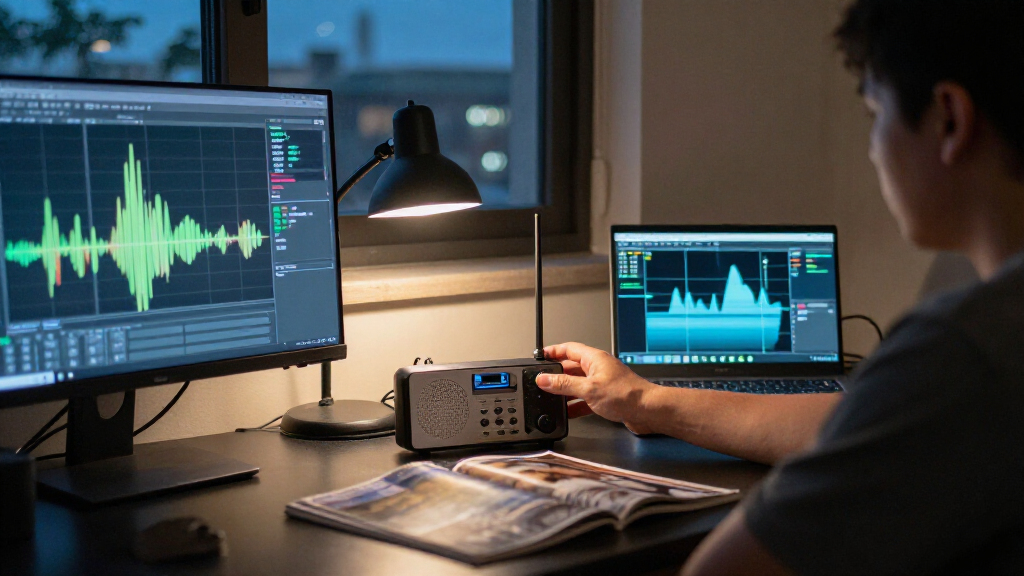
According to Wccftech, the method combines a software-defined radio receiver with an antenna to capture electromagnetic signals associated with an HDMI connection. A neural network is then trained to reduce interference and reconstruct the captured data as screen images. The report says the resulting images can include readable text and recognizable desktop windows, but it does not provide measurements of image quality or a detailed account of the test setup.
The technique draws on TEMPEST-style surveillance, which involves studying unintended electromagnetic emissions from electronic equipment. Wccftech describes older analog VGA signals as comparatively easier to reconstruct, while digital HDMI emissions are more difficult to interpret. Deep-TEMPEST’s reported contribution is the use of machine learning to process signals that would otherwise be difficult to turn into a coherent image.
As described, the method does not depend on malware, downloaded files, or network access to the target computer. That does not establish that every computer or HDMI cable can be observed in practice: the report does not specify the equipment configuration, distance, environmental conditions, or limits of the demonstration. Those details are needed to judge the technique’s practical reach.
Deep-TEMPEST Screen signals, decoded
A reported research demonstration uses deep learning to reconstruct screen images from radio emissions associated with HDMI cables. Its real-world range and reliability remain unclear.
How the method works
The approach analyzes electromagnetic signals linked to an HDMI connection.
A software-defined radio receiver and antenna collect emissions associated with the cable.
A neural network is trained to reduce noise in the captured signals.
The model turns the processed signals into screen images that the report says can show readable text and recognizable windows.
Why security teams should care
Signal interception could raise physical security concerns beyond conventional network monitoring.
- Does not rely on malware or network access, according to the report.
- Could matter for organizations displaying confidential information.
- No stated operating distance or accuracy measurements.
- No evidence it works through walls or across ordinary screen setups.
Evidence gaps
The available account does not provide enough detail to judge practical reach or reproducibility.
Setup details
Receiver configuration, environment, and operating distance are not specified.
No benchmarks
The report gives no image quality measures, error rates, or independent test results.
Compatibility unknown
Results across different cables, displays, and computers are not provided.
Precautions mentioned
Wccftech lists possible mitigations, but reports no comparative tests of their effectiveness.
Risks Beyond Network Security
The report highlights a potential blind spot in conventional security monitoring. A method based on electromagnetic emissions would not necessarily produce the usual signs of a digital intrusion, such as suspicious software activity or network traffic. For organizations handling confidential information on screens, the possibility of physical signal interception is a reminder that protecting data involves more than securing accounts and firewalls.
However, a research demonstration is not the same as evidence of a widespread or easy-to-use attack. The available account does not establish that an observer can reliably read screens through walls in ordinary conditions, or that the technique works against a broad range of displays and cable setups. Its immediate significance is as a potential physical-security concern that warrants careful technical evaluation, not proof that routine screen surveillance is occurring.
Products Worth Considering

LG UltraGear 25G590B-B 25-Inch Full HD 1000Hz Gaming Monitor

Samsung 49-Inch Odyssey OLED G9 (G91SD) Dual QHD Curved Gaming Monitor

LG UltraGear 27-inch QHD OLED Gaming Monitor, 240Hz
As an affiliate, we earn on qualifying purchases.
From Signal Leakage to Images
Electronic devices can produce unintended electromagnetic emissions while operating. TEMPEST refers broadly to the study and mitigation of risks associated with such emissions. The concept predates Deep-TEMPEST; what Wccftech describes as new is applying deep learning to captured HDMI-related signals to help reconstruct visual information from them.
HDMI carries digital video data, and Wccftech says its high-frequency signals have traditionally been harder to interpret from radio emissions than older VGA signals. The reported model is intended to address that difficulty by denoising and assembling captured signals into frames. The account does not identify the researchers or provide a paper, independent replication, or benchmark results, so the specific performance claims remain difficult to verify from the information presented.
“Deep-TEMPEST uses deep learning to turn invisible HDMI electromagnetic leaks into legible screen captures.”
— Wccftech
Limits of the Demonstration
The report does not state how far away the receiver can be, what antenna or radio configuration was used, or whether the displayed content was captured under controlled or ordinary operating conditions. It also gives no error rates, sample images, independent test results, or comparison across different HDMI cables, monitors, and computers.
Wccftech describes the images as readable and the feed as real time, but the account does not include measurements supporting those descriptions. It is also unclear whether the technique can recover all content on a screen or only selected patterns under favorable conditions. Without fuller technical documentation, the practical threat level and reproducibility cannot be assessed.
Evidence Needed to Assess Risk
The next useful step would be publication of the demonstration’s technical methods and test results, including receiver hardware, operating distances, environmental conditions, image quality, and failure cases. Independent researchers could then assess whether the reported reconstruction can be reproduced and how performance changes across cables, displays, and shielding.
For now, the account points to possible precautions rather than a validated universal fix. Wccftech mentions shielded cabling, ferrite chokes, and TEMPEST-certified enclosures as mitigations, but does not provide comparative tests showing how much each reduces exposure. Organizations with high confidentiality requirements can review physical security and equipment shielding while awaiting clearer evidence; ordinary users should not interpret the report as proof that their screens are readily readable from outside a room.
Key Questions
What is Deep-TEMPEST?
Deep-TEMPEST is a reported research approach that uses deep learning to reconstruct screen images from radio-frequency emissions associated with HDMI cables.
Does it require malware or network access?
Wccftech says the described method relies on radio interception, rather than malware or access to the target computer’s network. The report does not provide enough test detail to establish how it performs in practical settings.
Can it read any screen through a wall?
The account does not establish that it works on any screen or through walls under ordinary conditions. It gives no range, accuracy, or broad compatibility results, so those claims remain unverified in the information available.
What countermeasures are mentioned?
Wccftech lists shielded cables, ferrite chokes, and TEMPEST-certified enclosures. The report does not include comparative measurements of their effectiveness against this specific demonstration.
Source: Wccftech