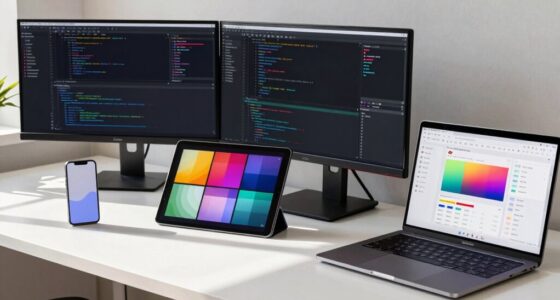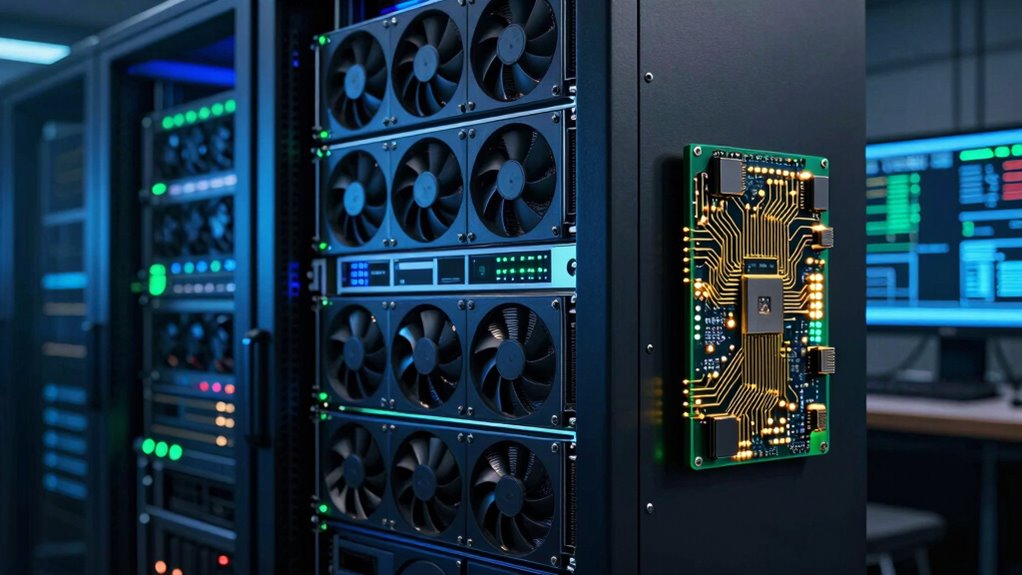

Devices suitable for AI workloads have powerful processors, such as high-performance GPUs or TPUs, designed for complex calculations. They incorporate specialized AI hardware accelerators for faster data processing and efficiency. These devices also handle data quickly and reduce latency, making them ideal for real-time tasks. Edge computing devices are compact and energy-efficient, while high-performance servers enable large model training. Keep exploring to discover how different hardware options can match your specific AI needs.

Get privacy and security gear delivered free with Prime
- Fast, free delivery on millions of items
- Prime Video, Amazon Music and more included
- Member-only deals all year
Key Takeaways
- High computational power and efficient data handling capabilities.
- Presence of specialized AI hardware accelerators like GPUs or TPUs.
- Low latency and energy-efficient design for real-time processing.
- Scalability to handle increasing data volumes and complex models.
- Integration of emerging technologies like quantum processors for advanced tasks.
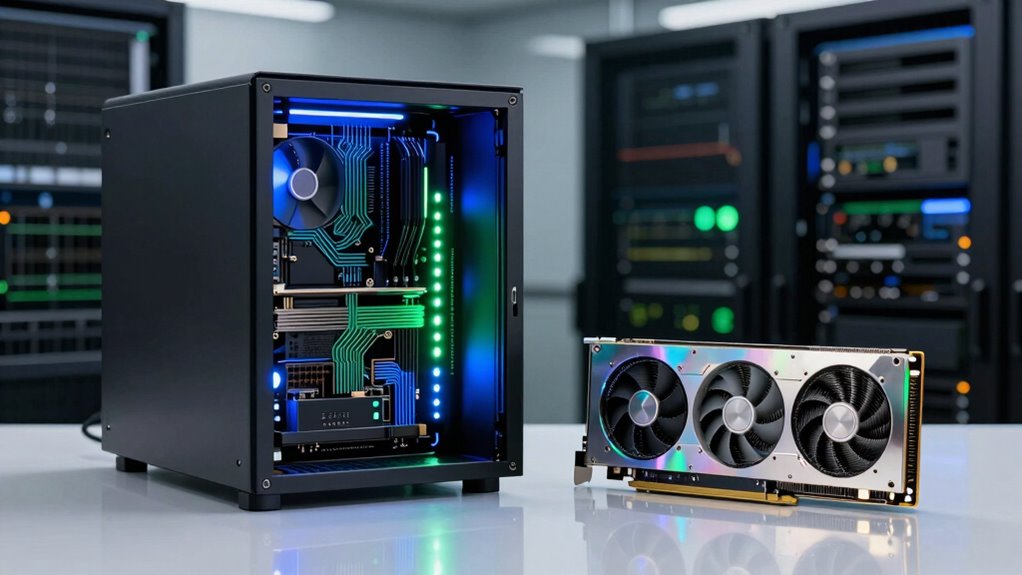
Are you wondering which devices are best suited for handling AI workloads? When it comes to managing complex AI tasks, the right hardware makes all the difference. Devices that excel in AI processing typically combine high computational power with efficient data handling. Traditional servers and high-performance GPUs have long been the go-to options, but newer technologies are shifting the landscape. Edge computing devices are gaining prominence because they bring processing closer to where data is generated, reducing latency and bandwidth demands. This is especially useful for real-time AI applications like autonomous vehicles, industrial automation, or smart cameras, where immediate decision-making is critical. Edge devices are designed to operate with limited power and space, yet still deliver substantial processing capabilities, making them ideal for distributed AI workloads. As these devices become more sophisticated, they are increasingly incorporating specialized AI hardware to optimize performance. Furthermore, the integration of AI-specific hardware accelerators enhances their ability to handle demanding AI algorithms efficiently. Incorporating hardware acceleration techniques can significantly boost processing speed and efficiency for AI tasks on these devices, enabling them to meet the growing demands of AI applications with greater agility.
Edge devices deliver powerful, low-latency AI processing for real-time applications in compact, energy-efficient designs.
Quantum processors are also emerging as a game-changer in AI hardware. Although still in early development stages, these processors promise exponential speed-ups for specific AI algorithms, particularly those involving optimization, pattern recognition, and large-scale data analysis. They have the potential to revolutionize how AI models are trained and deployed by solving problems that are currently computationally infeasible for classical computers. While quantum processors aren’t yet mainstream, their integration into future AI devices could substantially enhance performance, especially for tasks requiring complex calculations or massive data processing. Quantum computing is rapidly advancing, and its integration with AI hardware could unlock new capabilities in data processing. As research continues, the development of hybrid systems that combine classical and quantum processing may further expand the horizons of AI applications. These hybrid systems could lead to breakthroughs in AI efficiency and problem-solving capabilities, shaping the future of the industry.
The key to choosing a device suitable for AI workloads lies in understanding the specific demands of your applications. For instance, if you’re working with real-time data streams and need instant responses, edge computing devices are a practical choice. They can process data locally, minimizing delays and reducing the load on centralized servers. On the other hand, if your work involves training large models or conducting intensive simulations, high-performance GPUs and specialized hardware like tensor processing units (TPUs) might be necessary. As AI models grow more sophisticated, hardware that can handle parallel processing efficiently becomes increasingly important. Additionally, scalability considerations are crucial, as some devices better accommodate growth in data and processing requirements. For example, scalability is a key factor when designing AI infrastructure to ensure long-term adaptability and performance.
Ultimately, the ideal device for AI workloads depends on balancing speed, power consumption, scalability, and application needs. Combining traditional high-performance hardware with emerging technologies like edge computing and quantum processors can provide versatile solutions. As AI continues to evolve, staying informed about these hardware options ensures you select the most effective devices to meet your AI challenges. The future of AI hardware promises even more innovative devices that will push the boundaries of what’s possible, making your choice of equipment a vital factor in your success.
As an affiliate, we earn on qualifying purchases.
Frequently Asked Questions
How Do Energy Consumption Levels Affect Device Choice for AI Workloads?
Energy consumption levels greatly influence your device choice for AI workloads. You want devices with high energy efficiency to minimize power use while maintaining performance. Effective power management features help reduce energy drain during intensive tasks. Choosing devices with optimized energy consumption not only saves costs but also guarantees sustainability. By prioritizing energy efficiency and smart power management, you guarantee your AI workloads run smoothly without unnecessary energy waste or overheating issues.
What Role Does Software Compatibility Play in Device Selection?
Think of choosing a device as assembling a puzzle—software compatibility is the key piece that guarantees everything fits seamlessly. You need software integration that harmonizes with hardware compatibility, so your AI workloads run smoothly without glitches. Without this alignment, the device may struggle or crash, like a puzzle with missing pieces. Prioritizing software compatibility guarantees your system functions efficiently, enabling the full potential of your AI applications.
Are There Specific Security Features Needed for AI Devices?
Yes, AI devices need specific security features like data encryption and user authentication. Data encryption protects sensitive data during processing and storage, preventing unauthorized access. User authentication guarantees only authorized users can access and operate the device, safeguarding your AI workloads from breaches. These security features are essential to maintain data integrity, privacy, and trust, especially when handling sensitive information or deploying AI in critical applications.
How Does Device Scalability Impact Long-Term AI Projects?
Did you know that 60% of AI projects face scalability challenges within the first year? Your device’s scalability directly impacts long-term AI success, as it determines whether you can handle increasing data and workload demands. When hardware upgrades become necessary, seamless scalability ensures your project continues smoothly without costly delays. Failing to plan for scalability can limit growth, making it essential to select devices designed for easy upgrades and expansion.
What Are the Maintenance Requirements for Ai-Optimized Devices?
You need to regularly check the hardware durability of your AI-optimized devices to prevent breakdowns and guarantee consistent performance. Keep firmware updates current, as they often include security patches, bug fixes, and performance improvements vital for AI workloads. Additionally, monitor cooling systems and power supplies, perform routine cleaning, and track usage to maintain peak functioning, ultimately extending your device’s lifespan and ensuring dependable AI processing.
As an affiliate, we earn on qualifying purchases.
Conclusion
In the end, choosing the right device for AI workloads isn’t just about hardware specs; it’s about embracing the subtle art of balance. When you select a device that harmonizes power and efficiency, you’re gently nurturing the seeds of innovation without overwhelming your resources. Remember, the most suitable tools quietly support your vision, allowing your ideas to flourish in ways that speak softly but carry profound potential. Sometimes, less noise makes the clearest path forward.
As an affiliate, we earn on qualifying purchases.
As an affiliate, we earn on qualifying purchases.
Fall Picks
fall essentials
As an affiliate, we earn on qualifying purchases.