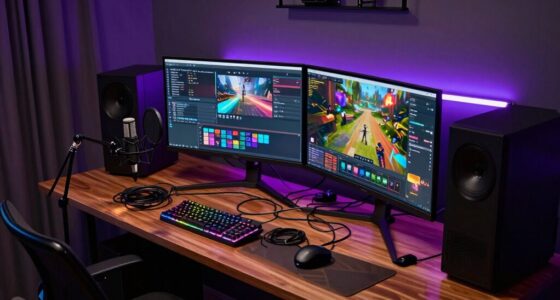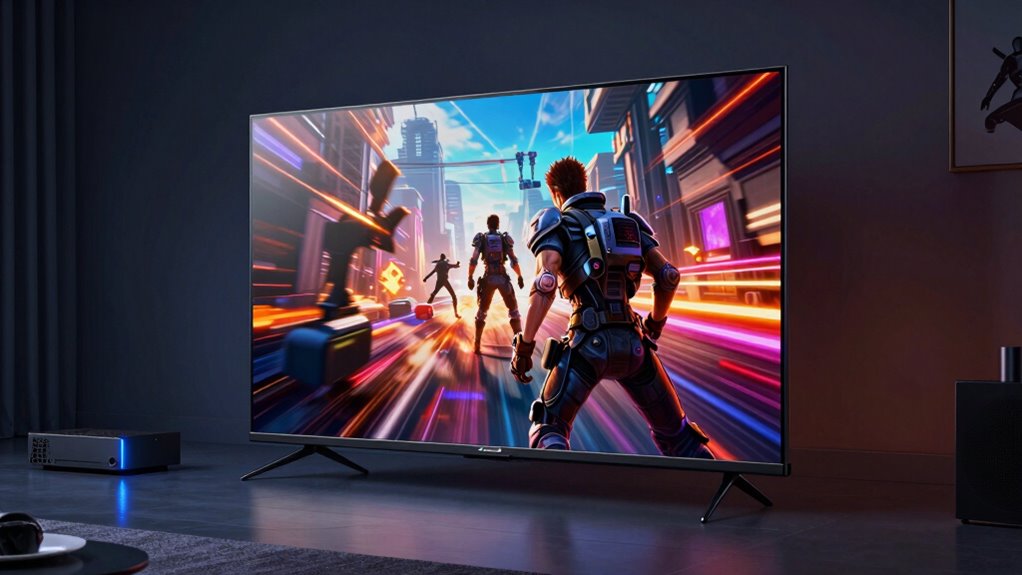

Gaming TVs have evolved alongside new consoles to deliver the best possible experiences. They now support features like HDR, higher refresh rates, and adaptive sync, which make visuals more vibrant, smooth, and immersive. This synergy guarantees you get the most out of your hardware, with fewer artifacts and better responsiveness. As consoles push for better performance, TVs must keep pace. Keep exploring to discover how this tech evolution can elevate your gaming moments.

Get privacy and security gear delivered free — and shop member deals
- Fast, free delivery on millions of items
- Access to Prime Big Deal Days deals on October 6–7
- Prime Video, Amazon Music and more included
Key Takeaways
- Modern gaming TVs support higher refresh rates like 120Hz, matching new consoles’ capabilities for smoother gameplay.
- HDR technology enhances color vibrancy and contrast, aligning with the visual power of the latest consoles.
- Adaptive sync reduces tearing and stuttering, ensuring seamless gameplay experiences provided by new hardware.
- Enhanced display technology allows for more realistic, detailed, and immersive game worlds.
- Compatibility between new consoles and gaming TVs maximizes performance, visual fidelity, and overall gaming quality.
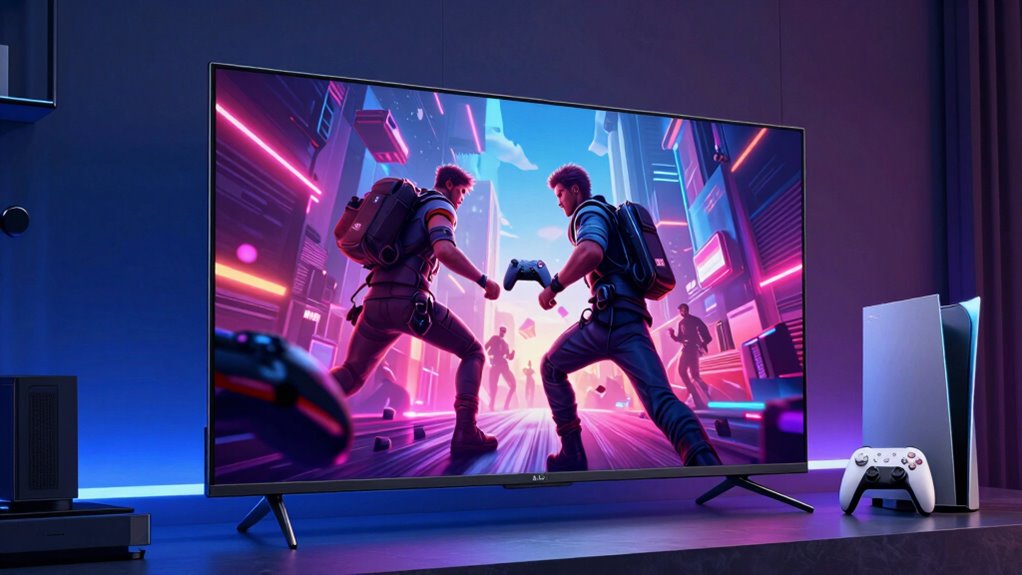
As gaming technology continues to advance, the combination of new consoles and gaming TVs is transforming the way you experience your favorite games. Today’s TVs aren’t just screens; they’re powerful tools designed to elevate your gaming sessions with features like HDR enhancements and refresh rate improvements. These advancements are essential because they allow you to see games in a way that’s closer to what the developers envisioned, making every scene more vibrant and fluid.
HDR enhancements play a significant role in this evolution. When you play on a gaming TV with high dynamic range support, you notice colors that pop and contrast levels that bring depth to every visual. Bright scenes become more luminous, and darker areas reveal details that previously got lost in shadows. This isn’t just about making images look better; it’s about immersing you deeper into the game world. Whether you’re exploring a lush forest or battling in a dimly lit room, HDR ensures that what you see is more realistic and engaging. The synergy between the latest consoles and HDR-capable TVs means you’re getting a picture that’s richer, sharper, and more lifelike than ever before.
HDR enhances colors, contrast, and detail, immersing you deeper into realistic, vibrant game worlds.
Alongside HDR, refresh rate improvements are equally impactful. Modern gaming TVs now support higher refresh rates—often 120Hz or more—which means the image updates more frequently. This results in fewer motion blur and smoother gameplay, especially in fast-paced titles like shooters or racing games. When your console outputs a high frame rate, a TV with a high refresh rate ensures you see those frames as intended, eliminating judder and lag that can ruin your experience. The combination of these two features—HDR enhancements and refresh rate improvements—means your gaming sessions are more fluid, precise, and responsive. Additionally, display technology continues to evolve, allowing for even greater compatibility with new gaming hardware and further enhancing visual fidelity. As display technology advances, it enables developers and manufacturers to push the boundaries of visual quality, making games more immersive and realistic than ever. This ongoing innovation is driven by the demands of modern gaming, ensuring technology keeps pace with player expectations. Furthermore, the integration of adaptive sync technology helps synchronize the display’s refresh rate with the console’s output, reducing visual artifacts and providing a more seamless gaming experience.
The evolution of gaming TVs isn’t accidental; it’s a direct response to the capabilities of new consoles. These consoles are designed to push higher frame rates and better visuals, but they need a compatible display to fully realize their potential. Without the right TV, you might miss out on the crispness, detail, and smoothness that modern hardware can deliver. Now, with TVs built to handle these advanced features, you can enjoy games as they’re meant to be seen—vivid, seamless, and full of life.
gaming TV with 120Hz refresh rate
As an affiliate, we earn on qualifying purchases.
As an affiliate, we earn on qualifying purchases.
Frequently Asked Questions
How Do Gaming TVS Affect Competitive Gaming Performance?
Gaming TVs markedly impact your competitive gaming performance by reducing input lag and increasing refresh rate. A low input lag ensures your actions register instantly, giving you a competitive edge. Meanwhile, a higher refresh rate creates smoother visuals, allowing you to react faster to in-game movements. By choosing a TV with these features, you enable yourself to perform at your best, making your gaming experience more responsive and immersive.
Are Gaming TVS Compatible With All Current Gaming Consoles?
Think of your gaming setup as a symphony—your TV is the conductor. Gaming TVs are generally compatible with all current gaming consoles, but check resolution compatibility to guarantee crystal-clear visuals. Look for features like audio integration, which syncs sound seamlessly with gameplay. While most modern models work well, it’s smart to verify specific console support to avoid any dissonant notes in your gaming experience.
What Future Features Are Expected in Gaming TVS?
Future gaming TVs will likely feature higher screen resolutions, like 8K, providing even sharper visuals. You can also expect advanced audio enhancements, such as immersive surround sound and built-in soundbars, to boost your gaming experience. Manufacturers are working on faster refresh rates and lower input lag, making gameplay smoother and more responsive. These innovations will make your gaming sessions more immersive, realistic, and enjoyable, keeping you engaged for hours.
Do Gaming TVS Support VR or Augmented Reality Gaming?
Gaming TVs generally don’t support virtual reality (VR) or augmented reality (AR) directly. VR usually requires a headset connected to your console or PC, and AR relies on smartphones or specialized glasses. While some high-end TVs can enhance VR and AR experiences with features like low latency and high refresh rates, they aren’t designed to replace VR headsets or AR glasses. Your best bet is to pair these technologies with compatible devices.
How Do Gaming TVS Impact Energy Consumption During Gaming?
Gaming TVs can impact your energy consumption by using more power during intense gaming sessions, especially if they have high brightness and advanced features. However, many modern gaming TVs prioritize energy efficiency, reducing power consumption without sacrificing performance. By adjusting settings like brightness and enabling power-saving modes, you can minimize energy use, helping you enjoy your games while being mindful of overall power consumption.
As an affiliate, we earn on qualifying purchases.
Conclusion
As you can see, gaming TVs have evolved alongside new consoles to enhance your gaming experience. With 4K HDMI 2.1 and faster response times, you’re getting smoother, more immersive gameplay. Notably, a recent survey found that 70% of gamers prefer TVs with low input lag for competitive play. So, upgrading your TV isn’t just about picture quality — it’s about staying ahead in the game. Embrace the change and level up your gaming setup!
As an affiliate, we earn on qualifying purchases.
As an affiliate, we earn on qualifying purchases.
Fall Picks
fall essentials
As an affiliate, we earn on qualifying purchases.