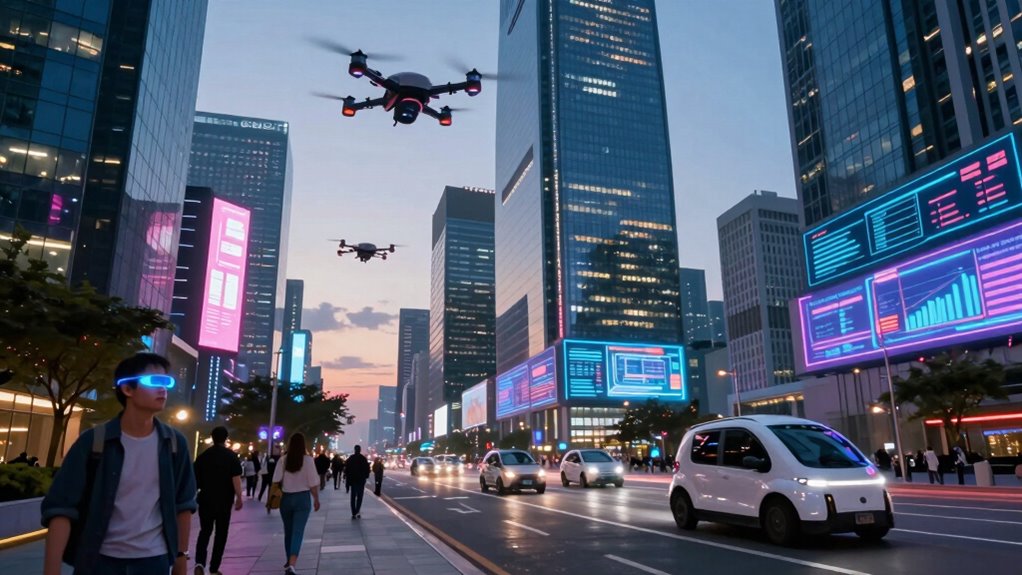

AI is already deeply embedded in daily life and business, with over half the world gaining access and billions using tools regularly. While adoption is rapidly increasing, especially in wealthier nations, many areas still lack access, creating global disparities. AI’s influence is transforming industries, automating jobs, and generating immense financial growth. As algorithms become more advanced and widespread, understanding how ready we are for this AI-driven world is essential—exploring further will reveal what’s next for us all.
Key Takeaways
- AI adoption is rapidly increasing, with over 78% of organizations integrating AI tools in 2024.
- Global investments in AI are soaring, reaching hundreds of billions, fueling widespread technological development.
- Infrastructure and access disparities could widen global inequalities, limiting readiness in less developed regions.
- Public perception is generally positive, with many users seeing AI benefits, but concerns about job displacement persist.
- Preparing for an AI-driven world requires addressing ethical, infrastructural, and societal challenges alongside technological advancements.

Have you ever wondered how AI has become an inseparable part of daily life and business? Today, it’s hard to imagine a world without it. In 2024, about 78% of organizations use AI, a sharp rise from just 55% the previous year. Large enterprises, those with over 10,000 employees, are leading the charge, with 87% adopting AI by 2025. Meanwhile, over a third of people now use AI tools daily, and this number is climbing rapidly, tripling since 2020. From chatbots to smart assistants, AI’s integration into everyday routines is undeniable, with 1.8 billion people having used some AI tool recently. The global market is valued at $44.89 billion in 2024, up 54.7% from $29 billion in 2022, with projections exceeding $66.62 billion by 2025.
The market surrounding AI is booming. Valued at nearly $392 billion in 2025, it’s projected to reach $3.5 trillion by 2033, growing at an impressive rate of over 31% annually. Generative AI, which creates content, is a key driver, with the market surpassing $66 billion and U.S. companies investing over $23 billion of that. Long-term forecasts see this segment reaching $1.3 trillion by 2032, fueling billions in software revenue and transforming digital advertising, infrastructure, and hardware sectors. The rapid technological advancements in AI are further accelerating the pace of innovation and adoption worldwide.
Investments reflect this momentum. In 2024, U.S. companies poured over $109 billion into AI, outpacing China’s $9 billion by a wide margin. Globally, private investments in AI hit $130 billion, marking a 40% increase. Nearly all major firms plan to boost their AI budgets over the next few years, with many deploying over $100 million in generative AI alone. These investments are fueling the rapid development of agentic AI—smart systems capable of reasoning and decision-making—that could account for over 70% of AI applications by 2029.
Despite these advances, disparities persist. AI adoption in wealthier nations like the U.S., Singapore, and Norway is twice that of less affluent regions, highlighting a widening global divide. Over a billion people have embraced AI in less than three years, yet more than half the world still lacks basic access to these tools. Data centers, mostly in the U.S. and China, hold 86% of global capacity, underscoring the concentration of AI infrastructure.
Public perception remains optimistic. About 66% of people use AI regularly, and most believe it offers significant benefits. Countries like China, Indonesia, and Thailand show high enthusiasm, while the U.S. trails behind. As AI becomes more integrated into work and daily life, the potential for industry transformation grows—displacing millions of jobs, creating new roles, and boosting productivity. With such rapid growth, it’s clear that we’re entering an era where algorithms influence nearly every aspect of our world.
Frequently Asked Questions
How Will AI Impact Global Economic Inequality?
AI will likely widen global economic inequality if you don’t actively address disparities. While some countries and companies benefit from rapid adoption and investment, others lag behind, especially in the Global South. You might see increased productivity and growth in advanced regions, but many people could miss out on these benefits. To guarantee fair progress, you need policies that support equitable access, education, and technology sharing worldwide.
What Are the Key Ethical Concerns With Pervasive AI?
You need to consider privacy breaches, bias, and job displacement as key ethical concerns with pervasive AI. As AI becomes more integrated into daily life, it may unintentionally reinforce societal inequalities and infringe on personal privacy. You should also be aware of accountability issues—who’s responsible when AI makes mistakes? Ensuring transparency and fairness is essential to prevent misuse and protect individual rights in this increasingly automated world.
How Prepared Are Governments to Regulate AI Effectively?
You should know that governments are somewhat prepared to regulate AI, but gaps remain. Many countries, like the U.S., are increasing regulations—doubling federal rules in 2024—but only 1% of companies are at AI maturity. You need to stay informed, as global legislation is evolving rapidly, and enforcement varies. Active international cooperation and adaptive policies are essential to keep pace with AI’s growth and guarantee you’re protected.
What Are the Risks of Over-Reliance on AI Systems?
Relying on AI systems is like walking a tightrope without a safety net; the risks are significant. You could face decision-making errors, privacy breaches, or bias amplification. Over-dependence might cause skills erosion or reduce human oversight, leading to catastrophic failures. To stay safe, you must maintain a balance, ensuring AI enhances your work without replacing essential human judgment. Proper regulation, transparency, and ongoing oversight are essential to mitigate these dangers.
How Will AI Influence Job Markets Worldwide?
AI will critically reshape job markets worldwide, automating routine tasks and creating new opportunities. You’ll see some roles diminish, especially in manual and repetitive sectors, but new jobs will emerge in AI development, data analysis, and tech support. Adaptability becomes essential. By embracing continuous learning, you can stay competitive, benefiting from AI’s growth rather than being displaced. Overall, AI’s influence will demand agility and reskilling across industries and regions.
Conclusion
Imagine walking through a forest where every tree, every breeze is guided by unseen algorithms. It’s beautiful, yet uncertain—each step shaped by forces beyond your sight. As AI becomes woven into every part of your life, remember: you hold the lantern. Will you steer wisely, or let the shadows of unchecked automation lead you astray? The choice is yours. Embrace the light of understanding, and guarantee this forest remains a place of wonder, not worry.