

Participating in hackathons helps you develop more than coding skills. You’ll learn how to communicate ideas clearly under pressure, collaborate effectively with diverse teammates, and solve problems creatively. It also builds resilience as you navigate setbacks and manage time tight deadlines. Plus, hackathons expand your network and boost confidence for future opportunities. Keep exploring, and you’ll discover how these soft skills can transform your personal and professional growth beyond the screen.
Key Takeaways
- Enhance communication skills through clear explanations, tailored messaging, and active listening under tight deadlines.
- Strengthen teamwork by negotiating roles, resolving conflicts, and building trust among diverse teammates.
- Boost problem-solving and creativity with rapid ideation, prototyping, and reframing ambiguous challenges.
- Develop resilience and time management by recovering from setbacks and prioritizing essential tasks under pressure.
- Expand networking opportunities, increase visibility, and build confidence for ongoing personal and professional growth.
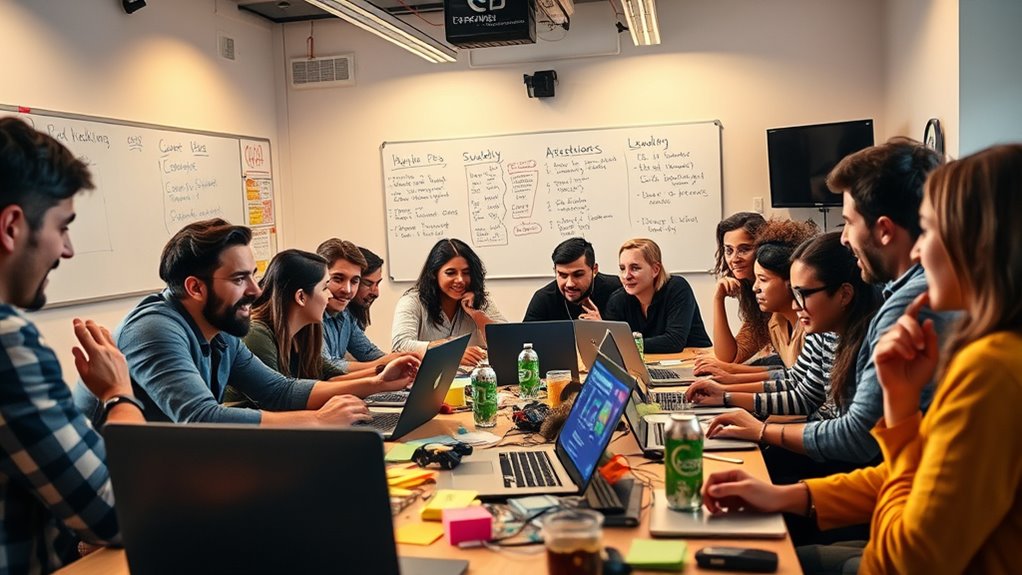
While coding often takes center stage at hackathons, the real value extends far beyond technical skills. Participating in these events pushes you to develop a range of soft skills that are essential in both professional and personal growth. One of the most noticeable areas is communication. Under tight deadlines, you learn to explain complex ideas clearly and concisely, often in rapid pitches or demos. This environment trains you to adapt your message quickly based on your audience, whether it’s judges, mentors, or teammates. Over time, your ability to listen actively and respond thoughtfully improves, making your collaboration more effective. Many participants report increased confidence in their presentation skills, feeling more comfortable sharing ideas under pressure.
Hackathons boost communication skills, confidence, and adaptability through rapid idea sharing and collaborative problem-solving.
Teamwork also sees significant growth during hackathons. Working with strangers from diverse backgrounds forces you to negotiate roles swiftly and handle differing opinions constructively. You develop conflict-resolution strategies and a sense of shared ownership, which enhances your ability to collaborate in high-stakes situations. These experiences foster a sense of belonging and relatedness, often leading to ongoing relationships or even future startup collaborations. You learn to trust your teammates and delegate tasks based on everyone’s strengths, which boosts your leadership potential. Moreover, these collaborative experiences highlight the importance of effective teamwork in achieving complex goals efficiently.
Problem-solving abilities sharpen considerably. The limited timeframe encourages divergent and convergent thinking, pushing you to generate many ideas rapidly and select the most feasible solutions. You become adept at lean prototyping, quickly creating minimum-viable products to test concepts. Reframing ambiguous problems into manageable subproblems becomes second nature, and you gain confidence in experimenting without fear of failure. This iterative approach, fostered under pressure, enhances your creative thinking and heuristic decision-making, which you can transfer to real-world challenges. Furthermore, hackathons are increasingly aligned with emerging technological phenomena and societal challenges, making the problem-solving process even more relevant and impactful. Developing these skills prepares you for a rapidly evolving job market that values adaptability and innovative thinking.
Hackathons also cultivate resilience and adaptability. Handling setbacks like code failures or shifting project scopes teaches you to recover quickly and pivot without panic. You learn to prioritize essential features and manage stress effectively, skills that translate well into workplace environments. The fast-paced nature of these events naturally enhances your time management, enabling you to plan, execute, and deliver within strict deadlines. These qualities combine to make you more agile, better prepared for unpredictable situations.
Networking is another major benefit. During hackathons, you interact with mentors, sponsors, and industry judges, expanding your professional network. Your visibility increases through public demos, awards, and media coverage, opening doors to potential employers and investors. Many participants form ongoing collaborations or startup teams during these events, leveraging the relationships built. Access to domain-specific communities and resources further supports your development long after the event ends. Ultimately, hackathons push you to grow in self-confidence, resilience, and adaptability—skills that are as essential as technical know-how in today’s fast-changing world.
Frequently Asked Questions
How Do Hackathons Improve Long-Term Career Prospects?
Hackathons boost your long-term career prospects by expanding your professional network, showcasing your skills through demos and projects, and demonstrating your ability to solve problems under pressure. You gain valuable soft skills like teamwork, leadership, and communication, which employers highly value. Plus, participating in hackathons shows your initiative, adaptability, and entrepreneurial mindset, making you stand out for potential opportunities, promotions, or even starting your own ventures.
Can Non-Technical Participants Benefit From Hackathon Soft Skills?
Yes, non-technical participants can definitely benefit from hackathon soft skills. You’ll improve your communication and presentation abilities, making it easier to share ideas clearly and persuasively. You’ll also develop teamwork, conflict resolution, and leadership skills through collaboration. Additionally, you’ll boost your problem-solving, creative thinking, and time management. These skills make you more versatile, confident, and prepared for diverse roles, enhancing your overall professional growth beyond just coding.
What Are the Most Transferable Soft Skills From Hackathons?
The most transferable soft skills from hackathons are like a Swiss Army knife—they open multiple doors in your career. You develop excellent communication and presentation skills, learning to pitch ideas convincingly under pressure. You sharpen teamwork, collaboration, and leadership, managing diverse groups and projects swiftly. Problem-solving, creative thinking, and resilience become second nature, equipping you to tackle complex challenges confidently in any professional setting.
How Do Hackathons Foster Leadership Development?
Hackathons foster leadership by giving you opportunities to coordinate teams, set goals, and delegate tasks under tight deadlines. You practice rapid decision-making, managing stakeholders, and inspiring others to stay focused on shared objectives. As you take charge of projects and troubleshoot problems, your confidence grows. These experiences develop your ability to lead under pressure, build trust, and motivate teams—valuable skills transferable to any professional setting.
Are There Industry-Specific Soft Skills Gained at Hackathons?
Imagine stepping into a bustling room where industry-specific jargon fills the air—you quickly learn to adapt your communication style, gaining soft skills tailored to your field. At hackathons, you develop industry-specific networking, problem-solving, and stakeholder management skills. You become adept at translating technical ideas into impactful stories, collaborating with domain experts, and steering industry norms—all essential soft skills that boost your career in your chosen sector.
Conclusion
Participating in hackathons isn’t just about coding; it’s about discovering your hidden potential. The skills you develop—communication, teamwork, adaptability—prove that soft skills are just as vital as technical know-how. When you collaborate under pressure, you realize that success depends on more than just code; it’s about connection and resilience. So, trust the idea that these experiences shape you into a well-rounded professional, proving that soft skills are the true drivers of innovation.