
If you’re looking for the top CAN-bus hacking shield in 2025, I recommend the Seeed Studio CAN-Bus Shield V2 for Arduino. It offers excellent compatibility with popular Arduino models, supports standard CAN protocols up to 1 Mbps, and features onboard data logging with TF/SD card slots. Its durable design and straightforward integration make it ideal for automotive and industrial projects. Keep going to discover more about this versatile tool and how it can boost your projects.
Key Takeaways
- The recommended shield for CAN-bus hacking in 2025 offers high compatibility with Arduino models like UNO and Mega.
- It supports standard CAN protocols up to 1 Mbps, ideal for automotive and industrial hacking projects.
- Features onboard data logging with SD card support, facilitating detailed CAN network analysis and hacking.
- Its robust design ensures durability for long-term hacking experiments in demanding environments.
- Advanced models include multi-channel support and firmware updates, enhancing hacking capabilities and versatility.
Seeed Studio CAN-Bus Shield V2 for Arduino
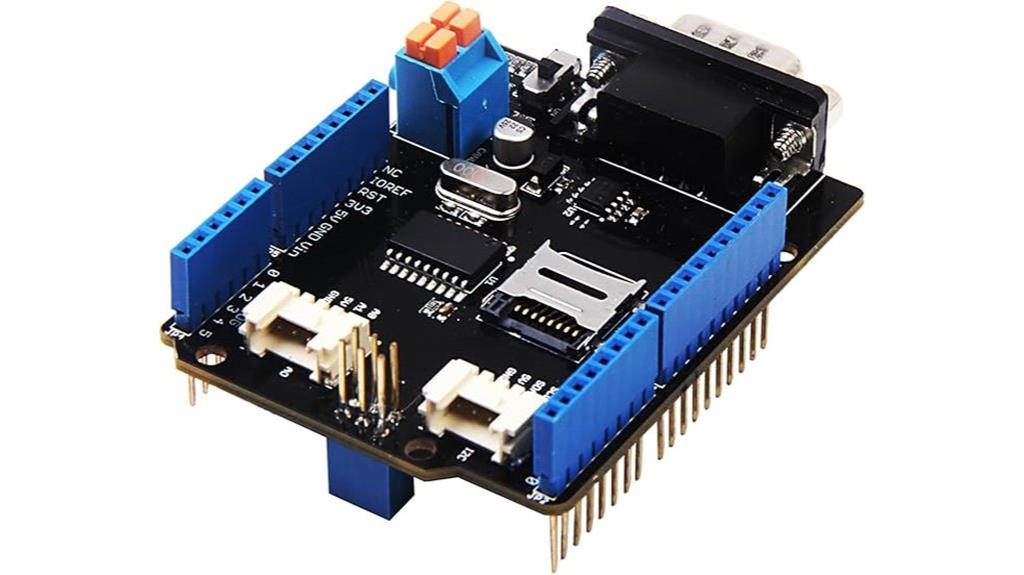
If you’re looking for a reliable CAN-bus hacking shield compatible with popular Arduino boards, the Seeed Studio CAN-Bus Shield V2 is an excellent choice. It works seamlessly with Arduino UNO, Mega, Leonardo, and LinkIt One, making it versatile for various projects. The shield uses MCP2515 as the CAN controller and MCP2551 transceiver, supporting both OBD-II and CAN standards. Its design ensures long-distance, medium-speed communication with high reliability. The embedded wiring inside the PCB enhances durability, and the onboard TF card slot allows data logging. Overall, it’s a solid, user-friendly option for interfacing with vehicle systems and industrial equipment.
Best For: makers, hobbyists, and engineers seeking a reliable and versatile CAN-BUS interface for automotive diagnostics or industrial projects using Arduino compatible boards.
Pros:
- Compatible with multiple Arduino models including UNO, Mega, Leonardo, and LinkIt One.
- Supports both OBD-II and CAN standards for broad application use.
- Features embedded wiring inside the PCB for enhanced durability and long-distance communication.
Cons:
- Internal wiring modifications require cutting the PCB wiring, which may be challenging for some users.
- Limited to medium-speed communication, not suitable for high-speed CAN applications.
- External wiring options are not visible or accessible without modification, reducing flexibility for custom setups.
Factors to Consider When Choosing Can‑Bus Hacking Shields

When choosing a CAN‑bus hacking shield, I consider how well it works with my Arduino model to guarantee compatibility. I also look at supported CAN protocols and data transfer speeds to match my project’s needs. Additionally, I evaluate wiring complexity and data storage options to find a shield that fits my technical skills and requirements.
Compatibility With Arduino Models
Choosing a CAN-bus hacking shield that’s compatible with your Arduino model is vital for smooth integration. I always check if the shield supports my specific Arduino, whether it’s UNO, Mega, Leonardo, or LinkIt One. Compatibility with the microcontroller architecture and communication protocols ensures the shield works seamlessly. I also verify that the pinout and interface connections match my board’s available pins and headers, preventing connection issues. Firmware and driver support are important too; I confirm they align with my Arduino IDE version and development environment to avoid compatibility problems. Finally, I review the manufacturer’s specifications to make sure the shield includes necessary components like MCP2515 and MCP2551, which are compatible with my setup. This careful check guarantees smooth operation and easier troubleshooting.
Supported CAN Protocols
Understanding which CAN protocols a hacking shield supports is essential for guaranteeing reliable communication within your system. Most shields support the standard CAN protocol (ISO 11898-1), which runs up to 1 Mbps, suitable for many applications. Many also support CAN FD, enabling higher data payloads and faster speeds, ideal for modern, data-intensive systems. For specialized needs, some shields include support for protocols like J1939, common in heavy-duty vehicles, or OBD-II, used in automotive diagnostics. However, compatibility with proprietary or extended protocols might require firmware updates or hardware tweaks. Selecting a shield that aligns with your specific CAN protocol assures seamless data transfer and system integration, preventing communication issues and maximizing your hacking capabilities.
Data Transfer Speed
The data transfer speed of a CAN-bus hacking shield directly impacts its performance and reliability, making it a critical factor to regard. While the standard CAN protocol supports speeds up to 1 Mbps, practical applications often use lower speeds to ensure stable communication over longer distances. Higher data rates demand more robust shielding and wiring to reduce noise and electromagnetic interference, which can compromise data integrity. When choosing a shield, it’s essential to take into account the maximum supported data rate to match your specific needs. Medium speeds, like 500 kbps, strike a good balance, offering decent transfer rates without sacrificing signal quality over extended cables. Ultimately, selecting the right speed depends on your application’s requirements for both performance and stability.
Wiring Complexity Level
The wiring complexity of CAN-bus hacking shields varies markedly, affecting how easy or challenging it is to set up and maintain the system. Some shields feature plug-and-play designs, making installation quick and straightforward, while others require detailed internal wiring modifications, which can be more intricate. Shields with embedded wiring inside the PCB reduce external connections, simplifying setup but making internal changes difficult later. Conversely, external wiring configurations demand careful routing and secure connections to maintain signal integrity, especially over longer distances. The number of jumpers or switches needed to configure pinouts also influences ease of wiring; more adjustments mean increased chances of errors. Understanding the wiring diagram and connector types is vital to minimize mistakes and ensure reliable communication.
Data Storage Options
When choosing a CAN-bus hacking shield, considering its data storage options is crucial for effective data logging and analysis. Shields with onboard SD or TF card slots allow me to store large amounts of data locally, making long-term recording straightforward. Some shields have internal memory or EEPROMs for saving configuration settings or small logs, which is helpful for quick adjustments. External interfaces like USB ports or Wi-Fi modules expand storage and enable easy data transfer to other devices. The storage choice directly affects my ability to track extensive CAN traffic over time and conduct detailed diagnostics. Compatibility with formats such as CSV, TXT, or binary files ensures I can easily retrieve and analyze data using common software tools. Ultimately, selecting the right storage options enhances my ability to gather, analyze, and manage CAN bus data efficiently.
Physical Durability Features
Choosing a CAN-bus hacking shield that can withstand tough environments is essential for reliable performance. Look for shields with robust, high-quality casings or protective coatings that resist impacts, dust, and moisture. Reinforced mounting holes or brackets are crucial to prevent damage during installation or transportation. Check if the shield includes heat dissipation features like heat sinks or ventilation to avoid overheating during extended use. Securely soldered or mounted connectors and ports ensure durability through repeated plugging and unplugging. Additionally, internal wiring or circuits should be protected from accidental cuts, abrasion, or environmental exposure. These durability features help ensure your shield remains reliable and functional, even in demanding conditions, making it a smart investment for long-term projects and harsh environments.
Ease of Integration
Ensuring seamless integration of a CAN-bus hacking shield starts with verifying compatibility with your existing hardware setup. Check that the shield’s pin configuration and communication protocol match your microcontroller’s specifications to avoid wiring headaches. It’s also important to consider whether the shield supports key features like data logging, multiple CAN channels, or specific pinouts relevant to your project’s needs. Ease of integration is greatly enhanced by clear documentation, example code, and libraries compatible with your development environment. Physical design matters too—look at the form factor and connector types to ensure the shield fits neatly into your system or enclosure. Taking these factors into account helps streamline setup, reduces troubleshooting, and gets you up and running quickly.
Price and Value
The price of CAN-bus hacking shields can vary considerably, making it essential to weigh the features and build quality against your budget. Budget options often provide basic functionality, while higher-priced shields include advanced features like data logging, multiple interfaces, and enhanced durability. When evaluating value, consider the included components such as controllers and transceivers, which impact performance and compatibility. A more expensive shield typically offers better long-term value through improved reliability, compatibility with various Arduino models, and durability over time. Cheaper shields may lack essential support or documentation, leading to increased troubleshooting and development time. Balancing cost with the necessary features and build quality ensures you get a shield that meets your project needs without overspending on unnecessary extras.
Frequently Asked Questions
Can Can-Bus Hacking Shields Integrate With Other Automotive Systems?
Yes, CAN-bus hacking shields can integrate with other automotive systems. I’ve used them to connect with various components like ECUs, infotainment units, and sensors. They often support multiple protocols, making integration smooth. Just verify compatibility with your vehicle’s specific systems and firmware. Proper setup allows for effective testing, diagnostics, or even hacking, giving you a thorough view of your car’s network and functionality.
What Is the Maximum Data Transfer Rate Supported by These Shields?
Did you know that the maximum data transfer rate supported by these shields can reach up to 1 Mbps? I’ve found that many modern CAN-bus hacking shields are designed to handle high-speed data exchanges, making them ideal for real-time diagnostics and hacking projects. This speed guarantees smooth communication with automotive systems, giving you the ability to analyze and manipulate data quickly and efficiently.
Are These Shields Compatible With All Arduino Models?
Most of these shields are compatible with various Arduino models, but I always double-check the specific shield’s documentation first. Typically, they work well with Arduino Uno, Mega, and Leonardo, as long as the necessary libraries are supported. Keep in mind some shields might need additional configuration or adapters for newer or less common Arduino boards. Always verify compatibility before purchasing to guarantee seamless integration.
How Secure Are Can-Bus Hacking Shields Against Cyber Threats?
I once tested a CAN-bus hacking shield, and it was surprisingly vulnerable, much like a locked door with a weak lock. While these shields offer some security, they’re not foolproof against cyber threats. Skilled hackers can exploit vulnerabilities, so I recommend pairing them with robust cybersecurity measures. Always stay vigilant—it’s like locking your car but leaving the windows down; you need more than just a lock.
Do These Shields Support Wireless Can-Bus Communication?
Yes, many of these shields support wireless CAN-bus communication, allowing for remote access and testing. I find that wireless features are increasingly common, making it easier to monitor and manipulate CAN networks without physical connections. Just keep in mind, though, that not all shields have this capability, so I always double-check the specifications before choosing one for my projects.
Conclusion
Think of choosing the right CAN-Bus shield as selecting a sturdy bridge across a busy river. It needs to be reliable, fast, and durable enough to carry your data safely to the other side. As you navigate the options, remember that the perfect shield isn’t just about specs—it’s about trust and connection. When you find that solid bridge, you’ll be ready to conquer any can-bus challenge that comes your way in 2025 and beyond.