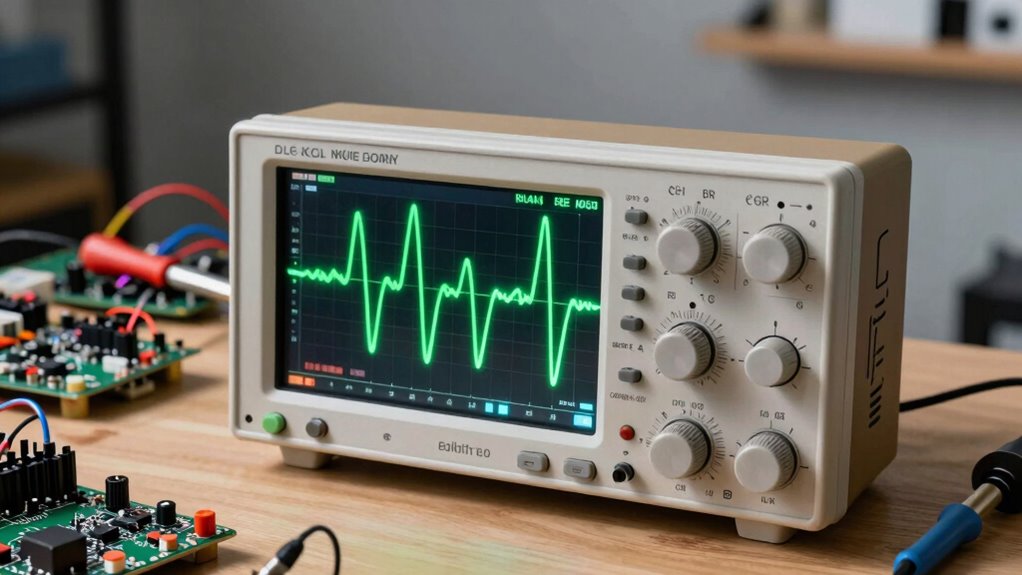
Oscilloscopes are still essential for serious makers because they let you see real-time analog and digital signals, helping you troubleshoot and refine your circuits effectively. They reveal waveform distortions, noise, and timing issues, making debugging much easier. With user-friendly interfaces and digital connectivity, you can analyze and record signals easily. Staying familiar with oscilloscopes guarantees you can build reliable, safe projects. Keep exploring, and you’ll discover even more ways they can enhance your engineering skills.

Get privacy and security gear delivered free — and shop member deals
- Fast, free delivery on millions of items
- Access to Prime Big Deal Days deals on October 6–7
- Prime Video, Amazon Music and more included
Key Takeaways
- They provide real-time visualization of both analog and digital signals for accurate troubleshooting and analysis.
- Enable detection of noise, distortions, and timing issues crucial for reliable circuit design.
- Offer immediate feedback during debugging, facilitating iterative testing and optimization.
- Connect easily to computers or smartphones for detailed recording, analysis, and documentation.
- Essential for educational and hobbyist projects, bridging theoretical knowledge with practical application.
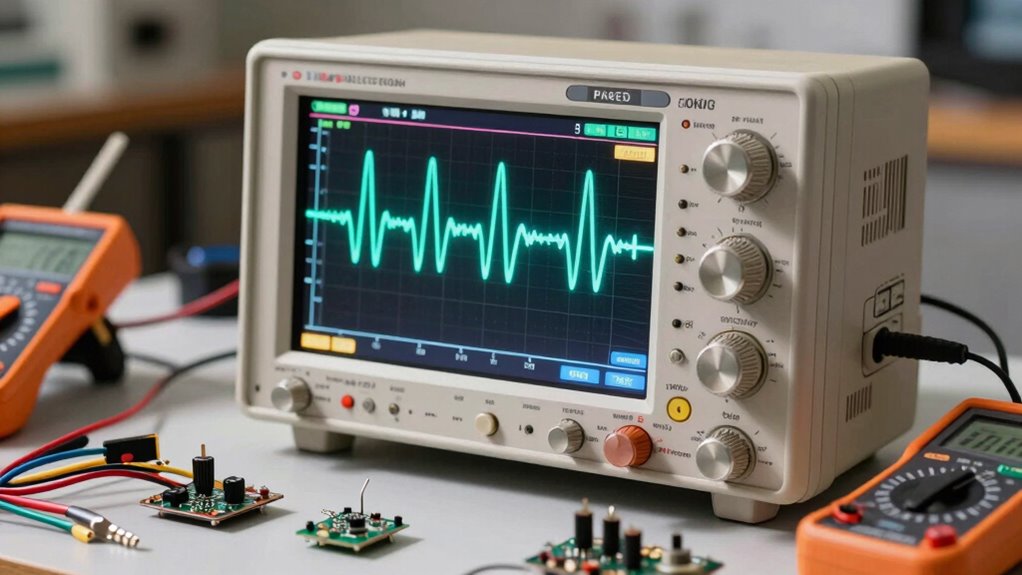
If you’re a maker delving into electronics projects, understanding how signals behave is vital, and that’s where oscilloscopes come in. These tools allow you to visualize electrical signals in real-time, giving you insight into how your circuits function. Whether you’re working with analog signals or digital interfaces, an oscilloscope provides a window into the electrical world that’s invaluable for troubleshooting, designing, and refining your projects.
Analog signals carry continuous waveforms that can vary smoothly over time, and seeing these signals helps you spot distortions, noise, or unexpected behaviors. When you’re troubleshooting an audio amplifier, sensor interface, or power supply, an oscilloscope shows you the signal’s shape, amplitude, and timing. This visual feedback is essential because it helps you identify issues that are hard to detect with multimeters alone. You can observe how your circuit responds to different conditions, ensuring it operates as intended. For makers who experiment with analog circuits, oscilloscopes are an indispensable tool that bridges theoretical understanding with practical application. Understanding electrical signals is fundamental to making precise adjustments and improvements.
Seeing analog signals reveals distortions, noise, and behavior, helping troubleshoot and optimize circuits effectively.
Digital interfaces, on the other hand, involve discrete signals that switch between defined voltage levels, representing binary data. While digital signals are simpler to interpret than analog ones, they still benefit from the detailed view an oscilloscope provides. When you’re working with microcontrollers, communication protocols like I2C, SPI, or UART, or digital sensors, an oscilloscope helps you verify that data is transmitted correctly. It can reveal timing issues, signal integrity problems, or interference that might cause your digital communication to fail. Being able to see the digital pulse sequences** helps you troubleshoot and optimize your digital systems more effectively. Additionally, understanding the behavior of digital signals can lead to more robust and efficient designs. Recognizing the importance of timing in digital signals further enhances your troubleshooting capabilities. For serious makers, having the ability to see both analog waveforms and digital pulse sequences makes oscilloscopes versatile, enabling you to troubleshoot complex systems** with confidence.
Despite the rise of specialized testing equipment and software-based analyzers, oscilloscopes remain relevant because of their direct, real-time visualization capabilities. They give you immediate feedback, which is critical during active debugging and iterative development. Modern oscilloscopes are user-friendly and integrate digital interfaces, allowing you to connect directly to your computer or smartphone for enhanced analysis and recording. This connectivity makes it easier to document your work and share findings with others. As the importance of understanding signals continues to grow in electronics, oscilloscopes provide a crucial link between theoretical knowledge and practical application. Whether you’re a hobbyist tinkering in your garage or a professional maker developing prototypes, an oscilloscope remains a fundamental tool that keeps you connected to the signals you’re working with, ensuring your projects are accurate, reliable, and safe.
As an affiliate, we earn on qualifying purchases.
Frequently Asked Questions
Can Oscilloscopes Analyze Digital Signals Effectively?
Yes, oscilloscopes can analyze digital signals effectively. They distinguish between analog and digital inputs, offering digital channels for precise measurement. You can verify signal integrity by capturing fast digital pulses and checking timing, edges, and glitches. Modern oscilloscopes with digital capabilities help you troubleshoot complex digital systems, ensuring your signals are clean and accurate. This makes them essential tools for any serious maker working with digital electronics.
What Are the Best Budget Oscilloscopes for Beginners?
You’ll find that affordable options like the Rigol DS1054Z, Siglent SDS1104X-E, and Owon VDS1022I offer excellent beginner-friendly features. These budget oscilloscopes provide clear displays, easy-to-use interfaces, and reliable performance for tackling basic electronics projects. While cost-effective, they still deliver the essential functions you need to analyze signals accurately, making them perfect for newcomers enthusiastic to learn without breaking the bank.
How Do Oscilloscopes Compare to Logic Analyzers?
Oscilloscopes and logic analyzers serve different purposes; oscilloscopes excel at analyzing analog signals and providing detailed view of signal fidelity over time. Logic analyzers, on the other hand, focus on digital signals, capturing multiple channels simultaneously for protocol analysis. If you need to troubleshoot analog circuits or observe continuous waveforms, an oscilloscope is ideal. For digital system debugging, a logic analyzer offers more all-encompassing insights into digital signal interactions.
Are Portable Oscilloscopes Reliable for Fieldwork?
Sure, portable oscilloscopes are incredibly reliable for fieldwork—if you love risking accuracy and durability. They’re designed to withstand rough conditions, so field durability’s usually solid. However, their portable accuracy can sometimes be a gamble, especially in extreme environments. If you’re okay with occasional compromises on precision, they’re great companions. Just don’t expect them to replace your lab-grade scope when absolute accuracy matters most.
How Often Should Oscilloscopes Be Calibrated?
You should calibrate your oscilloscope at least once a year to guarantee accuracy maintenance. If you use it frequently or in critical applications, consider more frequent calibration, like every six months. Regular calibration helps prevent measurement errors and keeps your device reliable. Keep an eye on the manufacturer’s recommendations and any signs of performance drift. Proper calibration ensures your oscilloscope provides precise readings for your projects.
handheld analog digital oscilloscope
As an affiliate, we earn on qualifying purchases.
As an affiliate, we earn on qualifying purchases.
Conclusion
Remember, a tool is only as good as the person wielding it. Oscilloscopes remain essential for serious makers because they give you real-time insights into your circuits, helping you troubleshoot and innovate with confidence. Even in a world full of digital alternatives, they’re a reliable, hands-on way to understand what’s happening under the hood. Keep one in your toolkit—because sometimes, old school is the best school. Don’t forget, “the proof is in the pudding.”
USB oscilloscope for microcontrollers
As an affiliate, we earn on qualifying purchases.
As an affiliate, we earn on qualifying purchases.
entry-level oscilloscope for electronics hobbyists
As an affiliate, we earn on qualifying purchases.
As an affiliate, we earn on qualifying purchases.
Fall Picks
fall essentials
As an affiliate, we earn on qualifying purchases.