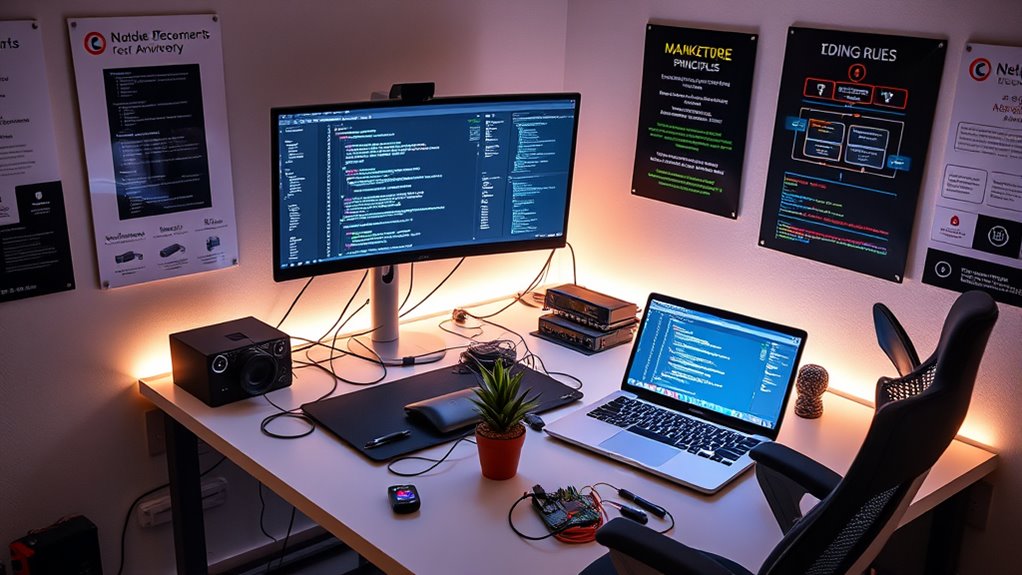

To set up a home lab for ethical hacking, you’ll need a decent computer with enough power, virtualization tools like VMware or VirtualBox, and a few different operating systems. Segment your network for safe experimentation, and utilize essential tools like Metasploit and Nmap. Regularly update your skills and engage with online communities. With a structured approach, you can effectively learn while minimizing risks. Discover more about optimizing your lab setup and tools to enhance your learning experience.

Get privacy and security gear delivered free — and shop member deals
- Fast, free delivery on millions of items
- Access to Prime Big Deal Days deals on October 6–7
- Prime Video, Amazon Music and more included
Key Takeaways
- Invest in a capable computer and virtualization tools like VMware or VirtualBox for running multiple operating systems simultaneously.
- Segment your virtual environment to isolate different experiments, ensuring safe testing of malware and vulnerabilities.
- Utilize essential open-source tools such as Metasploit, Wireshark, and Nmap for effective network scanning and penetration testing.
- Engage in online Capture The Flag (CTF) challenges to apply and refine your ethical hacking skills in simulated scenarios.
- Join cybersecurity communities to share knowledge, stay updated on trends, and enhance your learning through collaboration.

Have you ever wondered how ethical hackers hone their skills in a safe environment? Creating a home lab for ethical hacking practice is one of the best ways to develop and refine your abilities without risking exposure to real networks. By setting up a controlled space, you can experiment, learn, and make mistakes without damaging anything valuable. The key lies in using effective tools, techniques, and strategies to replicate real-world scenarios.
To get started, you’ll need to consider the hardware and software you want to use. A decent computer with ample processing power and memory is essential. You might also want to invest in additional storage or an external hard drive to keep your virtual machines organized. Utilizing virtualization techniques, like VMware or VirtualBox, allows you to run multiple operating systems on a single machine. This enables you to simulate various environments, mimicking the networks you’ll likely encounter in the field.
One vital aspect of your home lab setup will be network segmentation. By dividing your virtual environment into separate segments, you can create isolated areas for different experiments. This means you can safely test malware, perform penetration testing, or analyze vulnerabilities without risking the integrity of other systems. For instance, you could have one segment dedicated to a vulnerable web application and another for your attack machine. This separation not only protects your main system but also helps you understand how different network configurations operate.
While setting up your home lab, make sure you have a variety of tools at your disposal. Open-source tools like Metasploit, Wireshark, and Nmap can be invaluable for ethical hacking practice. They allow you to scan networks, identify vulnerabilities, and test your skills in real-time. Additionally, understanding color accuracy is essential for ensuring your visual data representation is clear and effective during analysis. Don’t forget to explore online platforms offering Capture The Flag (CTF) challenges or other competitive environments. These platforms often provide real-world scenarios that allow you to apply what you’ve learned in your lab.
Finally, remember that continuous learning is essential in the field of ethical hacking. As you make progress, think about joining online communities or forums where you can share your experiences and learn from others. Engaging with fellow enthusiasts will inspire you and keep you updated on the latest trends and threats in cybersecurity. By creating a home lab that incorporates network segmentation and virtualization techniques, you’re laying a strong foundation for your journey into ethical hacking. Jump in, experiment, and watch your skills grow!
Frequently Asked Questions
What Operating Systems Should I Install for Ethical Hacking Practice?
For ethical hacking practice, you should install Kali Linux and Parrot Security OS. Both are tailored for penetration testing and come with essential tools. Consider using a lightweight distribution like Ubuntu or CentOS for your network simulation projects. Make certain your hardware compatibility with these operating systems to avoid performance issues. You’ll find that using virtual machines can also help you manage resources effectively while practicing your skills safely.
How Can I Ensure My Home Lab Is Secure?
To guarantee your home lab is secure, focus on hardware security and network segmentation. Did you know that 60% of small businesses experience a cyber attack? Start by securing your devices with strong passwords and regularly updating firmware. Implement network segmentation to isolate critical systems, making it harder for attackers to access sensitive data. Regularly monitor your network for unusual activity, and consider using firewalls to further enhance your lab’s security.
What Tools Are Essential for Beginners in Ethical Hacking?
For beginners in ethical hacking, essential tools include network scanning and password cracking software. Start with Nmap for network scanning to discover devices and services on your network. Then, use tools like John the Ripper or Hashcat for password cracking, which help you understand the vulnerabilities in password security. These tools provide a solid foundation for learning and practicing ethical hacking techniques effectively and safely.
Can I Use Virtual Machines for My Home Lab Setup?
Absolutely, you can use virtual machines for your home lab setup! In fact, it’s like having a superpower for ethical hacking! Virtual machines offer incredible benefits, like isolating environments and running multiple systems simultaneously. For your VM setup, start with software like VirtualBox or VMware. Allocate enough RAM and CPU, and consider snapshots for easy recovery. It’s the ultimate way to practice without risking your main system—your ethical hacking journey awaits!
How Do I Test the Effectiveness of My Hacking Skills?
To test the effectiveness of your hacking skills, conduct penetration testing on your own systems or authorized environments. Use tools like Metasploit or Burp Suite to identify vulnerabilities. After that, perform a vulnerability assessment to evaluate your findings and improve your techniques. Keep track of your progress by documenting each test, analyzing the results, and refining your methods. This way, you’ll continuously enhance your skills and stay sharp in the ever-evolving field of cybersecurity.
Conclusion
As you wrap up setting up your home lab for ethical hacking, remember, the knowledge you gain here can open doors—but it can also expose vulnerabilities. Every keystroke could lead to a breakthrough or a pitfall. What will you discover as you dive deeper into the world of cybersecurity? The thrill of the unknown awaits, and with each challenge you tackle, you’re not just honing your skills; you’re shaping the future of digital safety. Are you ready?
Fall Picks
fall essentials
As an affiliate, we earn on qualifying purchases.